Hi there! It’s likely that if you’ve read this article, you’ve heard the term “AI” used in a variety of contexts, including the news, movies, your phone, and possibly even your smart refrigerator. However, what happens if someone asks, “Okay, but what actually is artificial intelligence?” Many of us become a little frozen.
Don’t worry. I have you covered. Let’s simplify it like we’re having coffee: just plain English, no scary math, no jargon.
The Most Simple Definition
Artificial intelligence (AI) refers to the ability of computers to perform tasks that would typically require human intelligence.
Things like:
- “Hey Siri, play my chill playlist” is an example of spoken language comprehension.
- Unlocking your phone with facial recognition
- winning at Jeopardy or chess against people!
- Suggestions for the upcoming Netflix series you should watch
AI is essentially humans teaching machines to think and learn somewhat like humans do.
Wait… So Is It Like a Robot Brain?
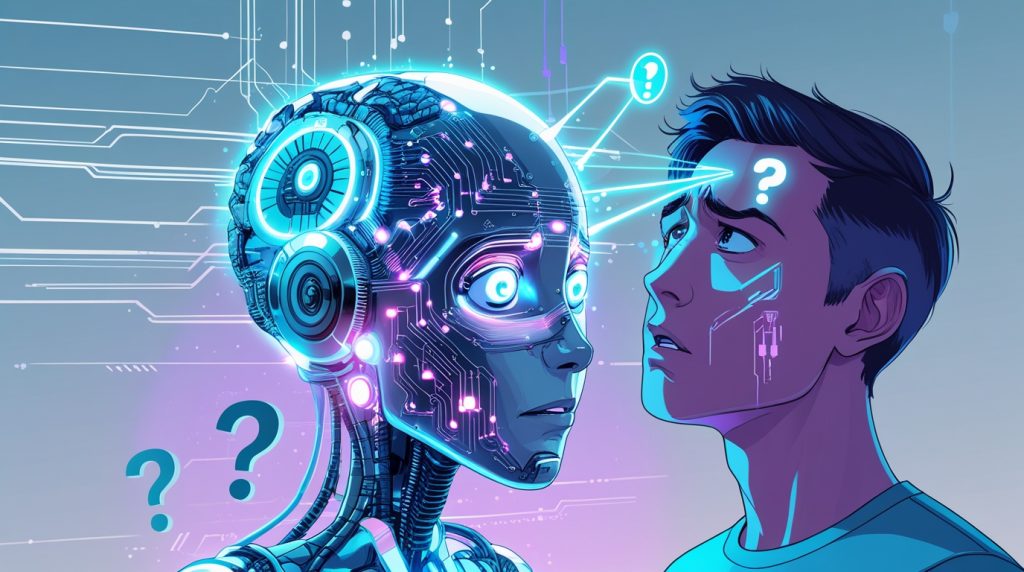
Not quite, but kind of. When people hear the term “AI,” they frequently think of sci-fi robots, but the majority of AI nowadays has no body at all. It’s just software that runs on enormous cloud computers.
Consider it this way:
- Your brain is made up of software (your memories, thoughts, and personality) and hardware (the squishy stuff).
- AI is computer hardware plus sophisticated software that imitates some of those “thought” skills.
The Three Main Flavors of AI (That Actually Matter Right Now)
1) Narrow AI (The AI we use every day)
This is the AI that is currently ubiquitous. It excels in one particular area.
Example :
- At 2 a.m., Spotify discovers that you enjoy melancholic indie music.
- Gmail completes your sentences as you type an email. The car is driven by Tesla’s Autopilot.
- It is very intelligent, but only in its narrow field. When you ask it to do something else, it has no idea.
2) General AI (The “human-level” dream)
An artificial intelligence (AI) that is capable of writing novels, cooking, cracking jokes, and learning quantum physics from scratch without the need for specialized training is the stuff of science fiction dreams.
We haven’t arrived yet. Not even near. The majority of experts believe it won’t happen for decades, if at all.
3) Superintelligence (The “whoa” level)
An AI that is more intelligent than the most intelligent humans in every area, including science, creativity, social skills, and more. This is the one that causes people to feel both anxious and excited. Once more, this is just conjecture.
Therefore, 99.9% of the time when someone claims that “AI is taking over the world,” they are referring to Narrow AI performing exceptionally well rather than Skynet.
Okay, But How Does It Actually Work?
There are several methods for making computers “smart,” but machine learning is currently the most popular.
Consider teaching a young child what a dog looks like:
- In a bad way: Write a 500-page set of rules, such as “four legs, furry, barks, tail usually wags.”
- In a clever manner: Say, “This is a dog,” after displaying 10,000 dog photos to the child. They eventually figure it out on their own.
Machine learning is that. The computer gradually modifies its internal settings until it becomes extremely adept at identifying patterns after we feed it millions of examples (pictures, sentences, chess games, etc.).
Deep learning, which makes use of neural networks that are loosely inspired by how brains function, is the incredibly potent version of this that exists today. ChatGPT, DALL-E image generation, and the majority of the astounding things you see are powered by this.
A Quick Real-Life Example
Let’s consider some suggestions from YouTube:
- You watch one sourdough baking video.
- The AI observes.
- It observes that many of the millions of viewers of that same video went on to watch “How to make the perfect crumb.”
- “Hmm, this person might like that one too,” it muses.
- Your next suggested video is now available.
It’s not magic. Simply put, it’s extremely quick pattern matching on a large scale.
The Stuff People Worry About (Fair Questions)

- “Will I lose my job to AI?” → Certain jobs, yes; many, no. Similar to how computers changed jobs in the 1990s, “AI will change jobs.”
- “Is AI risky?” Is AI Narrow? Very seldom. If we ever develop general/super AI without carefully considering safety, the greater risks will arise much later.
- “Is ChatGPT genuinely thinking?” → No, not at all. It uses patterns to predict the next word in a sentence. Although it is incredibly skilled at mimicking human speech, it lacks the “understanding” that you and I have.
The Bottom Line
Artificial intelligence is a tool we created and is already a part of daily life; it is neither magic nor science fiction. AI is subtly working in the background to make things quicker, simpler, and more individualized, from the instant you use your face to unlock your phone to the moment Netflix predicts what you’ll watch tonight.
Indeed, it will alter industries, jobs, and how we make things. Similar to how the internet, smartphones, and electricity felt disruptive at first but eventually became impossible to live without, some of those changes will be messy, but the majority will be immensely helpful. AI vs. humans is not the future. It involves both humans and AI.