Ever hit “Buy Now” and like magic a product pops into your cart? Or maybe you fill out a form, and a confirmation email lands in your inbox seconds later. It all feels so easy, right? But behind that smooth online moment, there’s a tag team making it happen: frontend and backend development.
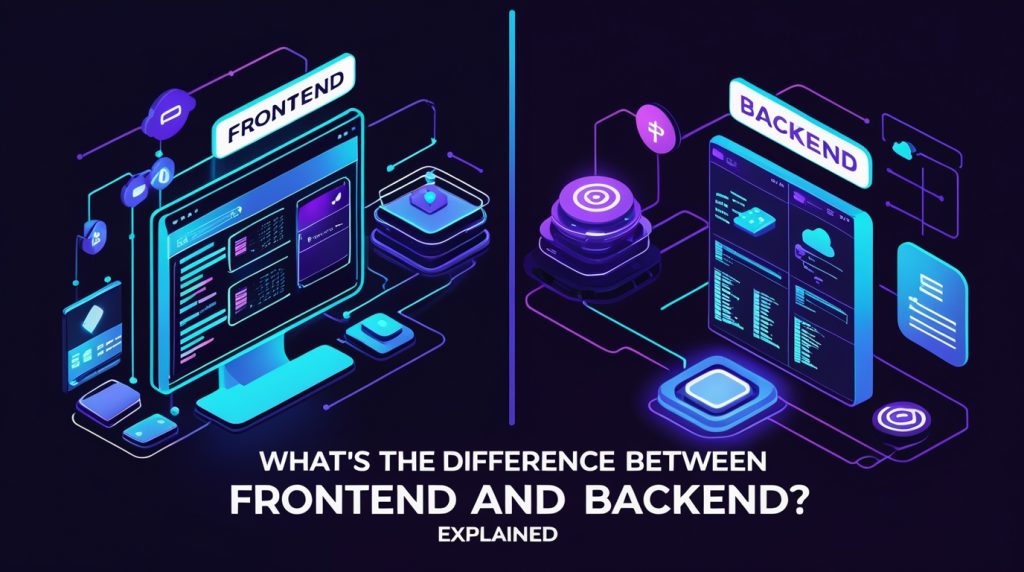
Picture your favorite restaurant for a second. The frontend is everything you see—the cozy lights, the menu, the friendly server. It’s the part you interact with, where your order gets taken. Then there’s the backend, humming away out of sight. That’s the kitchen, full of clattering pans and busy chefs, turning raw ingredients into something delicious. Without both, your meal or your website just wouldn’t come together.
Now, this isn’t just tech jargon for coders. Whether you want to break into the field, hire someone who knows their stuff, or just figure out how websites really work, understanding the split between frontend and backend is key. So, let’s pull back the curtain and see what’s going on.
Part 1: The Frontend:- What You See and Touch

Frontend, or client side development, is all about what happens inside your browser. It’s the look, the feel, and the way you interact with a site or app. When a design goes from a flat image to something you can actually use, that’s frontend magic.
What’s the point? Build an interface that’s smooth, inviting, and easy to use something that brings the designer’s vision to life and makes sense for real people.
The Three Pillars
Frontend development stands on three main technologies:
- HTML (HyperText Markup Language): This is the bones of the page. It lays out headings, images, buttons think of it as the basic frame of a house.
- CSS (Cascading Style Sheets): Here’s the style. CSS adds color, layout, fonts, and animation. It’s paint, furniture, and all the details that make the space feel just right.
- JavaScript (JS): This is where things get interesting. JavaScript adds interactivity the slideshow that flips through photos, the instant warning when you forget to enter an email, the feed that updates without a page reload. It’s the brains and muscle.
The Modern Frontend Toolkit
Sure, HTML, CSS, and JavaScript are the foundation, but building a modern site takes more. Developers reach for frameworks and tools to handle big projects and keep things running smoothly:
- React, Vue.js, Angular: These let you build complex apps, like Gmail or Facebook, by breaking the interface into reusable pieces. It keeps things organized and fast.
- State Management (Redux, Context API): When you need to keep track of data that changes everywhere like what’s in your shopping cart these tools help.
- Build Tools (Webpack, Vite): They handle boring but important stuff, like shrinking images, optimizing code, and making sure everything fits together.
- Responsive Design & Frameworks (Bootstrap, Tailwind CSS): In a world of endless devices, these frameworks make sure the site looks great on everything, from giant monitors to tiny phones.
How Frontend Developers Think
The best frontend devs are equal parts coder and artist. They sweat the details perfect spacing, fast load times, making sure everything works in every browser, and that everyone (including people with disabilities) can use the site. If users stick around, say nice things about the design, and find what they need without hassle, that’s a frontend win. Explore More
Part 2: The Backend:- Where the Real Work Happens

Think of the frontend like the dining room at your favorite restaurant. It’s where you sit, order, and eat. The backend? That’s everything happening behind the “Employees Only” door the kitchen, the storeroom, the chef’s secret recipes. You never see it, but without it, nothing would work.
The backend’s main job is to make sure the frontend has everything it needs. It handles your requests, runs the logic, pulls data from the database, and keeps things secure, fast, and able to handle lots of people at once.
So what’s under the hood?
- The Server: This is the workhorse. It could be a physical machine or something floating in the cloud, but its job is the same it hosts the files, the database, and all the backend code. It’s always on, always listening.
- The Database: Think of this like a giant digital filing cabinet. Every user profile, product listing, blog post, or transaction lives here. You’ll hear names like MySQL, PostgreSQL, MongoDB, or Firebase these are just different flavors of that filing cabinet.
- The Backend Application: This is the brains. It’s a pile of code written in a backend language, telling the server what to do when someone asks for something.
Backend developers have a toolbox packed with different languages and frameworks, each with its own vibe:
- JavaScript/Node.js: Lets you use JavaScript on both sides, which is pretty handy if you want everything in the same language.
- Python (Django, Flask): Clean and easy to read. Python is great for data-heavy apps, machine learning, or when you want to build things fast.
- PHP (Laravel): Old-school but still everywhere, especially powering blogs or sites like WordPress. Laravel gives it a modern twist.
- Java (Spring): The go-to for big companies. Think banking systems or mega online stores. It’s all about stability and handling lots of traffic.
- Ruby (Ruby on Rails): Makes building standard web apps super fast, thanks to its “convention over configuration” style.
- C# (.NET): Microsoft’s heavy hitter, often running things behind the scenes at big businesses or on Windows servers.
So what does the backend actually do all day? Picture logging in:
- You type your username and password and hit “Login.”
- The frontend wraps up your info and sends it to the backend using an API basically, a set of rules for how different pieces of software talk to each other.
- The backend gets the request, right at the login endpoint (like
/api/login). - It checks your info, then asks the database, “Hey, is there a user with this name? Does the password match?”
- The database answers.
- The backend decides what happens next: If it’s a match, it creates a secure token (think of it as a digital handshake) and sends back your profile info. If not, you get an error.
- The frontend gets the answer and, if all’s good, stores your token and updates the screen “Welcome, [Your Name]!”
But logging in is just the start. The backend handles payments, shoots off emails, crunches heavy algorithms, manages file uploads, and keeps things running fast by caching data.
You have to think like a backend developer to really get it. They live in a world of logic, algorithms, security, and infrastructure. They worry about server bills, tweaking databases for speed, designing APIs, following privacy laws, and juggling thousands of users at once. In the end, their work gets judged by how fast, safe, and reliable everything feels. If you never notice them, they’re probably doing it right. Explore More
Part 3: The Handshake:- How Frontend and Backend Talk

Frontend and backend aren’t doing their own thing in separate rooms. They have to talk, and they do that through APIs mostly REST, sometimes GraphQL if you want to get fancy.
Think of the API as a super-efficient waiter. The frontend is the customer. Instead of barging into the kitchen, the customer just places an order: “Can I get the user profile for account #12345?” The waiter carries that request to the kitchen the backend where the data gets prepared. Then, the waiter brings the finished dish (usually in JSON) back to the table. The frontend takes it from there and serves it up to the user.
This setup is great because it keeps things flexible. A mobile app and a website can both talk to the same backend. Teams can work at the same time frontend folks can play with mock data and design the interface while backend engineers handle the business logic and databases.
Full-Stack Development: Conducting the Whole Orchestra
Some developers go deep into one area. Then you’ve got full-stack developers they know both sides, frontend and backend. They can follow the whole journey, from a button click all the way down to the database and back. On small teams, they’re the glue holding things together, making sure nothing falls through the cracks.
Choosing Your Path: Frontend or Backend ?
So, which side feels right for you?
Frontend might be your thing if:
- You care about design and love thinking about user experience.
- You like seeing your work instantly visual feedback is your jam.
- You find yourself obsessed with layout, color, and how things move.
- Details matter to you. You want things to look and feel just right, everywhere.
- You think in terms of user journeys and interactions.
Backend could be your calling if:
- You enjoy logic puzzles and wrangling data.
- Scaling, security, and efficiency sound interesting.
- You’d rather work with algorithms and servers than with color schemes.
- You want to build the powerful machinery behind the scenes.
- You’re methodical and love thinking about processes and architecture.
Conclusion: More of a Dance Than a Divide
Sure, frontend and backend are different, but they’re not meant to be at odds. The best products come from both sides working together. Backend lays the strong, secure foundation. Frontend builds on that to make something people actually want to use.
At the end of the day, everyone’s aiming for the same thing: to make something that works, that people can rely on, that actually matters. Frontend gives the product its face and personality. Backend brings the logic and guts. Together, they’re not just building websites or apps they’re creating the digital world we live in now.
No matter which path you choose the creative side or the engineering side you’re learning how to shape reality with code. And honestly, that’s a little bit magical.
Explore our Programming Category