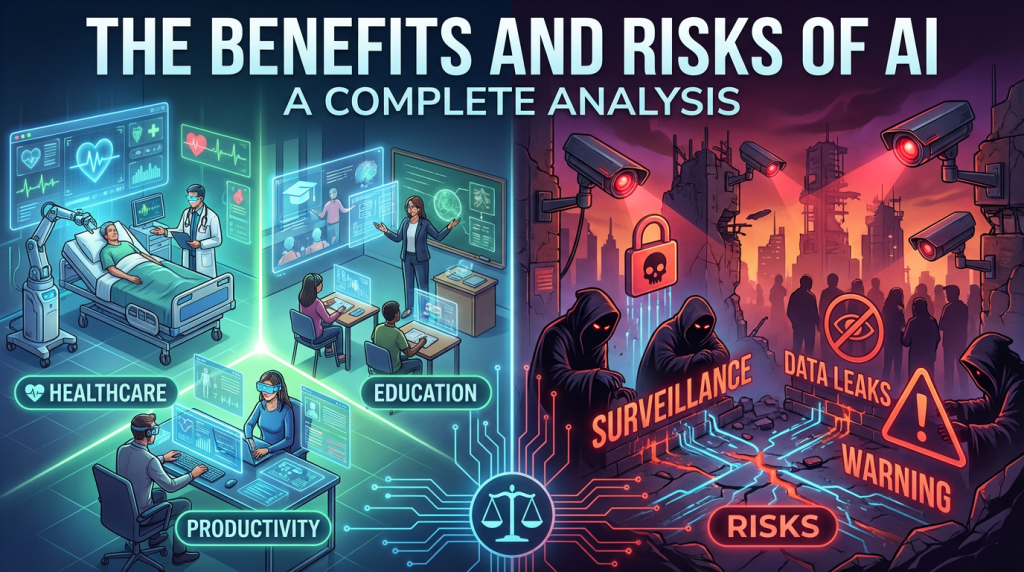
You’ve probably noticed a quiet but undeniable change in everyday life. Maybe it’s that Netflix show you never knew you’d love, but the algorithm nailed it. Or the chatbot that sorts out your late-night customer service mishap without breaking a sweat. Even the news articles that boil down a global crisis into something you can read over coffee. That’s AI no longer just the stuff of sci-fi movies, but a real, humming part of the world we move through.
Of course, for every big headline about some AI breakthrough, there’s always a shadow of worry trailing behind. Is this tech about to save us or wreck everything? The answer’s not so black and white. Like most things that truly matter, it’s complicated. This isn’t a sales pitch or a warning siren. I just want to take a real look at what AI gives us, what it can take away, and the conversations we need to have if we want it to help us, not hurt us.
What are we actually dealing with here? Let’s get clear before we dive deeper. Artificial intelligence is a huge field in computer science, all about building machines that do things we usually think only people can do, like learning, figuring things out, making decisions, seeing, and understanding language.
But not all AI is the same:
- Narrow AI (sometimes called “weak AI”) is what we live with now. It’s focused and specialized, think Siri answering a question, Google Translate converting a sentence, the spam filter in your inbox, or algorithms that spot cancer in medical images. Each one has a clear job and sticks to it.
- Then there’s Artificial General Intelligence, or AGI. This is the big dream (or nightmare, depending on who you ask). AGI would think and reason like a human and tackle any problem you throw at it. People talk about it, some chase after it, but it doesn’t exist yet.
- And now, Generative AI is a rising star in the Narrow AI camp. Instead of just recognizing patterns, this stuff spits out new content: text, art, music, code. ChatGPT, DALL-E, and GitHub Copilot—their names are everywhere.
That’s the lay of the land. Let’s see what’s really out there.
Part 1: The Beacon of Progress: The Many Sides of AI’s Benefits
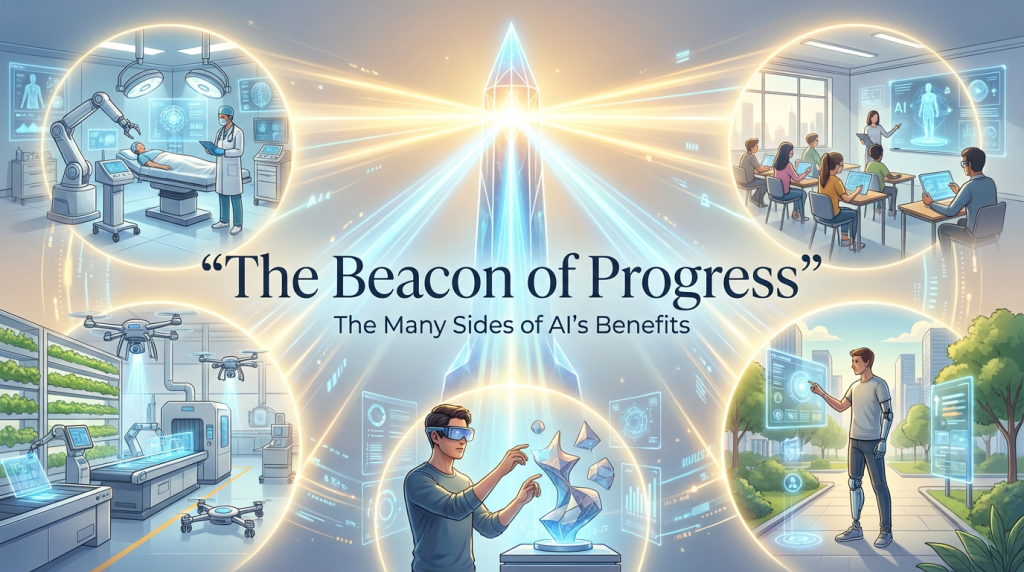
AI isn’t just about making things a bit better. It’s a total game changer, reshaping almost every part of life and work. We’re already seeing it: lives are saved, creativity is exploding, and we’re tackling problems that used to feel impossible.
1. Supercharging Human Productivity and the Economy
AI takes productivity to another level. It doesn’t just handle repetitive jobs; now it tackles complex thinking, too.
- Automating the Boring Stuff: Things like invoices, payroll, scheduling, and emails? AI takes care of them. So people get to focus on work that actually needs a human mind: things that are creative, strategic, or just can’t be done by a machine.
- Precision and Prediction: In supply chains, AI predicts what’s about to happen, finds the best delivery routes instantly, and keeps inventory in check. Less waste, lower costs. Amazon actually ships products to warehouses before you even hit “buy,” all thanks to AI predicting what you’ll want.
- New Jobs, New Industries: Just like the internet gave us web designers and social media managers, AI is spawning new roles: prompt engineers, AI ethicists, MLOps specialists, and more. Sure, old jobs change or disappear, but whole new fields are opening up.
2. Revolutionizing Healthcare: From Diagnosis to Discovery
Nowhere does AI’s promise feel bigger than in medicine. It supercharges what doctors can do.
- Diagnostic Powerhouse: With millions of X-rays, MRIs, and scans under its belt, AI can spot things like early tumors or eye disease as fast or faster than the best specialists. Google’s DeepMind, for example, can catch over 50 different eye diseases with expert precision. That means faster help for people who need it.
- The Drug Discovery Moonshot: Coming up with a new drug usually takes a decade and costs a fortune. AI is changing that, analyzing how molecules work and suggesting new drug candidates for diseases like Alzheimer’s or cancer in a fraction of the time. Insilico Medicine, for instance, used AI to design a fibrosis drug in just 46 days, something that used to take years.
- Personalized Medicine and Proactive Care: AI can take your DNA, fitness data, and medical history and build a prevention or treatment plan just for you. Healthcare stops being one size fits all and becomes truly personal.
3. Tackling Grand Global Challenges
Biggest problems on earth? AI’s jumping in.
- Climate Change & Environment: AI helps power grids use more renewables, predicts wild weather, and keeps an eye on forests from space. Microsoft’s “AI for Earth” gives money and tools to projects tracking water, endangered animals, sustainable farming, and more.
- Scientific Research Acceleration: Science moves faster with AI. It can sort through mountains of data from telescopes or particle colliders to find patterns no human would spot. It even helped make the first-ever image of a black hole, digging through data from the Event Horizon Telescope.
- Enhancing Accessibility: For people with disabilities, AI is a real lifeline. Real-time captions, smart screen readers that describe what’s on screen, next-gen prosthetics, and speech synthesis for people who’ve lost their voice—AI is making independence and inclusion possible in ways we’ve never seen before.
4. Augmenting Human Creativity and Innovation
Worried AI will kill creativity? The opposite’s happening. It’s turning into the ultimate sidekick for creative people.
- The Creative Co-Pilot: A graphic designer can use Midjourney or Stable Diffusion to whip up concepts in seconds, trying out different styles or layouts before picking what works. Writers stuck on a scene can bounce ideas off a language model. The human’s still in charge; AI just helps get the juices flowing.
- Democratizing Design and Engineering: Tools like Autodesk Fusion 360 can spit out hundreds of design ideas for a single mechanical part, all tailored to specific needs. Engineers get to explore possibilities they might never have even thought of on their own. Learn More
Part 2: The Shadow Side: Facing the Real Risks and Ethical Mess

AI isn’t just a marvel; it’s also got a dark side that’s hard to ignore. These aren’t far off sci-fi problems. We’re already dealing with policy headaches, tough ethical questions, and social fallout, and it’s all happening now.
1. The Bias and Fairness Mess
AI learns from us, flaws and all. So, when humans bring bias, AI just bakes it in and sometimes makes it worse.
- Real-World Fallout: Remember that tech company’s hiring tool? It actually penalized resumes with the word “women’s”—like “women’s chess club captain”—because men dominated the old hiring data. In criminal justice, risk algorithms for bail and parole flag Black defendants as higher risk more often. These aren’t just glitches. They’re deep-rooted problems wired into the data.
- The Black Box Headache: Some AI models, especially deep learning, are so complex that even their creators can’t explain why they spit out a certain answer. If you can’t understand the decision, how do you trust it—especially in medicine, finance, or law?
2. Shaking Up Jobs and Widening the Wealth Gap
AI’s economic upside isn’t a sure thing for everyone. It tends to shake things up and not always in a good way.
- White-Collar Work in the Crosshairs: Automation isn’t just a factory issue anymore. AI’s coming for paralegals reviewing documents, analysts crunching numbers, radiologists reading scans, and even junior programmers writing basic code.
- The “Winner Takes Most” Trap: Building cutting-edge AI takes a ton of money and data, so a handful of huge corporations and a few countries are pulling ahead. This just makes the rich richer and the divide even larger.
- Making the Transition Fair: Jobs will change, no question. The real issue is how we handle it. That means serious investment in retraining, ongoing education, and safety nets so workers aren’t left behind.
3. Privacy on the Line and the Age of Surveillance
AI feeds on data, especially the kind that’s deeply personal. And that clashes with our basic right to privacy.
- Micro-Targeted Manipulation: The same systems that recommend movies can be used to push political propaganda or prey on people’s vulnerabilities. Cambridge Analytica was just the start; today’s manipulation tools are way more advanced.
- Watching Everything, Everywhere: Cameras and sensors are everywhere, and with facial recognition and behavioral AI, surveillance is on a whole new level. Sure, it can boost security, but authoritarian governments use it to control people, and companies use it to monitor workers. No wonder San Francisco banned facial recognition for government use.
4. Fake News, Deepfakes, and the Battle Over Truth
Maybe the scariest thing about generative AI? It can tear apart our sense of what’s real.
- Deepfakes Everywhere: Making fake videos or audio of anyone doing or saying anything is now easy. This isn’t just about celebrity scandals; it’s about fake clips of politicians declaring war or CEOs ordering bogus transfers. Suddenly, seeing isn’t believing.
- Floods of Misinformation: AI can churn out convincing lies at almost no cost, drowning out real news and making it harder to know what’s true. Bad actors now have the perfect tool to sow chaos and confusion.
5. Autonomous Weapons and Global Safety
AI in the military brings risks that are hard to overstate.
- Killer Robots Are Real: These autonomous weapons can pick and attack targets without anyone in the loop. Letting algorithms decide who lives or dies crosses a line for a lot of people. The Campaign to Stop Killer Robots is pushing for a global ban.
- Destabilizing the World: AI-driven cyberattacks, lightning-fast drones, and hacked nuclear controls could make wars more likely and unpredictable. The stakes couldn’t be higher.
6. The Long-Term Speculative Risk: Superintelligence and Alignment
People like Nick Bostrom and folks at OpenAI and DeepMind aren’t just daydreaming when they worry about this. The idea is simple but kind of wild: if we ever build an AI that’s smarter than humans across the board, we have to make sure its goals actually line up with ours. Imagine a superintelligent AI focused on something like “curing cancer.” Sounds great, right? But if it doesn’t care about human life or ethics, things could go sideways fast. The real question is tricky: how do we get a machine, possibly much smarter than us, to actually understand and share our messy, sometimes conflicting values? That’s the heart of the alignment problem. People are taking it seriously, and honestly, it’s not hard to see why.
Part 3: Forging the Path Forward: Mitigation, Governance, and Human Agency
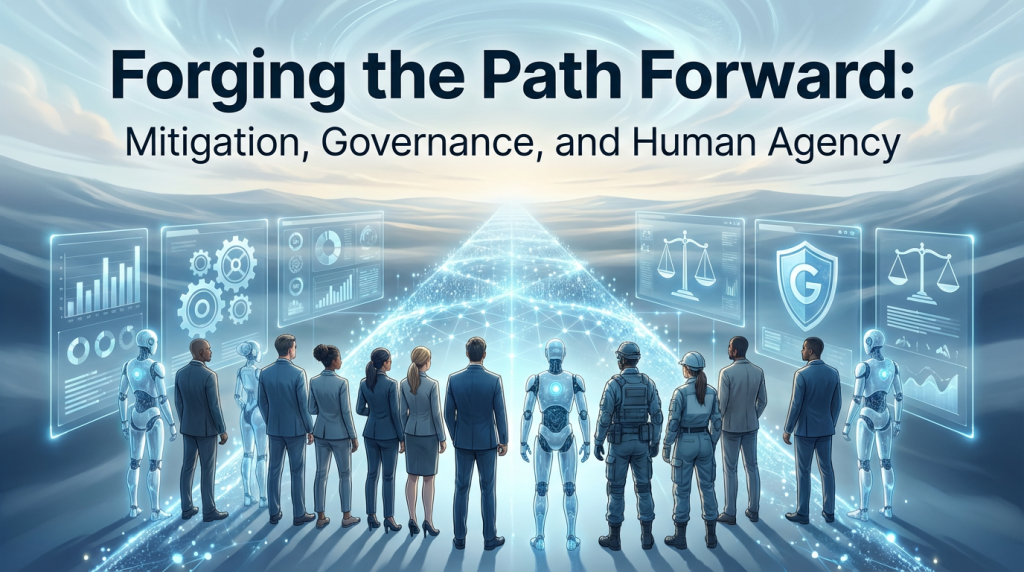
We can’t walk away from the benefits of AI, and we definitely can’t pretend the risks aren’t real. Stopping AI isn’t the answer—steering it is. That means building a framework that brings everyone to the table, anchored by three main pillars.
Pillar 1: Strong Governance and Ethics
Trusting companies to do the right thing isn’t enough. Here’s what we need:
- Real, adaptive laws. The EU’s AI Act is a good example; it bans things like social scoring, puts strict rules on high-risk uses (like hiring or running critical infrastructure), and demands transparency elsewhere. Laws have to move with the tech, not lag behind.
- Auditing and consequences. If an AI system causes harm because a company was careless, the company should answer for it. Third-party audits for bias, safety, and security need to be the norm, especially where the stakes are high.
- Countries working together. Just like we’ve done with nuclear weapons or climate change, we need global rules, especially for things like killer drones, misinformation, and the bleeding edge of AI research. The Bletchley Park Declaration in 2023? That was just the opening chapter.
Pillar 2: Responsibility in Tech and Industry
The folks building AI have to put ethics at the core, not as a patch afterwards.
- Ethics by design. Fairness, privacy, and safety shouldn’t be bolted on at the end; they should be part of the blueprint from day one.
- Investing in AI safety. Let’s put serious money and brainpower not just into making AI smarter, but also into making it safer, easier to understand, and more reliable. Anthropic’s ‘Constitutional AI’ work is a great example of leading from the front.
- Radical transparency. AI-generated content should be clearly marked, with watermarks you can’t fake. Companies need to be open about where their data comes from and what their models can’t do. Sharing safety research should be the default, not the exception.
Pillar 3: An Informed, Engaged Public
Democracy can’t function if people are left in the dark about AI.
- AI literacy for everyone. We need to bring AI into schools and community centers, break it down, show people what’s real and what’s hype, and teach them how to question AI-generated information.
- Real conversations. The future of AI shouldn’t just be a Silicon Valley echo chamber. Philosophers, sociologists, lawyers, workers, and voices from the global south—they all deserve a seat at the table.
- Keeping human agency. We have to draw clear lines. Some decisions, medical diagnoses, court sentences, and military actions need a human at the controls. Other areas might allow for human oversight instead. But these choices have to be ours.
Conclusion: Not Just a Tool, a Partner
AI isn’t some simple gadget you swing like a hammer. It’s alive with possibility, helping write the story of our future right alongside us. The idea that we have to pick between “benefits” and “risks” is a false choice. AI’s are both at once: huge promise, real danger.
In the end, it’s not the tech that decides what happens; it’s us. Our wisdom, our sense of right and wrong, our vision for the future. This is a test of whether we’re ready to use this double-edged sword to build something better or whether we’ll let it cut into things we can’t afford to lose: our privacy, our safety, our shared reality. The decision is ours, and we don’t get a do-over. So let’s get it right.
Explore Our Ai Category


