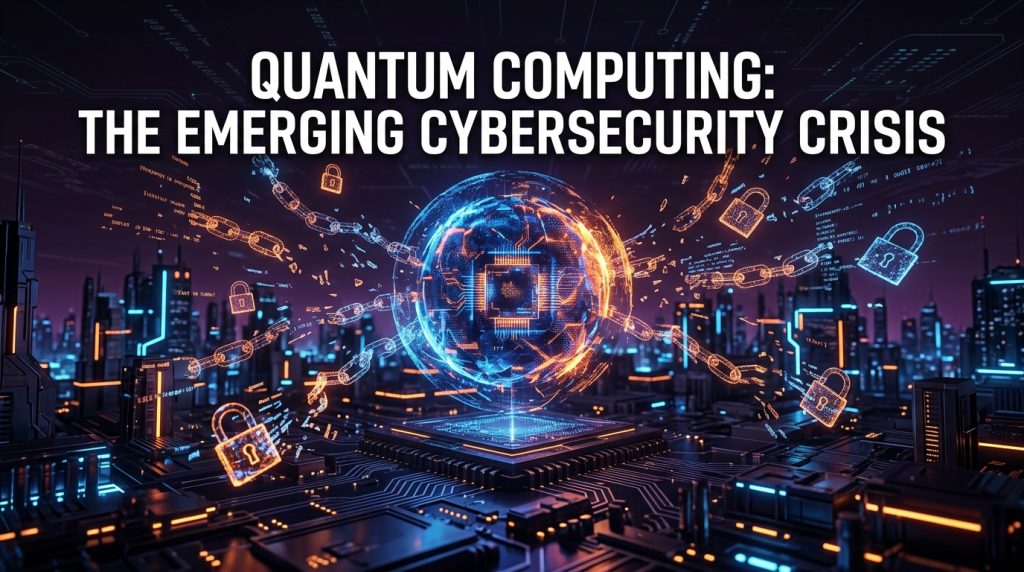
The field of quantum computing is rapidly evolving from theoretical physics into reality. Nowadays major technological corporations provide cloud quantum processors. Thus, this revolutionary technology is becoming increasingly available. Nevertheless, there is a dark side of this development: quantum computers not only allow us to discover new drugs, improve materials, and optimize operations but also put an end to the cryptography that ensures the safety of our digital world.
The problem of security is two-folded: on the one hand, quantum computers will be able to break the existing encryption; on the other hand, the quantum computers are vulnerable to attacks of another type.
The “Harvest Now, Decrypt Later” Threat
The sneakiest possible quantum threat does not even require the current availability of quantum computers yet. The enemies can store encrypted messages for decryption in the future. The practice of “harvest now, decrypt later” (HNDL) implies that all information transmitted now IP, health information, and state secrets will become public knowledge within the next decade when cryptographically useful quantum computers appear.
The logic is simple the confidentiality of all secrets that need to be kept after 2030-2035 is compromised the very second the information passes through a vulnerable quantum channel.
The Algorithms Under Siege
Quantum computing poses the greatest risk to asymmetric cryptography. Shor’s algorithm is able to solve efficiently the hard mathematical problems that support RSA, Diffie-Hellman, and ECC algorithms. This implies:
- RSA encryption and digital signatures become vulnerable
- Diffie-Hellman key exchanges lose their security guarantees
- ECDSA signatures (used in cryptocurrency wallets) become forgeable
Symmetric algorithms and hash functions are also vulnerable. Grover’s algorithm gives a quadratic speed-up for brute-force attacks, cutting in half the security strength of AES and SHA algorithms. Even though AES-256 remains secure with 128 bits of quantum security, AES-128 falls down to 64 bits of security.
The Standardization Response
Considering this existential challenge, the National Institute of Standards and Technology (NIST) has been spearheading a long-term initiative for standardizing Post-Quantum Cryptography (PQC). In August 2024, NIST established three historic standards:
- FIPS 203 (ML-KEM): A lattice-based key encapsulation mechanism, which will replace RSA and ECDH
- FIPS 204 (ML-DSA): A lattice-based digital signature algorithm, which will replace RSA and ECDSA signatures
- FIPS 205 (SLH-DSA): A stateless hash-based digital signature algorithm with conservative security
This process continues to develop. In May 2026, NIST declared nine algorithms that made their way to the third round of additional digital signature standardization, among which FAEST, HAWK, and MAYO can be named.
The Migration Challenge
Moving towards PQC cannot be achieved through a mere software patch. PQC algorithms require much larger keys and signatures—whereas a key exchange used to use 100 bytes, now it could take up to a kilobyte. Businesses need to prepare for:
- Approximately 20% latency increase due to larger packet sizes requiring more round trips
- Hardware bottlenecks as legacy devices lack memory for new key sizes
- VPN appliances and smartcards may suffer buffer overflows or boot failures
The “upgrade myth” does not take into account how deep cryptographic keys and algorithms are entrenched in contemporary systems from TLS terminators through service meshes, JWT signers, backup encryption, and third-party libraries. Quite often, businesses find out that they have “archeological” cryptography in cron jobs, black boxes from vendors, and old certificates.
Quantum Hardware Vulnerabilities
However, while PQC is concerned with the danger posed by quantum computers cracking conventional cryptographic systems, quantum computers have their own unique security issues. In contrast to conventional computing devices, quantum computers require complex control equipment such as signal generators, mixers, and FPGAs, which have not been studied comprehensively in terms of security.
In quantum cloud services where multi-tenancy exists, new attack possibilities arise. Crosstalk attacks make it possible for the attacker circuits to reduce the fidelity of computations made by victims on the same processor. Research shows that using CNOT gates, the attacker can make the victim’s program produce accurate results in only 20% of the cases.
Another type of attack is adversarial SWAP injection. Using the tactic of occupying closely connected qubits, adversaries make the compiler generate more SWAP gates for the victim’s computation, hence raising error rates. The maximum increase in the number of SWAP gates was 20-25% and even 55% in some cases.
Side-channel attacks are not less vulnerable as well. Analysis of timing of the reset process discloses the flow of the program operation, and analysis of the power consumption allows for reverse engineering of gate-level circuits. The most worrying part is that conventional reset gates cannot always reset the qubits’ states.
The Path Forward: Building Crypto-Agility
Quantum migration should be seen as a strategic transition process and not as a tick-box exercise. The suggested “3Ps” approach helps provide a structure:
- Proactive: Identify and catalog all cryptographic systems prior to migration
- Preventive: Deploy hybrid key exchange protocols (a mixture of classical and post-quantum algorithms) for preventing HNDL attack
- Practical: Adopt crypto-agility to make future transitions of cryptography simply configurations instead of re-architectures
The time pressure is evident. According to NIST IR 8547, quantum vulnerable cryptographic algorithms will be deprecated after 2030 and then become obsolete after 2035. Even more urgent is the case of national security systems, which, according to CNSA 2.0, will exclusively utilize quantum-safe algorithms starting from 2030.
Conclusion
Quantum computing security is one of the major challenges of this age. While quantum computing is offering us unparalleled computational prowess through the same physics, this very physics poses a great risk to decades of trusted cryptography. However, it opens up an opportunity at the same time, that is, a chance to develop more adaptive and robust cryptographic infrastructure.
The shift has started. According to the data from Cloudflare, more than half of the browser connections are already performing post-quantum key exchanges during their initial TLS handshakes. The point is not whether companies will perform the shift or not; the real point is whether they will do that proactively or reactively.
Explore Our Cybersecurity Category