It is no longer a matter of whether or not artificial intelligence will replace cybersecurity jobs; it is now an issue that professionals everywhere have to face. Based on statistics released by the industry, almost 80% of IT security workers today expect AI to cut down drastically the number of workers needed for their jobs, with half expecting it to happen within two years. But there is much more to the issue than mere replacement of jobs.
The Reality of AI in Cybersecurity Today
First of all, let’s look at what is going on on the ground. The cybersecurity industry is suffering from a severe talent shortage there is a global shortage of 4.8 million professioshortage; AI is used predominantly to solve this shoprofessionals,duce the number of current jobs. According to Gartner, 80 percent of the value of AI in Chinese cybersecurity use cases will be derived from process automation and skill enhancement, not job cuts, by 2028.
The difference is key. AI takes care of the volume issue, the constant stream of alerts, log analysis, and scanning that has been overwhelming security teams for years. However, the demand for cybersecurity professionals continues to rise, and the hiring managers become more and more interested in candidates with skills in artificial intelligence. Indeed, 97 percent of IT security hiring managers actively seek candidates with at least one AI competency.
The Tasks AI Can Truly Replace
AI excels at certain types of cybersecurity work, particularly:
- First-tier SOC monitoring: Where alerts are filtered for false positives and prioritized
- Simple vulnerability assessment: Identification of existing vulnerabilities
- Pattern-based threat detection: Recognition of existing threats using signature-based technology
- Analysis and correlation of logs: Mining large amounts of data to find abnormalities
These are the “repetition, process, and volume” jobs that, according to Nic Wilson, an industry expert on cybersecurity, are the most susceptible to pressures from AI. There was never any differentiation between the worth of these jobs and the possibilities of automation, and hence they have been the most transformable.
What AI Cannot Replace
Here’s where the human element becomes irreplaceable:
Strategic Judgment and Context
AI may recognize anomalies, but AI does not know what context these anomalies are set in. To make security decisions, one needs to know the priorities of the organization, how much risk the organization is prepared to take, and the consequences that might follow certain actions in the real world.
Ethical Responsibility and Accountability
According to a study conducted by ISC2 that interviewed 856 security experts, 50% said that when decisions made from the recommendation of artificial intelligence result in mistakes, the end-user bears the burden of responsibility. You can’t blame the AI for a security failure that has cost millions of dollars or has compromised customer information.
Unknown Threat Hunting
It is good at spotting familiar patterns. However, skilled hackers are always changing their approaches to get past automated systems. Discovering the genuinely new pattern of attack, the one that has never occurred before, requires a certain human insight and creativity in connecting apparently disparate bits of information.
Complex Incident Response and Recovery
A leader who is capable of making tough decisions during such times, coordinating different teams, and handling the legal and reputation side of the problem becomes necessary. These are definitely human skills.
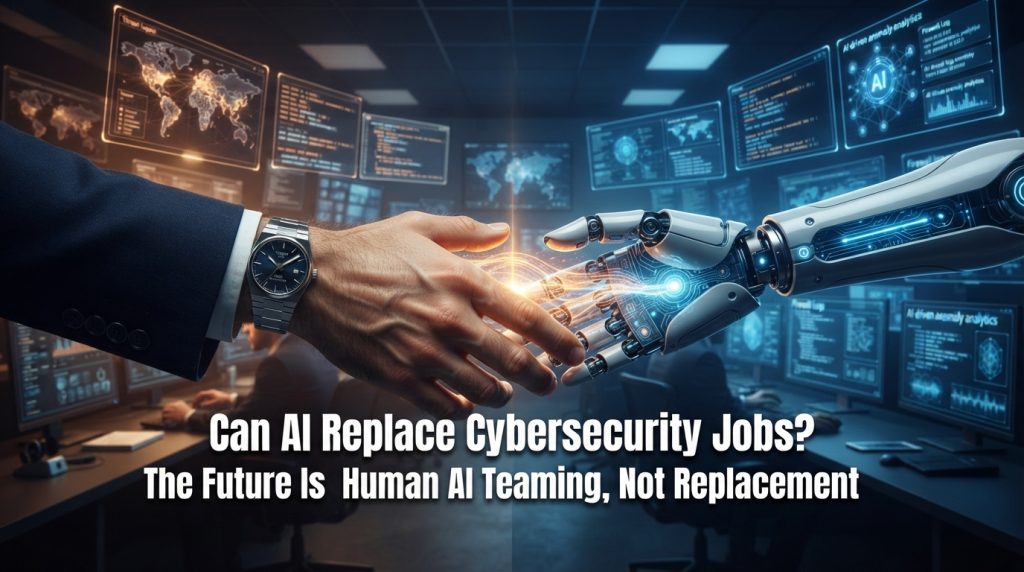
A New Model: Human AI Teaming
The research now suggests evolution rather than substitution. There was a recent paper in the International Journal of Information Security suggesting the “Reciprocal Human-Machine Learning” model, which implies the constant cooperation of cybersecurity experts and AI algorithms with each other. Such collaboration was noted to be effective in increasing the accuracy of detection and raising the level of knowledge about the situation among the experts.
Another example of the Augmented Intelligence Framework for cybersecurity is the idea that AI “should augment rather than replace human intelligence through a more harmonious working relationship.” In this model, there are six paradigms of human AI interaction: “human-in-the-loop”, “human-on-the-loop”, “human-in-the-loop”, “machine-in-the-loop”, “human-on-the-loop”, and completely autonomous systems.
The Job Market Paradox
There is an apparent paradox within the cybersecurity field, where as automation increases in certain jobs, the need for experienced professionals is greater than ever before. In addition, security engineering jobs are on the rise, and top cybersecurity executives receive salaries worth $7 million to $8 million, showing how much importance the field currently holds since not many people have the required skills.
The most noticeable change has come about within the hiring practices of companies, where 61% of employers say that adaptability is now the most important skill among those looking for jobs in cybersecurity, more so than even practical experience.
What This Means for Cybersecurity Professionals
The warning to the current and future cybersecurity workers is unambiguous: there is no way AI will kill the demand for cybersecurity jobs, but it will redefine the competencies that will be required.
The key change will be shifting from the implementation of tasks to overseeing processes. Instead of executing routine actions manually, cybersecurity specialists need to learn how to control and monitor AI algorithms, evaluate the results, and use their own judgment in making decisions based on the intelligence provided by AI.
As one expert noted, “The worst mistake to make right now is to get caught in a doom loop.” Every significant innovation in cybersecurity history, from firewalls to cloud computing and automated tests, has generated even more job opportunities than it has eliminated. The issue is not whether people are needed in cybersecurity or not, but whether you are ready to adapt your skills to perform more challenging tasks.
Conclusion
AI will not simply displace cybersecurity professions in the manner described above. Yet, it will drastically transform them. The professions that are under the greatest threat from AI are those involving high degrees of repetition and large amounts of data. On the other hand, the professions that are most needed now are those involving judgement, strategy, and managing AI systems.
The “augmented analyst” is the professional of the future, the one who can use AI as a tool and provide the human components that machines cannot.
Explore Our Cybersecurity Category