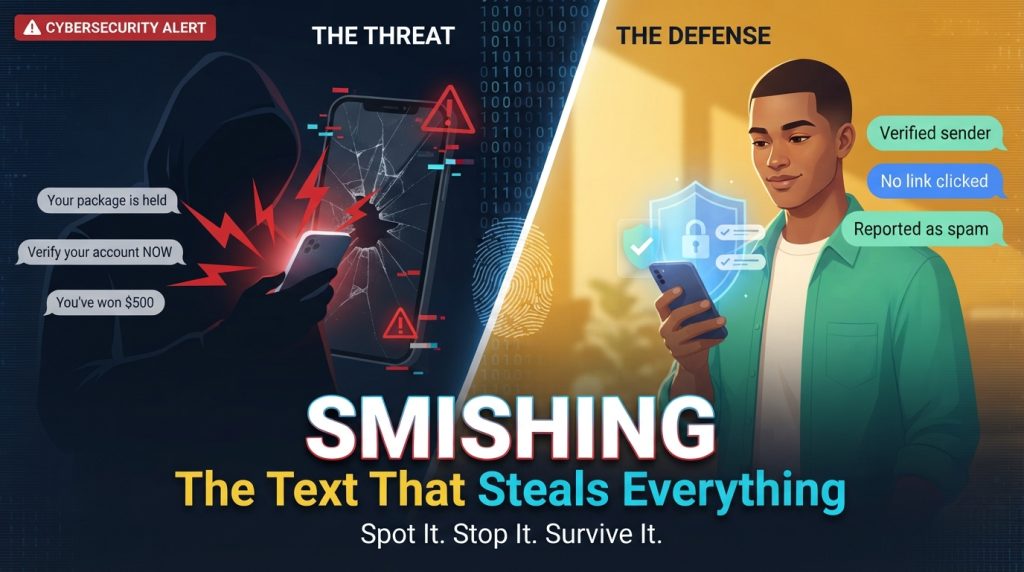
Your cell phone rings. A message from an unknown contact: “USPS: Your package is being held at our facility because of an incomplete address. Update your information here: [link].”
You don’t expect to receive any packages. Perhaps, though, you purchased an item or two recently that you cannot remember. Or maybe someone is sending you a present. Regardless, the URL appears to be valid, as you have received shorter links before from legitimate organizations. You click on it.
In just one click, you lose everything.
SMS phishing, more commonly known as smishing, has progressed from spammy and often laughable “You’ve won a prize” messages into an advanced and AI-driven menace that is responsible for billions in individual and corporate losses each year. According to 2025 numbers reported by the Internet Crime Complaint Center of the FBI, there were 1 million incidents, causing over $20.9 billion in losses, and phone-based attacks are 40% more successful than email campaigns.
Here’s why you should care.
Table of Contents
- What Is Smishing, Really?
- From Premium SMS to AI-Powered Deception: A Brief History
- Why SMS Is the Perfect Attack Vector
- The Modern Smishing Playbook
- Anatomy of an Attack: The Error524 Campaign
- The AI Acceleration
- How to Spot a Smishing Message (The Real Signs)
- Protecting Yourself: A Layered Defense
- Deeper Dive: The Technical Background
- Enterprise Defense: Beyond Awareness Training
- The Regulatory Landscape
- What Comes Next: The Future of Smishing
- Actionable Takeaways and Resources
What Is Smishing Really?
Smishing is a type of phishing attack carried out via text messaging. The word “smishing” is made by combining the words “SMS” and “phishing.” Fraudsters send their text messages in order to make recipients click links, disclose sensitive information, download malware, or make any kind of payments.
If phishing means throwing a net into the sea of email accounts, smishing implies putting a hook right in people’s pockets. The means of delivering the attack have changed, yet the aim remains the same to use psychological tricks in order to break through security measures.
The list of targets is familiar enough: banks, delivery companies, government organizations, employers, and streaming services. The message puts people under pressure, fear, or curiosity. The link directs the victim to a fake web page or installs malware. The result is that the victim either discloses his personal data willingly or unwillingly.
What distinguishes smishing from its older brother phishing? It is the context of communication. People communicate by texting only with close relatives, friends, and work colleagues. Therefore, when the message arrives and says that it is from the bank, the psychological filter does not start working.
From Premium SMS to AI-Powered Deception: A Brief History
The very first SMS message was sent in December 1992, “Merry Christmas,” from engineer Neil Papworth to his colleague using the Vodafone GSM network. Not long after, attackers realized the potential of this medium.
At the early stages (late 1990s–2000s), the attacks were primitive. Criminals convinced the victim to call a premium-rate telephone number or send money for prepaid credit to unknown persons via the mobile phone service. The message said something like, “Congratulations! You have won. Please call this number to get your reward.” The purpose of the crime was limited theft of several dollars at a time.
The age of smartphones (2007–2015) has changed the situation completely. With phones turning into a general-purpose computer device with banking applications and emails stored in it, the value of the device itself has increased. The smishing scam started redirecting users to a fraudulent website collecting their credentials.
The last period (2016–2022) is characterized by the professional work of the fraudsters. Phishing-as-a-Service platforms appeared, making it possible for any attacker, even one without technical skills, to run a complex phishing attack campaign.
The age we are currently in (2023-Present) is characterized by personalized AI. Large language models produce flawless communication in whatever language there may be. There are data brokers who provide phone numbers, names, and behaviors.
Why SMS Is the Perfect Attack Vector
There are several structural issues that give SMS attacks a unique appeal:
No intrinsic spam filtering capability. Email services have invested years in developing complex systems for spam filters. However, SMS traffic is completely unprotected. Though your carrier will block malicious addresses, there is no way of putting texts in the “spam” section like it is possible with Gmail, for instance.
Built on trust. Users perceive SMS less critically than emails. There is something very familiar and personal about SMS. Moreover, when it gets mixed with messages from your bank (the attacker spoofed your bank’s short code), the trick becomes even more difficult to detect.
Lack of link preview. Unlike emails, most phones cannot allow users to see where a link is actually directed just by hovering over it. The user either clicks on it or not. This fact is used by attackers with typo-squatting domains like “mygreetway-gov.com” instead of “mygateway.gov.”
The 60 seconds. Verizon’s Data Breach Investigations Report of 2026 reveals that the median time between opening the message and entering credentials is less than 60 seconds. This figure is amplified due to the nature of SMS notifications as a distraction tool.
Circumventing network security. SMS Blasters, phony cell towers that can even be carried in a backpack, can transmit messages to surrounding phones without any interference from the cell networks at all. Once selling for six-figure prices, this device is now available on the black market for the same price as a PC.
The Smishing Attack Process
The attacker uses a defined multi-step process. Analyzing this process can help you determine where you can stop an attack from proceeding.
Step 1: Victim Identification and Reconnaissance
The phone number of potential victims is identified by:
- Data breaches (data that is available on dark web markets)
- Data brokers (companies that sell marketing lists with personal information, including name, phone number, and purchasing history)
- Public records (lawsuits, property information)
- Posting too much on social media (sharing your number or having it available on social media accounts)
- Random creation (no need for precision in large-scale attacks)
In the case of valuable targets, the attackers will cross-reference various sources to build up a dossier on you: your name, your bank, your purchases, and your trips.
Stage 2: Infrastructural Configuration
Modern-day smishing attacks rely on state-of-the-art infrastructure, which includes:
- URL shorteners for obfuscation purposes
- Domain rotation to stay ahead of blocklists
- Cloud-based hosting to deploy the phishing websites that can be quickly deployed and taken down
- PhaaS tools that give phishing kits out-of-the-box
- Encryption of the communication channel (WebSocket, HTTP POST) for exfiltration of the stolen data
Stage 3: Transmission of Messages
The messages are crafted according to well-known psychological models:
| Tactic | Example | Psychological Lever |
| Urgency | “Your account will be suspended in 24 hours.” | Fear of Loss |
| Authority | “IRS Notice: Unpaid tax liability” | Respect for institutions |
| Reward | “You’ve been selected for a $500 gift card.” | Greed/curiosity |
| Familiarity | “Mom, I lost my phone; this is my new number.” | Trust in relationships |
| Utility | “Your package could not be delivered.” | Anticipation of purchase |
Stage 4: The Hook
The link is the most crucial stage. The following are some of the tactics adopted by hackers:
- Typosquatting: Paypa1. com, amaz0n.net, northernspruce-credit.com
- Country-code attack: .me, .ly, and .co domains may appear valid even to non-experts
- URL Shortener: bit.ly/xyz conceals the real destination
- QR codes embedded in messages, which bypass link preview entirely
Stage 5: Harvesting the Credentials
After clicking the link, you are directed to a pixel-perfect replica of a genuine login page. You enter your user name and password. Then, the page prompts you for your one-time authentication code. You enter this too.
In seconds, the attacker has:
- Credentials
- One-time authentication token
- Session cookies that can bypass authentication entirely
Then the attacker logs in, changes your password, and makes transactions.
Stage 6: Monetization
The compromised credentials can be employed to:
- Takeover accounts and transfer funds
- Conduct identity theft
- Sell on dark web markets
- Target further (exploit your contacts for the next attack wave)
Anatomy of an Attack: The Error524 Campaign
Error524 is a large-scale global smishing attack against financial services, telecommunication companies, logistics firms, retail companies, and governments in Europe, Asia, and the Americas, which took place in 2025–2026.
The method of the attack represents the current level of smishing attacks in terms of complexity:
- Lure: SMS messages pretending to be from trusted brand names and asking for confirmation of “delivery status,” “unpaid toll,” and “account verification.”
- Redirect: Shortened URLs that redirect through several domains to bypass detection.
- Payload: Extremely convincing phishing sites with official brand images asking for login credentials and payment information.
- Exfiltration: Collected data sent using encrypted WebSocket connections to the central attacker’s infrastructure.
What made Error524 interesting was the scale of the operation and how automated it was: the use of PhaaS infrastructure that allowed for carrying out the attack in different countries and industries at once.
The AI Acceleration
Generative AI has transformed the economics and efficacy of smishing campaigns. No more typos. In the past, security awareness training was all about looking for grammar mistakes, awkward wording, and clear translation blunders. LLMs are capable of creating fluent text in over 100 languages. The traditional indicators are a thing of the past.
Personalization at scale. Threat actors use LinkedIn, corporate news, and leaked data to create personalized emails that mention real projects, employees, and transactions. An email that seems like an attempt to contact you by your legitimate manager regarding your real transaction is not easily dismissed as spam.
Voice Cloning & Vishing. In just a few seconds of voicemail, YouTube clip, or podcast recording, attackers can reproduce voices with incredible accuracy. A 2025 warning by the FBI about scammers impersonating US officials using voice messages generated by AI technologies in order to build rapport and then compromise their accounts.
Agentic Orchestration. Not only can AI bots generate messages, but they can also orchestrate cross-channel messaging campaigns via email, SMS, telephone calls, and even social media channels depending on how the potential victim responds to each attempt at communication. If SMS does not prove successful, then the system switches to making telephone calls, failing which, it goes to LinkedIn. This is called “Advanced Persistent Manipulation.”
How to Identify a Smishing Text Message (Real Indicators)
Forget the outdated guide. This is how you should really spot a smishing attack.
The Universal Warning Signs
Unsolicited contact. If you didn’t contact them and didn’t ask for a password reset, package delivery, or application status, treat any message that claims otherwise as fraudulent.
Pressure with implications. “Take action now before we lock your account down.” “Pay us within 24 hours or else face legal repercussions.” Legitimate companies seldom create artificial deadlines using an SMS text.
Credential and MFA code request. Your bank will not send you any SMS text messages asking you for your password, PIN, or two-factor code.
Links you didn’t ask for. Even if the web address looks familiar, don’t follow it. Access the organization’s website yourself, or call the number on your card.
The Subtle Signs
The message is in your legitimate thread of messages. Spoofers may imitate short codes, such that their message comes side by side with legitimate messages from your bank. This is why “it’s from my bank’s number” is no longer a reliable way of identifying the legitimacy of a message.
The URL is close to right. Take a look: northernspruce-credit.com is not northernspruce.com. And services. mygreetway-gov.com is definitely not a government website. Also, that ending path /bs makes it illegitimate.
The tone seems slightly wrong. Even though AI has advanced to improve grammatical errors, there is something about context that feels wrong. Notifications of delivery of a parcel you never ordered. Notification of alerts in a bank you have never used.
Legitimate Organization Activities
While banks send transactional messages but will never ask you to click a link to “verify” your identity
Deliveries will notify you about the shipment with a tracking number that you will be able to input to their website, but not “update address information” through an SMS link. Government organizations will notify you through mail about any actions required
Protecting Yourself: A Layered Defense
There is no singular safeguard against smishing attacks. The defense should have multiple layers.
Layer 1: Behavioral Habits
Think twice before clicking. There is the 60 seconds of emotional vulnerability because people act on impulse. Develop a habit: all unexpected messages with links should be paused for 10 seconds and asked, “Did I expect this?”
Verify by contacting through an independent channel. If you receive a message from your bank, contact the bank through the phone number that is written on the back of your credit card. Do not use the number provided in the message.
Do not send your credentials through text messages. Credentials mean passwords, PIN numbers, and one-time codes. No legitimate organization will ever request such information through SMS messages. Never respond to suspicious messages even with a “STOP” command.
Layer 2: Technical Controls
Allow MFA but do not allow SMS-based MFA. This method is vulnerable to interception through SIM swapping or phishing attacks. Instead, use authenticator apps (Google Authenticator, Authy) or physical hardware keys (YubiKey).
Disable 2G where feasible. 2G technologies have been proven vulnerable, allowing hackers to intercept messages. Most modern devices provide an option for disabling 2G.
Activate carrier spam filters. Carriers provide spam filter service free of cost. Forward any suspicious messages to 7726 (SPAM). Always keep your device up-to-date. Updates patch the vulnerability that allows malware infections.
Layer 3: Recovery Preparedness
In case you suspect that you are the victim of smishing:
- Change your password right away on another device
- Notify your bank or service provider on another line
- Enable MFA if not done already
- Watch out for any unusual activity in your account
- Report the issue to your company’s IT department if it is related to work
Deeper Dive: Technical Background
This section becomes quite technical. If you are not interested in how this works, skip ahead to the next section called Enterprise Defense.
How Spoofing Works
The process of SMS spoofing uses SS7 (Signaling System No. 7), which is used worldwide for telecommunications. SS7 protocol does not have an authentication method, which means it assumes that all connections between operators are legitimate. It simply trusts any message as originating from the sender.
One can put whatever he wants in the sender ID field; it can be the bank’s short code, the identifier of the government organization, or the mobile number of a person. Thus, the message will appear as coming from that entity.
The STIR/SHAKEN protocol for voice calls is gradually being implemented by carriers and gives cryptographic confirmation of the caller ID. SMS has nothing like that yet; however, in the future, RCS (Rich Communication Services) might solve that problem.
Architecture of the Phishing Page
Modern smishing phishing sites include:
- Responsive design that replicates the interface of the mobile version of the target brand
- JavaScript for input validation and avoiding obvious typos
- Backend logging that tracks keystrokes and submits information using AJAX to attacker-controlled servers
- Tools for cloning entire login procedures, including MFA
Some advanced phishing kits employ reverse proxy mechanisms such as Evilginx. With this architecture, the victim sees the legitimate website and uses real credentials, but the attacker steals session tokens while the legitimate website does not even see the session at all.
SMS Blasters
The SMS Blaster is a portable gadget that emulates a genuine cell tower by sending a signal stronger than that sent by actual cell towers in the vicinity and therefore attracting mobile phones to connect to it. The attacker can now send out SMS without routing them through the carrier network.
This technology exploits vulnerabilities in the 2G and 3G technology networks. With many carriers discontinuing these older technologies, the use of SMS Blasters will gradually decline.
Enterprise Defense: Beyond Awareness Training
Organizations are faced with smishing attacks from both sides: employees who can be targeted and their customers who might fall victim to brand spoofing.
For Employees
Test communications via phone. Phishing simulations are mostly performed via email. Verizon research proves that phone-centric phishing attacks work about 40% better than email, yet many programs do not test this channel. Add testing of SMS and voice phishing to your training program.
Teach pretexting awareness. Pretexting is a type of attack in which an attacker poses as IT support or one of your colleagues. Skills required to recognize such attacks differ from those needed to detect a phishing email. Train employees how to verify their identity before reacting to any urgent request.
Reward, not punish. Reward employees for reporting suspicious messages, and not punish them. Psychological safety culture increases reporting frequency.
Fusion center model. Merge the efforts of fraud, cyber threat intelligence, and physical security departments. The attacks usually begin with executive impersonation.
For the Customers
Train proactively. Provide scam alerts on a regular basis, using actual examples. Train customers to authenticate communications through legitimate means. Make it easy to report. Create an avenue for customers to easily report any suspicious communications. Forwarded messages can be intelligence used to monitor scams.
Think about blocking links. Some operators block all clickable links in SMS from customers. It blocks most of the scams but hinders legitimate communications. Weigh up pros and cons.
Utilize RCS if possible. Rich Communication Services offers encryption and better authentication compared to SMS. With more and more usage, it makes spoofing difficult.
Technical controls
- Security gateways for emails that scan known phishing domains
- Endpoint Detection and Response (EDR) for identifying malware using malicious links
- DNS filtering for blocking known malicious domains
- Security Information and Event Management (SIEM) for correlation of indicators in multiple channels
The Regulatory Landscape
The response from governments is slow but happening.
In the U.S., some actions have been taken by the FCC:
- A rule mandating mobile termination operators to block texts coming from phone numbers determined by the Commission to be fraudulent
- Extending the protections provided by the National Do Not Call List to text messaging
- Curtailing the “lead generator loophole” where one consent would allow automated messages to be sent by a range of vendors
In the UK, Ofcom has suggested rules that would make the mobile networks block scam SMS in a more proactive manner, including blocking false sender names and volume controls on pay-as-you-go SIM cards.
At the international level, the GSMA’s Open Gateway program seeks to offer federated APIs for identity verification and federation, not using SMS-based verification. The problem here is that regulation is always lagging behind attack innovation.
What Comes Next: The Future of Smishing
Several factors can be expected to come into play during the next stage of smishing:
RCS usage. With the advent of Rich Communication Services, which provide encryption and sender authentication, smishing would become more difficult to execute. However, the adoption rate is slow, and attackers are constantly adapting to such changes.
AI against AI. Smishing defenders are currently developing machine learning tools to detect smishing patterns and identify malicious content or websites. However, the attackers are also relying on artificial intelligence.
API-based verifications. The Open Gateway initiative by GSMA aims to replace SMS authentication for phones by carrier APIs that validate phone numbers directly without sending verification messages. This would eliminate a key smishing channel.
2G/3G termination. As mobile carriers terminate their legacy networks, SMS Blaster would become less efficient. However, this process could take several years, and some devices would continue to use old protocols.
Cognitive approaches. Cognitive research, i.e., the studies of human mental processes related to successful smishing, would focus on confirmation bias, the need for cognition, and similar factors.
The key takeaway: no amount of technical measures alone will be enough to counter smishing effectively.
Actionable Takeaways
For Individuals:
- Take a pause before you click anything. Any unexpected link must be paused for 10 seconds, and ask yourself “Was this expected?”
- Confirm yourself. If any message says that it is from your bank, then contact the number on your card and not the link.
- Never disclose credentials through text. Never will your password, PIN, and MFA code be asked through SMS.
- Use MFA codes through apps and not SMS codes.
- Report and delete. Forward any spam to 7726 and then delete it.
- Turn off 2G, if supported by your phone.
- Check your online footprints. The lesser the publicly available data about you, the tougher it becomes for any hacker to target you.
For Organizations:
- Use your awareness program to test phone-based phishing scams.
- Voice-based pretexting training is different from identifying suspicious emails.
- Use a fusion center concept to bring together fraud intelligence, cyber threat intelligence, and physical security.
- Proactively educate your customers using real-life examples and simple methods to report.
- Think about RCS as part of your strategy for secure business communication.
- Use industry ISACs to exchange threat intelligence with your partners.
- Deploy technical layers, including email filtering, DNS blocking, EDR, and SIEM analysis.
Final Word
Smishing is possible because it takes advantage of a basic human trait: our trust in our phones. The buzz in our pocket, the familiar name, and the message that requires immediate action—none of it is unreasonable. This is how we are programmed to use the device that is closest to us. The trust is not naïve; it’s how we communicate. However, attackers have found ways to use our trust against us. A text does not come out of the blue; it comes when you are cooking dinner, walking the dog, or half asleep at 6 in the morning and your defenses are down.
The solution is not paranoia; it’s skepticism. Taking a minute before clicking. The habit of verification through other means. The understanding that no legitimate institution acts in such a manner.
This also includes being skeptical about the people you love. The “Hi Mom, I lost my phone” con succeeds because it exploits your emotions. Have a conversation with your loved ones. Decide on a code word. Come to an agreement that any urgent money request is not made solely by text message. Your phone is a tool. Keep it that way. Upgrade your phone. Secure your phone. Switch to using an authenticator app. Be skeptical of any link as if it were a stranger knocking at your front door, but politely so.
And when you are fooled because this happens even to cautious people, don’t let yourself feel ashamed. Make the report quickly. Change your passwords. Contact your bank. Time is more important than embarrassment. Those sixty seconds every time.
Explore Our Cybersecurity Category. And if you are reading it up to here, leave a sweet comment to motivate us to write blog everyday.