Artificial Intelligence, Machine Learning, Deep Learning these terms pop up everywhere now, don’t they? You see them in every tech blog, every product launch, every meeting where someone wants to sound cutting-edge. People toss them around like they’re interchangeable, but honestly, lumping them all together just muddies the waters. If you’re trying to really get what’s going on in tech, or you’re making choices about using these systems, the differences matter.
It’s easy to see why folks mix them up. They’re close cousins, they overlap, and even the pros slip up with the language sometimes. Still, if you actually understand what sets AI, ML, and DL apart, you can cut through a lot of the noise. You spot the real breakthroughs, you see what’s hype, and you start to get how these tools are actually reshaping everything healthcare, movies, you name it.
So, let’s clear things up. I’ll break down what each one means, how they fit together, and give you some examples that stick.
The Big Picture: How They Relate
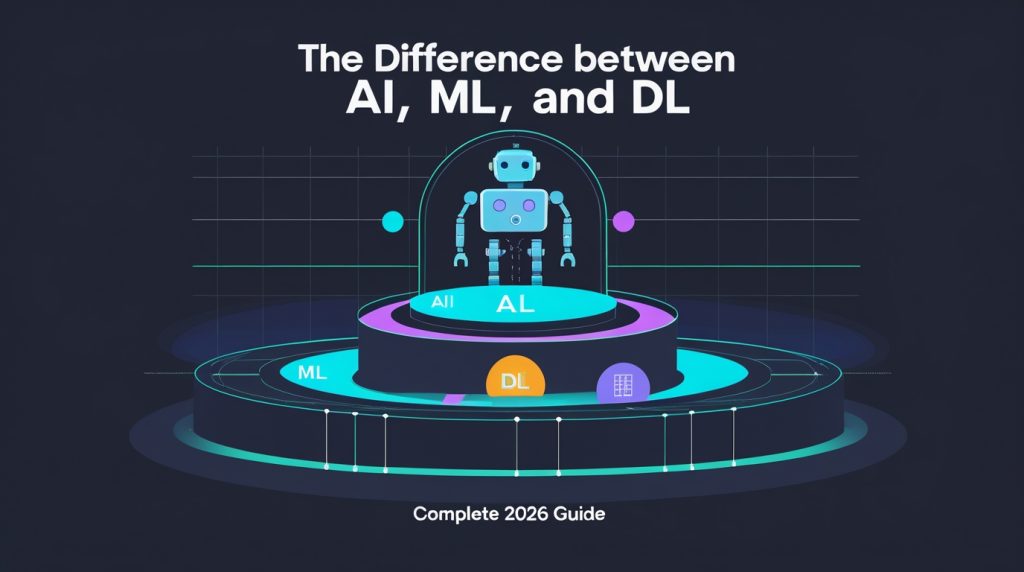
Before diving into definitions, picture a set of rings inside each other. The biggest ring is Artificial Intelligence. Inside that sits Machine Learning. And inside that, Deep Learning. It’s kind of like those Russian dolls, one inside another.
So, Deep Learning is always a type of Machine Learning, and Machine Learning is always a type of Artificial Intelligence. But it doesn’t go both ways. Not every AI system uses Machine Learning, and not every Machine Learning system uses Deep Learning. Each layer narrows the focus and the method.
Remembering this hierarchy helps you dodge the usual mix-ups. Using these terms like they all mean the same thing is like calling every vehicle a Tesla. Sure, a Tesla is a car, and a car is a vehicle, but you wouldn’t swap those words around.
Artificial Intelligence: The Biggest Umbrella
AI is the dream of building machines that do things only humans could do before. When people first coined the term back in the ‘50s, they were thinking about computers that could reason, solve problems, learn, see, or understand language basically, anything that seemed intelligent.
With AI, it’s all about what the system does, not how it does it. If a computer pulls off a task that would take human smarts, it counts as artificial intelligence. That covers a lot, from old school rule based programs to today’s neural networks. Learn More
Early AI: Rules and Logic
The first wave of AI worked nothing like the stuff you hear about now. Back then, humans wrote out rules if X and Y happen, do Z. These systems could look clever in tight situations but fell apart outside their comfort zone.
Take an old spam filter. It’d be packed with rules like, “If the email says ‘Viagra’ or ‘Nigerian prince,’ send it to spam.” It made decisions automatically, so that was AI, but it didn’t learn or adapt. Programmers had to update those rules all the time.
Traditional AI looked like this:
- Systems ran on hard coded rules
- Human experts wrote out their knowledge
- Worked well for clear, rule based problems
- Fell flat with anything unexpected
- Needed constant human tweaking to stay useful
- Couldn’t learn from experience
- You could trace exactly how the system made a decision
These old-school AI systems were actually pretty useful in their day think early medical diagnosis tools or finance programs. For example, a medical AI might have thousands of rules: “If fever and cough and fatigue, maybe pneumonia.” But you can see the limits. The second something didn’t fit the rules, the system got lost.
Modern AI: The Wider World
Nowadays, AI covers everything from those old rule based programs to the latest learning machines. When a company says they use AI, they could mean anything from a simple decision tree to a deep neural network. Just hearing “AI” doesn’t tell you much about what’s really going on.
Here’s what falls under AI these days:
- Virtual assistants like Siri or Alexa
- The recommendation lists on Netflix or Amazon
- Self driving cars
- Banking systems that catch fraud
- Apps that translate languages
- Photo apps that recognize faces or objects
- Chess engines and other smart game players
- Chatbots that handle customer questions
- Medical tools that help doctors diagnose diseases
And that’s just scratching the surface.
All these examples have one thing in common: computers doing things that usually take some smarts. But the way they pull it off varies a lot. Some systems just follow logic and rules, while others lean on statistics. More and more, though, people use Machine Learning which is a whole different ballgame, and that’s what we’re diving into next.
Machine Learning: Learning from Data
Machine Learning isn’t just another AI trick it’s become the go to method lately because it works so well. Instead of coding out every single step, you let the computer learn patterns from real data. The more it sees, the better it gets.
So here’s the real shift: you stop micromanaging the computer with detailed instructions. Instead, you feed it a pile of examples and let it figure things out. This is a lifesaver for problems where spelling out the rules is either too hard or flat out impossible. Learn More
How Machine Learning Works
Think about how you learned what a dog is. Nobody gave you a checklist. Your parents just kept pointing “Look, a dog!” and eventually, you put the pieces together: fur, four legs, that look, the tail wag. Machine Learning works in a similar way.
You give the algorithm tons of examples, say, thousands of photos labeled “dog” or “not dog.” It sifts through them, picking up on the things that make a dog a dog. After enough examples, it can spot a dog in a brand-new picture, even if it’s never seen that breed before.
Here’s what the process actually looks like:
- Collect training data: get lots of examples of what you want to learn.
- Pick an algorithm: decide how you want the system to learn.
- Train the model: let the algorithm find patterns in your data.
- Test and validate: see if it works on stuff it hasn’t seen before.
- Deploy: start using it to make real predictions or decisions.
- Monitor and retrain: keep it sharp as things change.
This isn’t just for spotting dogs in photos. Companies use these steps to predict what customers will buy, catch fraud, recommend movies, forecast sales, diagnose diseases you name it.
Types of Machine Learning
Machine Learning isn’t just one thing. There are a few main ways to go about it, each with its own strengths, depending on what you’re dealing with.
Supervised Learning: It is probably the most common. Here, you have labeled examples basically, you know the right answers in advance. You show the computer both the question and the answer, and it learns to match new questions to the right answers. Businesses love this type because they already have tons of historical data with known results.
For example, with a spam filter, you hand over thousands of emails already marked “spam” or “not spam.” The system learns what makes an email junk, then flags new ones that look similar.
Unsupervised Learning: is a bit different. You give it data without any labels, and it tries to find patterns on its own. This is great when you want to uncover things you didn’t even know you were looking for.
Say you run a shop and want to understand your customers better. You feed in their purchase data, and the algorithm groups them into clusters like “frequent small shoppers,” “holiday binge buyers,” or “luxury splurgers” all based on real buying habits, not guesses.
Reinforcement Learning: It works kind of like training a pet. The system tries stuff out, gets rewarded for good moves, and learns to avoid mistakes. Over time, it figures out what works best through trial and error.
AI that plays games uses this all the time. It experiments with different moves, sees which ones pay off, and keeps getting better this is how computers ended up beating world champions at games like chess and Go.
Machine Learning Algorithms
There are loads of different algorithms that make all of this possible. Each one has its sweet spot the trick is picking the right tool for the job. Knowing a few of the big ones helps make sense of what’s actually happening when people talk about Machine Learning.
Common ML Algorithms
- Decision Trees split data by asking a series of questions about its features like a game of 20 Questions, but with math.
- Random Forests round up a bunch of decision trees and let them vote on the answer, which usually gives a stronger result.
- Support Vector Machines draw boundaries between categories, aiming for the cleanest possible separation.
- Naive Bayes leans on probability, guessing categories based on how likely certain features are.
- K-Nearest Neighbors checks which examples are closest to the new one and lets the majority decide.
- Linear Regression predicts numbers think house prices or temperatures by drawing the best fitting line through the data.
- Logistic Regression does something similar but for categories, estimating the odds that something belongs in a group.
Each of these tackles pattern finding in its own way. Decision trees use a flowchart approach, while neural networks (that’s up next) weave together webs of tiny processing units.
Deep Learning: The Neural Network Revolution
Deep Learning takes machine learning to the next level, borrowing ideas from how real brains work. It’s been around in labs for years, but lately, it’s pulled off some mind blowing feats stuff like recognizing faces in photos, understanding natural language, and transcribing speech with uncanny accuracy.
The “deep” part? That just means stacking lots of layers in a neural network. With each extra layer, the network gets better at spotting more complex, abstract patterns. That’s why deep learning can solve problems that used to be impossible for older machine learning tools. Learn More
Neural Networks: The Foundation
Neural networks are the backbone of deep learning. Imagine a bunch of nodes (call them “neurons”) arranged in layers, all connected. Each connection has a weight a number that says how much one neuron influences another. During training, the network tweaks these weights to get better at whatever task it’s working on.
A simple neural network might have three layers: one to take in the data, one hidden layer to process it, and one output layer to spit out results. Deep learning just stacks more hidden layers—sometimes a dozen, sometimes a hundred so the network learns in stages, building up from simple patterns to really complex ones.
Neural Network Structure
- Input Layer: Takes in the raw stuff pixels, numbers, words, whatever you’ve got.
- Hidden Layers: Crunch and transform the data, step by step.
- Output Layer: Produces the answer or prediction.
- Connections: Wires that link neurons, each one with its own adjustable weight.
- Activation Functions: Decide when a neuron “fires” or stays quiet.
Say you’re training a network to spot faces. The first layers might just look for edges or blobs. Next ones start piecing together eyes, noses, and mouths. Deeper still, the network puts it all together and recognizes an actual face maybe even tells you whose face it is. The wild part? The network figures all this out on its own, just by training on data. No one has to hard code the steps.
What Makes Deep Learning Special
The real magic of deep learning is that it teaches itself what matters. Old school machine learning demanded lots of “feature engineering” humans had to guess which parts of the data were important. Deep learning mostly skips that. It starts with raw data and learns the features that get the job done.
That’s why deep learning crushes it with messy data images, audio, language where the patterns are buried deep. Where older algorithms struggle, deep learning shines, picking up on everything from edges and textures to objects and meaning, all by itself.
Deep Learning Breakthroughs
- Image Recognition: Beating humans at spotting objects in pictures.
- Natural Language Processing: Making sense of and even writing human language.
- Speech Recognition: Turning spoken words into text with surprising accuracy.
- Machine Translation: Translating between languages smoothly.
- Generative Models: Creating believable images, text, or music out of thin air.
- Game Playing: Outperforming champions in games like Go and StarCraft.
- Drug Discovery: Predicting how molecules interact to help find new medicines.
What links these breakthroughs? They all deal with really complicated data and tangled patterns that most people can’t spot on their own. Deep learning’s trick learning layer by layer, building up understanding makes it perfect for these kinds of challenges.
The Cost of Deep Learning
Deep Learning can do amazing things, but it doesn’t come cheap. For a lot of problems, old-school Machine Learning just makes more sense.
Here’s what Deep Learning really asks for:
- Huge piles of data: think millions of examples just to get started
- Serious computing muscle: expensive GPUs or specialized gear
- Long training times: even top hardware can take days or weeks to finish
- Real expertise: you need folks who understand how to build and tune these networks
- Massive energy use: training big models can rack up shocking electricity bills
- Murky decision-making: it’s tough to figure out exactly why a network spits out the answers it does
So, when a company thinks about Deep Learning versus classic Machine Learning, it needs to look at these costs and ask: is it worth it? For many business problems, simpler methods get the job done with way less hassle less data, less waiting, and much lower costs.
Practical Examples: Seeing the Differences
Examples always help. Let’s look at something familiar: fighting spam emails. You’ll see how AI, ML, and Deep Learning each play their part.
Spam Filtering: Three Ways to Tackle It
Traditional AI (Rules):
Back in the day, people wrote rules by hand. Stuff like, “If the email says ‘free money’ and the sender isn’t in your contacts, mark it as spam.” This works for the obvious scams, but you have to keep updating your rules because spammers never quit. It’s automation, sure, but the system doesn’t learn from experience it just follows instructions.
Machine Learning:
Now, take a bunch of emails, mark which ones are spam, and let an algorithm figure out the patterns. It learns which words, senders, or structures usually mean trouble. As you feed it fresh examples, it keeps up with new tricks from spammers. This is both AI and ML no need for hand written rules and you don’t have to use Deep Learning here. Simple models like Naive Bayes or Decision Trees work just fine.
Deep Learning:
Here’s where things get fancy. A neural network chews through raw email text and digs up patterns so subtle, people might not even spot them. It learns the language, analyzes sender habits, and gets better as you feed it more data. This approach uses heavy-duty neural networks, so it’s AI, ML, and Deep Learning all rolled into one.
Medical Diagnosis: Another Angle
AI (Rules):
Think of an expert system that follows medical rules. “If the patient has a fever over 102°F, trouble breathing, and chest pain, check for pneumonia.” It’s helpful, but only as good as the rules you write down.
Machine Learning:
Here, you train an algorithm on a mountain of patient records. It learns how symptoms and test results line up with different diseases. Sometimes it spots patterns doctors miss, and you don’t need deep neural networks for this classic ML works.
Deep Learning:
Now, imagine feeding raw X-rays or MRI scans into a neural network. The system learns to spot signs of disease directly from the images, picking up on details nobody told it to look for. No need to program features by hand the network figures it out on its own.
Choosing the Right Approach
Getting these differences straight matters. More complex tech isn’t always the answer the best choice depends on your needs.
When to stick with Traditional AI (Rules):
- The rules are clear and don’t change much
- You need decisions you can explain to anyone
- The law says you must be able to show your work
- You barely have any data
- The task is simple and well understood
- You rarely have to update your rules
When Machine Learning Makes Sense:
- You’ve got lots of historical data to work with.
- The patterns are just too tangled for humans to write good rules.
- The rules themselves keep shifting over time.
- You want predictions that juggle multiple factors at once.
- It’s a job where the occasional mistake won’t ruin everything.
- Your hardware or budget is decent, but not unlimited.
When Deep Learning Is Worth It:
- You’re dealing with images, audio, or video.
- You’ve got millions of examples in your dataset.
- The patterns are really complex think “needle in a haystack” stuff.
- You have the computing power to back it up.
- You need the absolute best performance you can get.
- The task involves natural language or understanding human communication.
Truth is, most real-world systems mix and match. Take self-driving cars: they use Deep Learning for seeing the road, traditional Machine Learning to plan routes, and old school rule based logic for following traffic laws. Each approach has its own strengths, and the magic happens when you combine them.
Common Misconceptions Clarified
A few myths keep popping up around AI, ML, and Deep Learning. Let’s clear them up:
Misconception 1: “AI always learns from data”
Nope. Old-school AI runs on hand-crafted rules no learning involved. AI describes the quest for smart behavior, not any specific method.
Misconception 2: “Deep Learning is always better than Machine Learning”
Not true. Deep Learning is a beast it gobbles up data and computing power. For plenty of problems, simpler Machine Learning gets the job done with fewer resources.
Misconception 3: “These terms are basically interchangeable”
They aren’t. AI, Machine Learning, and Deep Learning each cover different ground and use different tools. Getting these terms right keeps everyone on the same page.
Misconception 4: “AI systems are intelligent like humans”
We’re not there yet. Even the flashiest AI today can only handle narrow, well defined tasks. Human level smarts are still out of reach.
The Future: Where These Technologies Are Heading
The lines between AI, ML, and Deep Learning are always shifting as new ideas come out. A few trends stand out. Hybrid systems are emerging models that blend Deep Learning’s knack for patterns with the logical reasoning of traditional AI. These setups can learn from data and also make smart, rule-based decisions.
Deep Learning is getting easier to use, too. Researchers are finding ways to train models with less data, shrink them to run on phones, and cut down training times. This opens the door for more people to build powerful tools.
There’s also a big push for explainable AI. People want to know why a model made a certain decision, especially if it impacts real lives or needs to meet regulations. Making these systems less of a black box is a top priority.
Conclusion: Understanding the Distinctions
Artificial Intelligence is the umbrella any attempt to give machines smart behavior fits here. Machine Learning is one way to get there: the system learns from data, instead of just following hand coded rules. Deep Learning takes it further with neural networks stacked in layers, which dig out tricky patterns that used to be impossible to code by hand.
These aren’t just academic differences. They really matter when you’re deciding what’s possible, what you’ll need, and what fits your problem. When someone says “AI,” it’s fair to ask: Are we talking rules, classic ML, or Deep Learning? The answer tells you a lot about the system’s strengths and limits.
As AI keeps changing the world, understanding these differences helps you make smarter choices, see through buzzwords, and have better conversations about what’s actually going on. Next time these terms come up, you’ll know exactly what they mean and why you should care.
Explore Our Ai Category

