If you’ve hung out with software folks or techies, you’ve probably heard API tossed around. Even though they’re super important to how modern tech works, lots of people outside of tech find APIs a bit confusing. The good news is, you don’t need a computer science degree to get it the basic idea is pretty simple once you get past the tech talk.
This guide will break down what APIs are, why they matter, and how they change your everyday life without you even knowing it. Whether you’re a business person trying to figure out what your dev team is saying, a student looking into tech, or just curious how apps and websites link up, this explanation will give you a good start.
What Does API Actually Stand For?
API means Application Programming Interface. That’s a mouthful, so let’s take it apart. An application is just software like a phone app, a website, or any other program. Programming is the code that makes software run. An interface is where two things meet and do stuff together.
Put it all together, and an API is basically a way for different software pieces to talk and work with each other. Think of it like a messenger that takes requests from one app, delivers them to another, and brings back the answer. APIs set the rules for how this chatting happens. Learn More
The Restaurant Story
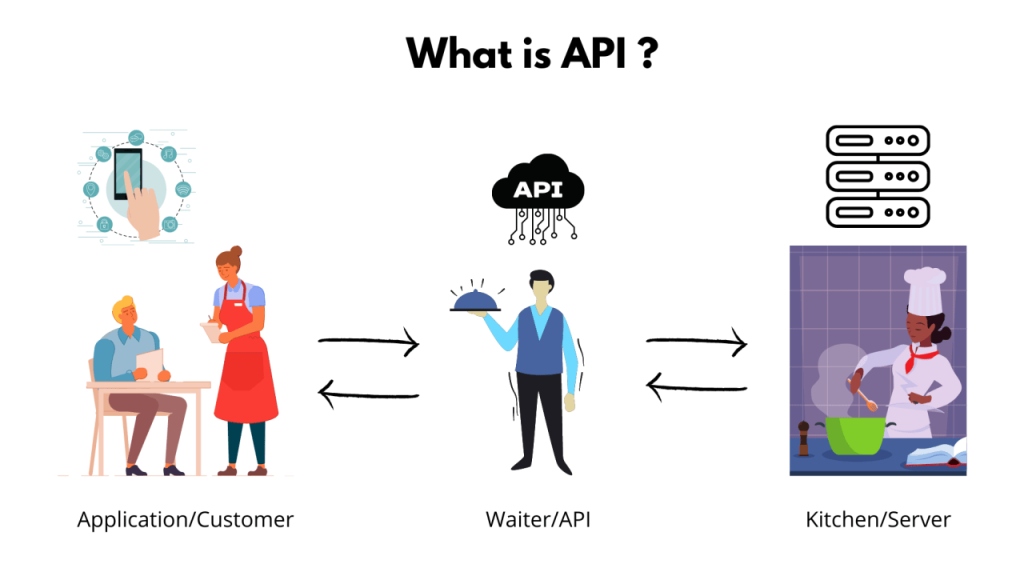
The most popular way to explain APIs is with a restaurant story, and it’s popular because it really works. Imagine you’re at a restaurant table. You want food, but you can’t just walk into the kitchen and start cooking. The kitchen has all you need, but you need a way to get to it.
How the Restaurant Works:
- You (the user): You know what you want but can’t go into the kitchen.
- The menu: Shows you what’s ready and how to ask for it.
- The waiter: Takes your order to the kitchen and brings your food back.
- The kitchen: Makes what you asked for based on the order.
In this story, the waiter is the API. You don’t need to know how the kitchen runs, what tools they use, or the recipes. You just need to know how to order from the menu. The waiter handles all the talking between you and the kitchen, following the rules for how orders work.
It’s the same when you use a weather app on your phone. The app doesn’t have all the weather info itself. Instead, it uses a weather API to ask for today’s weather from a weather service. The API acts like the waiter, fetching the info you asked for and sending it back to your app in a way it can show you.
Why APIs Are Super Important in Today’s Tech
APIs are totally vital to how modern software works. In fact, most of the apps and websites you use every day rely on many APIs working together behind the scenes. Knowing why APIs are so key helps explain why they’re such a big topic in tech talks.
Letting People Specialize
Before APIs were common, companies often had to build everything by themselves. If you wanted a map in your app, you’d have to create a whole mapping system from nothing, including keeping up with all the map data, route finding, and showing it on screen. This was expensive, took forever, and meant most companies couldn’t afford cool features.
APIs totally changed this by letting people specialize. Google got really good at maps and made an API that lets other developers use their map tech. Now, a small startup can put awesome maps into their app without building a map system themselves. This goes for tons of other services too.
Common Specialized Services You Get Through APIs:
- Paying for things: Stripe, PayPal, Square handle money moves.
- Maps and places: Google Maps, Mapbox give location services.
- Talking: Twilio sends texts and makes calls.
- Email sending: SendGrid, Mailchimp deal with sending lots of emails.
- Cloud storage: AWS, Google Cloud, Azure give you space to store stuff.
- Signing in: Auth0, Firebase handle user logins.
- Tracking stuff: Google Analytics watches what users do.
Making Apps Work Together
Today’s digital world rarely means using just one app alone. You might book a ride through an app that shows Google Maps, processes your payment with Stripe, sends you a confirmation via Twilio, and records the trip in your company’s expense system. Each of these links happens through APIs.
This connection builds powerful systems where special services team up to create experiences that no single company could build alone. You can book flights, hotels, and rental cars from one travel website because that site uses APIs to link up with airlines, hotel chains, and car rental companies.
Making Things Faster and More Creative
APIs really speed up how fast new features and products can be made. Instead of spending months or years building basic tech, developers can focus on what makes their product special while using APIs for everything else.
Good Stuff for Developers:
- New products get out faster.
- Costs for building things go down.
- You get to use cool tech without building it.
- You focus on what your business really needs, not the nuts and bolts.
- It’s easier to update and make features better.
- Less hassle keeping things running.
A developer with a good idea can now build and launch a fancy app in weeks that would have taken years without APIs. This speed has led to the huge number of apps and digital services we’ve seen in the last ten years.
How APIs Actually Work: The Tech Side Made Easy
While you don’t need to know every tiny detail to get what APIs are, knowing a bit about how they work helps make the idea clearer and makes tech talks easier to follow.
The Ask and Answer Dance
At their core, APIs work with a simple pattern: you ask for something, and you get an answer. One app asks for something (data, an action, etc.), and the API gives back an answer with what was asked or an error message if something went wrong.
How API Talk Goes:
- App asks for something: It wants specific info or to make something happen.
- API gets the request: Checks if it’s asked for correctly.
- API deals with the request: Finds the info or does the action.
- API sends an answer: Gives back the info or says it’s done.
- App gets the answer: Uses the info or deals with problems.
Let’s make this real with an example. When you check the weather on your phone:
- Your weather app sends a request to a weather API asking for current weather where you are.
- The weather API gets this request and makes sure it’s valid.
- The API looks in its data for weather info for your spot.
- The API sends back an answer with the temp, conditions, forecast, etc.
- Your app gets this info and shows it nicely.
This whole process can happen in a tiny fraction of a second, which is why weather apps feel instant even though they’re talking to computers possibly thousands of miles away.
Different Kinds of APIs
Not all APIs work the exact same way. Different situations need different approaches, and several kinds of APIs have come up to fit various needs.
Common API Types:
- REST APIs: The most popular kind, using standard internet rules.
- SOAP APIs: Older, more strict rules used in big company settings.
- GraphQL APIs: Newer way allowing more flexible data requests.
- WebSocket APIs: For real-time, two way chat.
- Webhook APIs: Send data when certain things happen.
- RPC APIs: Remote ways to run tasks.
For most everyday talk, when people say APIs today, they usually mean REST APIs. These use the same rules that make the internet work (HTTP/HTTPS), making them pretty easy to grasp and use.
API Keys and Checking Who You Are
You might wonder how APIs stop just anyone from using services. After all, if a weather API is there for your app, what stops someone from overusing it by making a million requests?
This is where API keys and checking who you are come in. When developers want to use an API, they usually need to sign up and get an API key basically a special password that tells the service who their app is. Every request to the API includes this key, letting the service keep track of usage and stop bad behavior.
API Security Tricks:
- API Keys: Special codes for each app.
- Rate Limiting: Stops too many requests in a short time.
- OAuth: Safe way to connect for user info.
- Encryption: Keeps data safe while it’s moving.
- Auth Tokens: Temporary passes that wear off.
- IP Whitelisting: Only allows requests from approved sources.
These safety steps guard both the API maker and the users. They make sure services stay up, stop misuse, and keep private info safe.
Everyday Examples You Definitely Use
APIs are so much a part of modern tech that you use dozens of them daily without even knowing it. Seeing these connections helps show how truly vital APIs have become.
Sharing on Social Media
Ever notice you can share articles, videos, or app stuff right to Facebook, Twitter, or Instagram without leaving the first app? That’s APIs doing their thing. When you tap a share button, the app uses social media APIs to post for you.
The app doesn’t need to know how Facebook stores posts or Twitter’s inner workings. It just needs to send the right info to the social media API, which handles the rest. This is why hundreds of thousands of apps and websites can add social sharing without each building their own special ways to do it.
Shopping Online
Shopping websites use APIs a lot throughout your buying process. When you type in your shipping address, the site might use a mail service API to check if the address is real and suggest fixes if needed. When you go to pay, payment processor APIs handle the money part safely.
How Online Shopping Uses APIs:
- Checking addresses and filling them in fast.
- Figuring out shipping costs right away.
- Handling payments and spotting fake stuff.
- Checking what’s in stock in different places.
- Tracking orders and sending updates.
- Suggesting products you might like.
- Customer review systems.
Just one online purchase might involve a dozen different APIs working together smoothly to give you an easy experience.
Booking Travel
Travel websites like Expedia, Kayak, or Booking.com don’t own airlines, hotels, or car rental places. Instead, they use APIs to search for available spots and prices from thousands of providers, make bookings, and handle reservations.
When you look for flights, the website sends API requests to many airlines at once, gathers their answers, and shows you all the results together. This is why you can compare hundreds of flights from different airlines on one screen APIs make it happen.
Smart Home Gadgets
Your smart home setup relies heavily on APIs. When you tell Alexa to turn off the lights, your voice command goes to Amazon’s API, which then uses the smart bulb company’s API to send the off message to your bulbs.
Smart home systems like Apple HomeKit, Google Home, and Amazon Alexa are basically API hubs that link to APIs from many device makers, letting you control everything from one place.
Fitness and Health Apps
Fitness trackers and health apps use APIs to share info between different services. Your running app might use GPS APIs to track your route, music APIs to control what you listen to while you run, and social media APIs to share what you did when you finish.
Many fitness apps also connect with each other through APIs. Your Fitbit data might go into MyFitnessPal for calorie tracking, which then links to your doctor’s health site, all through API connections.
APIs for Business: It’s More Than Just Tech
While APIs started as purely tech tools, their influence has grown way beyond the development team. Understanding APIs has become more and more important for business leaders, product managers, and planners.
Business Models Built on APIs
Some companies have built their entire business around giving out APIs. Stripe didn’t make a payment app for everyday people they built APIs that developers use to add payment stuff to their own apps. Twilio doesn’t make a texting app they give APIs that let other apps send texts.
Companies That Started with APIs:
- Stripe: The basic setup for payments.
- Twilio: Ways to talk (texts, calls, video).
- SendGrid: Email sending services.
- Auth0: Signing in and checking who you are.
- Algolia: Search tools.
- Cloudinary: Managing pictures and videos.
These companies realized that giving awesome APIs to developers could be more helpful than building apps for regular users. Their wins show how APIs have become products themselves, not just technical details.
Building Tech Communities
Many big platforms now give out APIs just to get other developers to build things on their platform. This builds communities where the platform becomes more helpful as more apps tie into it.
Salesforce, for example, gives out lots of APIs that have let thousands of apps add more to what it can do. This community makes Salesforce more useful to customers, who can adjust it to their exact needs using other apps that tie in through APIs.
Making Money from Info
APIs open new ways to earn money from info and services. Weather services sell API access to their info. Financial data providers charge for API access to market details. News groups offer APIs that let apps show their content while tracking usage and dealing with licenses.
The Future of APIs
As tech keeps changing, APIs are becoming even more central to how systems talk and share info. Several trends are shaping where API tech is headed.
AI and Machine Learning APIs
The rise of AI has created a new kind of APIs that give AI tools as a service. Instead of making AI models from scratch, developers can use APIs from companies like OpenAI, Google, or Anthropic to add AI features to their apps.
What AI APIs Can Do:
- Understanding and processing language.
- Recognizing pictures and videos.
- Turning speech to text and text to speech.
- Translating languages.
- Making new content.
- Figuring out emotions from text.
- Predicting things.
These AI APIs make fancy tech available to everyone, tech that would otherwise need special skills and huge computing power.
Managing and Running APIs
As companies use more APIs, managing them gets tricky. New tools and ways are popping up for API rules, security, watching, and explaining. Companies are treating their API setup as super important business tools that need careful handling.
Making Things Standard
The API world is slowly becoming more standard, making it easier for developers to work with many APIs. Standards like OpenAPI Specification help explain APIs consistently, while new standards for signing in and checking who you are simplify security.
Getting Started with APIs: What’s Next
If this guide got you interested in learning more about APIs, there are several ways to go depending on what you want to do and your tech background.
For Non-Tech People
Understanding APIs as an idea, like in this guide, is often enough for business roles. Focus on what APIs let you do rather than how to build them. Learn to ask good questions about what APIs can do, their limits, costs, and safety when looking at tools and sellers.
For Future Developers
Start playing with simple APIs that don’t need a lot of setup. Many services offer free levels that let you make API requests and see answers. Reading API instructions and making your first successful API call can be super satisfying and makes the whole idea clear.
Easy APIs to Check Out:
- Weather APIs: Simple info getting with clear results.
- Public Data APIs: Government and open info sources.
- Pokemon API: Fun data for learning.
- REST Countries: Info about countries and places.
- Cat/Dog Picture APIs: Fun and simple.
For Business Leaders
Think about how APIs might let your company do new things. Could your company give out APIs to partners or customers? Are there API-based services that could speed up your development or cut costs? Knowing the big picture of APIs can show new chances.
Conclusion: APIs Are Digital Connectors
APIs are one of the most important ideas in modern tech, even though they work silently in the background. They’re the links that let our increasingly digital world work as one connected system rather than separate islands of functions.
From the moment you check your phone in the morning to when you set your smart thermostat before bed, APIs are always working to fetch info, deal with requests, and link different services smoothly. Understanding this basic tech helps you make sense of how modern software works and why certain features and abilities have become possible.
Whether you’re just trying to understand tech better or thinking about a job in digital products, getting what APIs are and why they matter gives you a base for understanding a lot of how today’s digital world runs. The next time someone mentions APIs in a meeting or article, you’ll know exactly what they’re talking about and why it’s a big deal.
Explore Our Programming Category