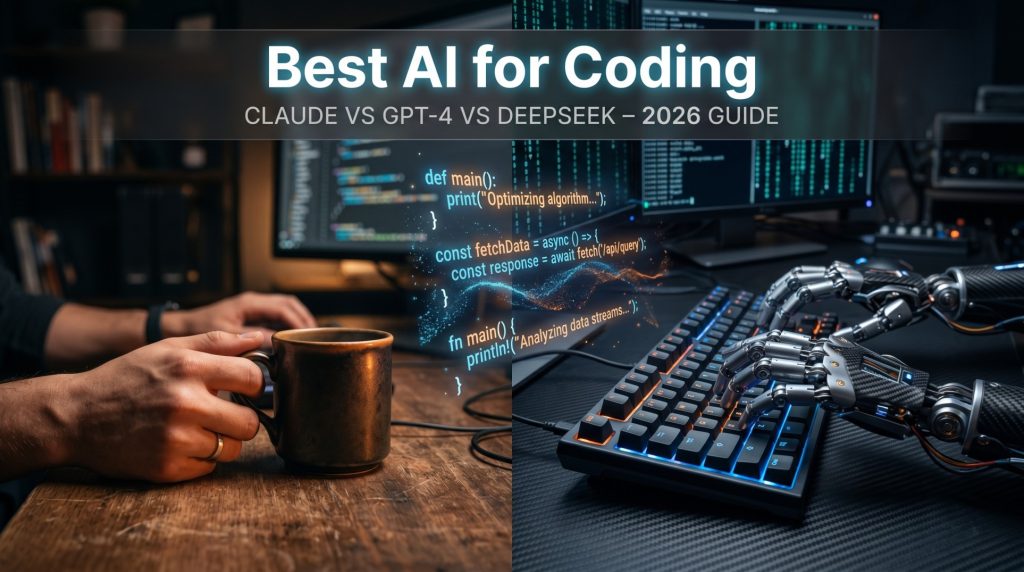
Let’s just come clean about this. If you’ve ever logged onto Twitter (aka X), you’ve undoubtedly seen half a dozen posts that say things like “Model X just killed coding” and “Model Y is a senior engineer with a PhD.” In actuality, as anyone who has spent 2 AM debugging their hallucinated API calls can tell you, the truth is much more complicated.
The question “Which AI is the best for coding?” seems deceivingly simple, but the correct response depends entirely upon what exactly you are doing: whether you are building a React front-end, crafting a Rust macro, or refactoring a legacy Python monolith.
This post will take you beyond the leaderboards, where we will assess which model holds the upper hand with the three great challenges of modern development: context windowing, steering, and logic debugging.
Here is where things currently stand in 2026.
The Big Three (And Why ChatGPT Isn’t the Default Anymore)
Once, the answer was just “GPT-4.” However, today’s world has broken into beautiful pieces. We have three separate categories: the generalist, the specialist, and the open source workhorse.
- Claude 3.5 Sonnet / Opus (Anthropic): The Architect
- GPT-4 Turbo (OpenAI): The Generalist
- DeepSeek-Coder V3 / Qwen-Coder (Open Source): The Speedrunner
Suppose you had a radio button option for your coding state of mind. It would probably be something along these lines:
□ I need perfect syntax, no slop: Claude
□ I need to think up a complicated algorithm: GPT-4
□ I’ve got five bucks, and it’s a big batch file: DeepSeek
Let’s tear down why you would pick each one.
1. Claude 3.5 Sonnet: The “No-BS” Coder
Unlike OpenAI, Anthropic has achieved something that OpenAI has yet to manage. The company has optimized its technology to favor accuracy over creativity. When you tell Claude to code, Claude won’t generate anything fancy that looks good but isn’t accurate. It will first try to clarify things.
This is what makes the “Artifacts” feature so important. Rather than just giving you the code, it actually shows you how it will work. If you need an interactive SVG dashboard or a unit test suite, for instance, Claude will render the output for you in real-time.
A working example:
Prompt: “Write a Python script to parse a semicolon-delimited log file with inconsistent timestamps and save any errors detected to a JSON file.”
- Claude’s methodology: The program will first generate a regex fallback chain. The program will handle any ValueError errors gracefully. There will be a main guard. The important thing is that the program works 95% of the time on the first attempt.
- The drawback: The program may be overly conservative. When asked to “hack together a quick prototype,” Claude always wants to do full-scale error handling, which is time-consuming during the ideation stage.
If you value clean code reviews and hate fixing indentation errors, Claude is your current winner.
2. GPT-4 Turbo: The Ideation Engine
GPT-4 still rules when it comes to explaining complex concepts. Where Claude succeeds, GPT-4 excels. As a developer at the beginner level, if you are struggling to understand the reason behind the failure of a quick sort operation performed on an identical array, the reasoning path by GPT-4 still wins the race.
But there is a downside to it. The latest changes in GPT-4 have made it a bit lazy. Suppose you want a 200-line code snippet, but you get just 50 lines along with the statement, “Write the remaining logic in this way.” It’s very annoying.
Use case:
Suppose you need to move some TensorFlow 1.x codebase to PyTorch. There is no resemblance between their syntax.
- Strength of GPT-4: “In TF you use tf.session.run(), but in PyTorch you call .backward() on the loss scalar.”
- Weakness of GPT-4: Verbatim copying of its code leads to deprecation warnings since the cutoff date of its training data did not include some small update to libraries like Pydantic V2.
Conclusion: Plan and learn from GPT-4. Execute via Claude.
3. The Rise of DeepSeek-Coder V3: The Local King
This is where it gets exciting for the privacy enthusiast and the budget-strapped student. DeepSeek-Coder, along with the newer versions thereof, shows that open source is just as good, if not better, than proprietary software at writing code.
Why is this significant to coding in particular?
Because code is less perplexing than natural language. Code has fixed structures (ASTs and compilation processes). By leveraging this property, DeepSeek learns from a massive collection of 2 trillion code tokens.
Use Case: Automated Test Writing
Suppose you are working with an old Java program that spans 300 lines. Suppose you need some unit tests for it. Using the OpenAI API will set you back a few cents per request. Using DeepSeek on your machine will run up your power bill.
- Prospective advantage: Batch processing of analysis becomes possible. “Generate JUnit tests for all files in this folder.”
- Potential danger: It may be argued that DeepSeek is quite intelligent but does not have such a safety training feature like Claude. In other words, when it comes to writing potentially harmful code by mistake, DeepSeek may do it without any warnings about the security problem.
In case you work in one of the highly regulated industries (such as finance and healthcare), where you are forbidden to upload your code to any US cloud service, DeepSeek Local becomes your single option.
The “Vibe Coding” Trap: Why Context Length is King
The latest buzzword that engineering teams are using is “vibe coding,” which involves copy-and-pasting errors until the AI magically figures out what you want to do. This won’t work for you once you cross the line of having a thousand lines of code.
But not with Context Windows. Here’s why:
- Claude 3.5: 200k tokens (approx. 500 pages of text).
- GPT-4 Turbo: 128k tokens.
- Gemini 1.5 Pro: 2 million tokens (the current champion).
What about Gemini? Why is it not on top of the list?
This is because the mere count of tokens does not mean perfect recall. The Gemini developed by Google knows everything about your codebase, but as recent research revealed, it experiences “lost in the middle.” In other words, if you feed an extremely large file to it, it will remember only the beginning and the end of it.
Practical workflow for large refactors:
- Use Gemini to scan the repo and create a “map of files” (high level).
- Use Claude to actually rewrite the specific
auth.pymodule (deep focus).
Radio Button: Which one fits your role?
○ I am a Student/Hobbyist.
    → Best AI: DeepSeek-Coder (Free, offline usage with unlimited quotas).

○ I am a Freelancer who fixes non-functional WordPress plugins.
    → Best AI: Claude 3.5 Sonnet (Best understands old school PHP spaghetti code).

○ I am a Data Scientist (Python/Pandas + SQL).
    → Best AI: GPT-4 (Strongest logical reasoning with Pandas DataFrames).

○ I am a Systems Engineer (Rust/C++) developer.
    → Best AI: Claude (Less prone to hallucinations due to memory safety concerns).
The Undervalued Skill: Prompting Structures
Here is the secret that most of the “Best AI” rankings leave out. The model is only half the picture. The other half is in the prompt.
Don’t use “Write a login form.”
Use this prompt: “Write a React login form using react-hook-form with Zod validation.” The email field is unique and should be required. A password has a special character requirement. Add a loading state. Output TypeScript props.”
Coding tip number one—the “Chain of Thought”:
Ask for a plan before writing any code.
Prompt: “We need to implement a rate limiter in Golang. Instead of coding right away, generate a list outlining what approach you’d take regarding concurrency control in the program. Then, stop. After I say “Go,” start coding.”
It forces the model to focus on structure over syntax first. Anecdotal results show this decreases errors by 40%.
The Final Verdict (For 2026)
The “best” is a fallacy peddled by technology thought leaders looking for affiliate links.
- For polished, production-ready code: Claude 3.5 Sonnet.
- For education, debugging, complex problem-solving, or SQL coding: GPT-4.
- For bulk tasks, free coding, or offline: DeepSeek-Coder V3.
And above all, don’t allow yourself to be replaced in your thought processes by the machine; merely delegate the typing to it.
Even if you request the AI to create your sort algorithm, you must still know about Big O notation. Even if you request it to create a Dockerfile for you, you must still be aware of how CMD and ENTRYPOINT work. It is not the developers of 2026 who avoid AI completely, nor those who believe AI unconditionally; rather, it is those who see AI as an extremely fast but slightly drunk intern.
Explore Our Ai Category

