The Question Before Getting Started
Now imagine if I asked you to come up with the most fundamental principle in cybersecurity. Encryption, strong passwords, firewalls, etc. These are the typical answers. They are all correct but they miss the mark because they do not provide any information about what you’re defending yourself against or the reason for prioritizing one defense over another.
There is one concept that has dominated the world of cybersecurity since the 1970s. The name of this model is the CIA Triad, and once you get it, you will never think about a security measure in the same old-fashioned way.
I know that may sound like a bold statement, but in fact, the basis of all security policies, compliance frameworks, and architectural decisions in computer science is the CIA Triad. Be it a developer making a decision on a database choice or an IT administrator setting up backups, you operate within the CIA Triad whether you are aware of it or not.
Now let’s dive deep into it and talk about everything. From the 1970s to quantum computing.
Part 1: What is the CIA Triad?
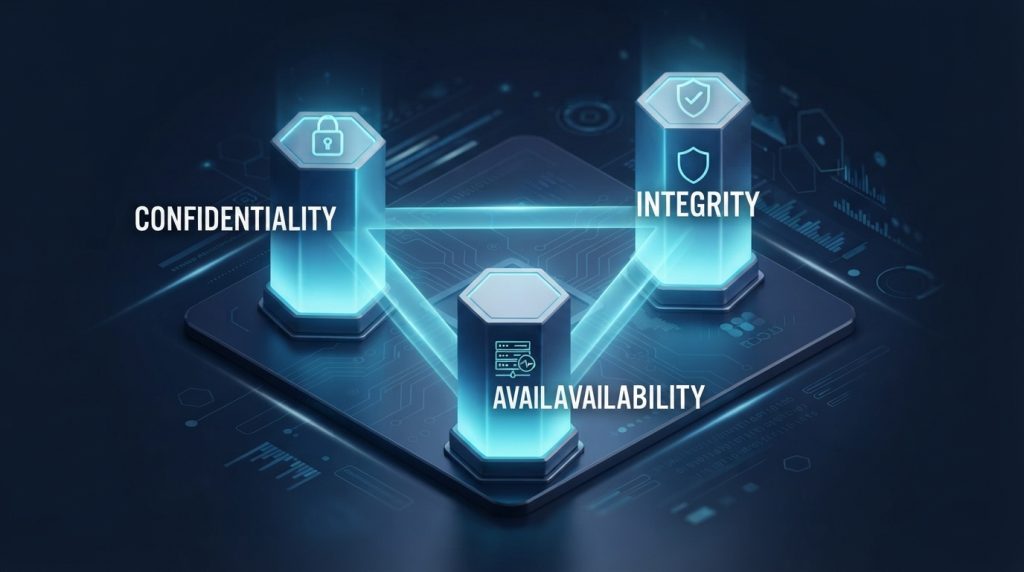
The CIA Triad is a framework describing the three fundamental principles of information security Confidentiality, Integrity, and Availability. It isn’t a product, nor is it a certification or any sort of tangible item. Rather, it’s a perspective a way to think about what “security” really is.
In other words, the easiest way to understand the CIA Triad is:
- Confidentiality: Only authorized parties can access it.
- Integrity: Only authorized parties can alter it.
- Availability: Authorized parties can access it when necessary.
Three simple questions. Every threat that has ever been made takes advantage of a vulnerability in one of those three areas. Each security measure that you ever implemented improves upon one of those three.
A Quick History Note
The actual formulation of the concept wasn’t created instantaneously, either. The ideas behind it first appeared in works from the Rand Corporation and the MITRE Corporation in the 1970s-1980s.
- 1972: The Anderson Report (“Computer Security Technology Planning Study”) mentioned security exposure as the basis for what would become the model.
- 1975: Saltzer and Schroeder’s famous paper “The Protection of Information in Computer Systems” reiterated those basic principles.
- 1986: The well-known “CIA” acronym was apparently first used by Steve Lipner in MITRE. This term remained memorable and appropriate to describe the efforts of security experts who have been striving to understand the core of the problem during many years.
What I like about this history is that it reveals one significant fact: the CIA Triad wasn’t created top-down. It was discovered through practice and observation.
Part 2: Pillar One Confidentiality
What It Actually Means
Confidentiality involves ensuring that no unauthorized users gain access to the information. Note the term “authorized” – confidentiality does not imply locking away all information so that nobody can access it. Instead, it concerns who gets access to what information.
The difference is significant because a hospital has to make sure its patients’ records are confidential, but a doctor must have access to them. In the same way, a bank must ensure the confidentiality of customer account information, but its tellers must use this information to perform transactions. Confidentiality means access control.
Why It Matters
When confidentiality is compromised, the consequences include disclosure attacks – accessing information by unauthorized parties. These consequences vary from unpleasant to catastrophic:
- Exposure of personal data leads to identity theft and fraud.
- Stolen intellectual property leads to loss of competitive advantage.
- Disclosure of government information compromises national security.
- Legal consequences become huge if customer data becomes publicly available. According to IBM’s Cost of a Data Breach Report, the global average cost of a data breach reached $4.4 million USD in 2025.
Popular Attack Vectors for Confidentiality Violations
Knowing attacks is the key to defending from them.
- Eavesdropping / Sniffing: intercepting packets using software such as Wireshark/tcpdump. Protected against by encryption (TLS/VPNs).
- Man-in-the-Middle (MITM) attack: an attacker is placed between two participants, forwarding their traffic and reading it. Defended against by certificate pinning, HSTS and mutual TLS.
- Credential theft: phishing, keylogging, credential stuffing. Defended against by MFA, password managers and phishing-resistant FIDO2 authentication.
- SQL injection: accessing data in databases through injection. Defended against by parameterized queries and WAFs.
- Insider threats: employees or contractors stealing confidential information. Defended against by least privilege principle, DLP and logging.
- Side-channel attacks: getting access to information through timing leaks, power consumption or electromagnetic emissions. Defended against by constant-time code and shielding.
- Social engineering: influencing people to reveal confidential information. Defended against by training and verification of identity.
- Theft: stealing laptops, hard drives or printing documents. Defended against by full disk encryption (BitLocker, LUKS).
How It’s Secured
Confidentiality can be assured using the following controls:
- Encryption (in transit and at rest): AES-256, ChaCha20, TLS 1.3
- Access Control List (ACL) and Role-Based Access Control (RBAC)
- Multi-Factor Authentication (MFA): SMS, TOTP, hardware tokens
- Data masking and tokenization for PII in non-production environments
- Network Segmentation and Micro-Segmentation
- Data Loss Prevention (DLP)
- VPNs and Zero Trust Network Access (ZTNA)
Real-Life Example
Let’s consider an example where you’re building an application for the healthcare industry. Confidentiality is required for patient records.
bash
# Encrypt a file at rest with OpenSSL (AES-256)
openssl enc -aes-256-cbc -salt -pbkdf2 -in patient_record.txt -out patient_record.enc

# Generate a strong key
openssl rand -base64 32 > key.bin

# Verify the encrypted file
file patient_record.enc
RBAC would be applied to your program as well only the doctor responsible for the patient would be able to view their full history. You will keep logs for all access attempts made. You hide the patient’s SSN except when there is a need to show it for some recorded reason. This is how confidentiality is achieved. It is a multi-layered approach.
Part 3: Pillar Two Integrity
What It Really Means
Integrity means making sure your data is accurate, complete, and unchanged unless it is changed by an authorized entity. And while confidentiality is important, this is far more subtle, and honestly, the one most people don’t give enough thought to.
See, when somebody accesses your personal information without authorization, that’s one thing. When someone changes your personal information without authorization you know what? That’s a whole new ball game entirely.
Why Is It Important?
When integrity is lacking, then alteration attacks take place data is altered through unauthorized methods. The problem with that is the fact that integrity issues go largely unnoticed no bells ringing, and no alarms going off when a number is altered in a database.
For example:
- A patient’s medical history having an incorrect blood type.
- An economic transaction that has been altered in its transmission.
- An alteration made to software prior to installation.
- Legal documentation that has been altered.
In each case, the system might appear to be working fine. But the data can no longer be trusted.
Integrity Attack Vector Examples
- Bit Flipping: Change a single bit to change data (e.g., row hammering attacks which exploit DRAM)
- Hash Collisions: Different values produce the same hash (MD5 is broken; use SHA-256+)
- Replay Attacks: Resend valid messages to initiate duplicated actions (defended with nonces & timestamps)
- Man in the Middle Data Tampering: Modification of data while it is being sent. (Defended with TLS & MACs)
- SQL Injection (write): Modifications of DB content (defended by parameterized queries)
- Supply chain tampering: Malicious code injection in software builds (SolarWinds incident)
- Malware/Rootkit: Modification of OS files or memory
- Insider Data Tampering: Proper data modification from authorized users (defended with segregation of duties and audit logs)
How It’s Protected
Integrity security measures are mostly oriented around detection and prevention
- Cryptographic hashing SHA-256, SHA-3, BLAKE3
- Digital signatures RSA-PSS, ECDSA, Ed25519
- Message Authentication Codes (MACs) HMAC-SHA256
- Version control and immutable audit logs
- Database constraints and validations
- File Integrity Monitoring (FIM) AIDE, Tripwire, OSSEC
- Change management procedures
- Code signing & SBOMs (Software Bill of Materials)
Practical Example: Hashing and Verification
bash
# Generate a SHA-256 hash of a file
sha256sum important_document.pdf
# Output: 3b241101... important_document.pdf

# Save the hash for later verification
sha256sum important_document.pdf > important_document.sha256

# Later, verify the file hasn't changed
sha256sum -c important_document.sha256
# Output: important_document.pdf: OK

# Sign a file with GPG (digital signature)
gpg --detach-sign --armor important_document.pdf

# Verify the signature
gpg --verify important_document.pdf.asc important_document.pdf
Integrity Mindset
This is what I’ve found helpful: integrity goes beyond just preventing change. It is about determining whether the change occurred or not, and by whom. That is why logging and auditing are so crucial.
If you cannot determine whether your data has been tampered with, you lack integrity, and have hope.
Part 4: Pillar Three Availability
What It Really Means
Availability means making sure that the system and data are available to people who have access to them. It seems like a softer pillar, but in today’s highly interconnected world, it’s possibly the most important one.
Here is a story that will prove that point. At one of the recent security conferences, INTERPOL’s Global CISO, Bjorn Watne, told a story of how his friend had a mattress that was cloud-connected and set its temperature at night. When the cloud system was down, the mattress used its default setting the hottest one. The friend woke up sweating.
It’s funny, but also a perfect metaphor of our lives now. When we face digital problems, the results are physical and happen really fast. In Norway, where Bjorn is from, nearly 100% of all payments of goods and services are made digitally. When the system crashes, the country simply stops.
Why Does It Matter?
Availability attacks, also known as denial attacks, try to make the systems unusable. They include the following:
- Ransomware – Data encryption and payment are demanded
- Distributed Denial of Service (DDoS) – Overwhelming of systems with traffic
- Hardware malfunctions: Disk crash, RAM failure, power supply unit failure
- Electricity failures and cooling failures
- Natural disaster: floods, fire, earthquakes
- Human error – Misconfiguration is the number one reason for outages in many organizations
The change is real: Security leaders were focused on confidentiality only before. The threat actors wanted to steal data and leave. But now, the attacks try to create disruption in the systems. Ransomware and supply chain and critical infrastructure attacks have increased the importance of availability.
Bjorn said: “We have to classify if the availability of the system overrides the need for confidentiality or integrity or vice-versa.”
Common Availability Attack Techniques
- Volumetric DDoS:– Bandwidth overloading (UDP floods, ICMP floods).
- Application DDoS:– HTTP flooding on costly endpoints.
- Ransomware:– Encrypts files and deletes backups.
- Resource exhaustion:– Memory leaks, high CPU usage, connection pool exhaustion.
- DNS attacks:– DNS hijacking, DNS cache poisoning, DNS amplification.
- BGP hijacking:– Redirecting traffic to a wrong network.
- Physical attacks:– Cable cuts, data center destruction.
- Insider sabotage:– An angry admin wiping production databases.
Protection from These Threats
Availability protection techniques include resilience and recoverability:
- Redundancy – RAID, cluster failover, multi-AZ (availability zones), multi-region
- Backups – 3-2-1 (3 copies, 2 media, 1 remote backup), immutable backups
- DDoS protection – Cloudflare, Akamai, AWS Shield
- Disaster Recovery (DR) and Business Continuity (BC) plans
- Load balancing and auto-scaling
- Monitoring and alerting
- Chaos engineering – Testing resilience by breaking things
Key Availability Metrics
| Metric | Meaning | Example |
| RTO | Recovery Time Objective — how long can you be down? | 4 hours |
| RPO | Recovery Point Objective — how much data can you lose? | 15 minutes |
| MTTR | Mean Time To Repair | 45 minutes |
| MTBF | Mean Time Between Failures | 10,000 hours |
| SLA | Service Level Agreement — promised uptime | 99.9% (“three nines”) |
| SLO | Service Level Objective — internal target | 99.95% |
Uptime math:
- 99% = 3.65 days down/year
- 99.9% = 8.77 hours down/year
- 99.99% = 52.6 minutes down/year
- 99.999% = 5.26 minutes down/year (“five nines”)
Practical Example: Backup Strategy
bash
# 3-2-1 backup using rsync
# Copy 1: local
rsync -av --delete /data/ /backup/local/

# Copy 2: remote server
rsync -av --delete /data/ user@backup-server:/backup/remote/

# Copy 3: cloud (S3 with versioning + object lock)
aws s3 sync /data/ s3://my-backup-bucket/data/ --storage-class GLACIER

# Verify backup integrity
sha256sum /data/* > /backup/manifest.sha256
The Hard Question
This is a good question to differentiate junior and senior security professionals: What’s the proper balance?
A completely confidential system could be useless. A completely available system could be insecure. CIA is not about having all three in large amounts. It’s about making decisions and taking into consideration some tradeoffs.
Part 5: The DAD Triad The Attacker’s Counterpart
There is always a counterpart for each defense. The three counterparts of the DAD Triad are Disclosure, Alteration, and Denial.
| CIA Pillar | DAD Attack | What Happens |
| Confidentiality | Disclosure | Unauthorized access to information |
| Integrity | Alteration | Unauthorized modification of data |
| Availability | Denial | Systems or data become inaccessible |
DAD Triad can be very beneficial since it makes you think from the perspective of a hacker. Rather than thinking “How do I defend this?” you will be thinking “How do I crack this?” This way of thinking forms the basis of threat modeling and pen testing.
Part 6: Threat Modeling with STRIDE
CIA Triad aligns perfectly with STRIDE – Microsoft’s approach to threat modeling:
| STRIDE Threat | Violates | Example |
| Spoofing | Authenticity | Fake login page |
| Tampering | Integrity | Modifying a database row |
| Repudiation | Non-repudiation | Denying you sent a message |
| Information Disclosure | Confidentiality | Data leak |
| Denial of Service | Availability | DDoS attack |
| Elevation of Privilege | All three | Gaining admin rights |
Other threat modeling methodologies include:
- PASTA (Process for Attack Simulation and Threat Analysis) – 7 steps, risk-focused
- DREAD (Damage, Reproducibility, Exploitability, Affected users, Discoverability) – risk rating system
- Attack Trees – hierarchical attack paths
- LINDDUN – privacy-oriented threat modeling
Part 7: Access Control Models
Access control is at the heart of confidentiality. Here are the models:
1. Discretionary Access Control (DAC)
Controlled by the owner. Found in Unix permission system.
bash
chmod 750 file.txt  # Owner: rwx, Group: r-x, Others: none
2. Mandatory Access Control (MAC)
Policy throughout the system (labels/clearances). Applied in SELinux and governmental systems.
3. Role-Based Access Control (RBAC)
Access depends on roles. The most popular in enterprises.
4. Attribute-Based Access Control (ABAC)
Access control by attributes (of user, resource, environment). The most flexible approach, applied in Zero Trust.
5. Rule-Based Access Control (RuBAC)
Access control by rules (for example, firewall rules).
Part 8: Cryptography – The Engine Behind CIA
Cryptography is by far the best tool to enforce CIA principles. Now let’s review the basics.
Encryption vs Hashing vs Encoding
| Concept | Reversible? | Purpose | Example |
| Encryption | Yes (with key) | Confidentiality | AES, RSA |
| Hashing | No | Integrity | SHA-256, bcrypt |
| Encoding | Yes (no key) | Representation | Base64, hex |
Key Point: Encryption Is NOT Security. Base64 encryption is easily decrypted.
Symmetric VS Asymmetric
- Symmetric (Same key): AES-256, ChaCha20 Fast, Bulk encryption
- Asymmetric (Public & Private Key Pair): RSA, ECC Slow, key exchange and signing
- Hybrid Approach (Both): TLS Asymmetric for key exchange and symmetric encryption
Common Algorithms (2026)
| Use Case | Recommended | Avoid |
| Symmetric encryption | AES-256-GCM, ChaCha20-Poly1305 | DES, 3DES, RC4 |
| Hashing | SHA-256, SHA-3, BLAKE3 | MD5, SHA-1 |
| Password hashing | Argon2id, bcrypt, scrypt | Plain SHA-256 |
| Digital signatures | Ed25519, ECDSA P-256, RSA-PSS | RSA-PKCS#1 v1.5 |
| Key exchange | ECDHE, X25519 | Static DH |
PKI and TLS in 30 Seconds
PKI (Public Key Infrastructure) is the mechanism for identity verification through CAs, certificates, and trust chains. When you connect to https://example.com:
- Certificate signed by trusted CA is sent from the server.
- Chain verification up to a trusted root CA is performed by the browser.
- Shared key is established using ECDHE by client and server.
- Encryption occurs using AES-GCM or ChaCha20.
Part 9: The CIA Triad Extended – Authenticity, Non-Repudiation & Co.
The CIA Triad forms the foundation for security and privacy concepts; however, over time it became evident that there are additional properties that need to be considered.
Authenticity
While integrity guarantees that data has not been modified during transfer, authenticity ensures that data has been received from its intended source. “This data has not been changed” vs. “This data has been created by an authorized source.”
Non-Repudiation
Non-repudiation prevents the sender from denying the creation and transmission of the data. Crucial in banking and other business transactions. Uses digital signatures and cryptographically secured logs.
The Parkerian Hexad (1998)
Donn Parker suggested expanding the CIA Triad to six properties:
- Confidentiality
- Integrity
- Availability
- Authenticity
- Possession (Control over data; data may be encrypted)
- Utility (data is usable; encrypted data without decryption means is not usable)
Part 10: Formal Security Models
For an in-depth study, some of the formal security models that exist on the CIA Triad include:
Bell-LaPadula Model (Confidentiality)
- Simple Security Property: “No read up” cannot read if clearance is lower than classification.
- Star Security Property: “No write down” cannot write to if clearance is higher than classification.
- Mnemonic: “Write up, read down.”
Biba Model (Integrity)
- Simple Integrity Property: “No read down” cannot read if integrity is lower than classification.
- Star Integrity Property: “No write up” cannot write if integrity is higher than classification.
- Mnemonic: “Read up, write down.”
Clark-Wilson Model (Integrity)
This model is based on well-formed transactions and separation of duties.
- CDI: Constrained Data Items (protected data)
- UDI: Unconstrained Data Items (inputs)
- TP: Transformation Procedures
- IVP: Integrity Verification Procedures
Popular in finance.
Part 11: Common Myths
Let me dispel a few myths I have heard before.
Myth #1: “Confidentiality Is Most Important”
It may have been true twenty years ago. It is not true today. With the growing interconnection and criticality of modern systems, the priorities have changed. The ransomware attack will not be bothered by your confidentiality controls.
Myth #2: “The Triad Is Just for Security Teams”
The CIA Triad is as much about governance as it is about security. Everyone – developers, product owners, execs – stands to benefit from learning it.
Myth #3: “You Can Have Them All Perfectly”
You cannot. Never at the same time. You cannot sustain this for eternity. You cannot achieve it at a reasonable cost. CIA Triad is all about managed compromises.
Myth #4: “The Triad Is Outdated”
I have read articles that said that the CIA Triad is an old concept because it lacks authenticity, non-repudiation, and privacy. It is not relevant to the topic at all.
Myth #5: “Encryption Is the Solution”
Encryption is indeed a great technology. Yet, it does not protect you from insider attacks, social engineering, or denial-of-service.
Part 12: Practical Takeaways
This is how to use the CIA Triad in practice, be it as a developer, an administrator, a manager or a person interested in security in general.
1. Use It as a Checklist
Asking the following questions for each system will help you:
- Confidentiality: who has access to this data and is it well controlled?
- Integrity: could this data be tampered with? How can I know about this?
- Availability: what should I do if the system goes offline? How long does it take me to get back online?
2. Prioritize Depending on the Situation
Data requires different level of protection depending on the situation. Website, available to anyone is less confidential but more available, while a signed legal contract is much more about integrity than availability.
3. Look for Trade-Offs
Sometimes increasing one element of the triangle will result in reducing the other. For example, encrypting data on hard drive (confidentiality) may make recovery harder (availability). Access control measures (confidentiality) may slow down legitimate actions (availability).
4. Communicate with the Triad
One underrated aspect of the triad? It provides a common language for techies and non-techie executives. By saying to an executive that “our confidentiality controls are good, but our availability position is bad,” they will understand.
5. Stay Relevant
The triad hasn’t been updated since 1986, but the threats have changed. Availability is now a board-level concern. Integrity attacks (supplied chains, deepfakes) are increasingly more complex. The post-quantum era is coming soon.
Part 13: Concluding Remarks
As I have argued from the outset, the CIA Triad is the most crucial notion in the realm of cybersecurity. Allow me to clarify this statement. Its significance does not stem from its complexity but from its simplicity. Its simplicity makes it memorable; its profundity makes it applicable in any situation. The ability to apply a model that you can easily memorize is the difference between reaction and response. Between tools and strategy.
When you next hear of a data breach, try to figure out whether it was due to a problem of confidentiality, integrity, or availability. (In fact, it often results in more than one.) When designing a system, make sure that you have accounted for all three pillars.
And when you are sitting in a room where someone mentions “we need to become more secure,” ask: “Secure in what sense?” Confidentiality? Integrity? Availability? That is enough to set you above everyone else in the room.
Quick Reference Cheat Sheet
| Pillar | Question | Attacked By | Defended By |
| Confidentiality | Who can see it? | Sniffing, MITM, SQLi, social engineering | Encryption, MFA, RBAC, DLP |
| Integrity | Who can change it? | Tampering, replay, malware, supply chain | Hashing, signatures, FIM, code signing |
| Availability | Can I access it? | DDoS, ransomware, hardware failure | Backups, redundancy, DDoS mitigation, DR |
Remember: CIA = “Only the right people can see, change, and access it.”
Disclaimer: This article was written with educational purposes in mind. It should be used as a resource for practicing defensive security measures and creating sound systems. It goes without saying that one should always have authorization before testing or modifying any system that does not belong to them.
Explore Our Cybersecurity Category. And if you are reading it up to here, leave a sweet comment to motivate us to write blog everyday.