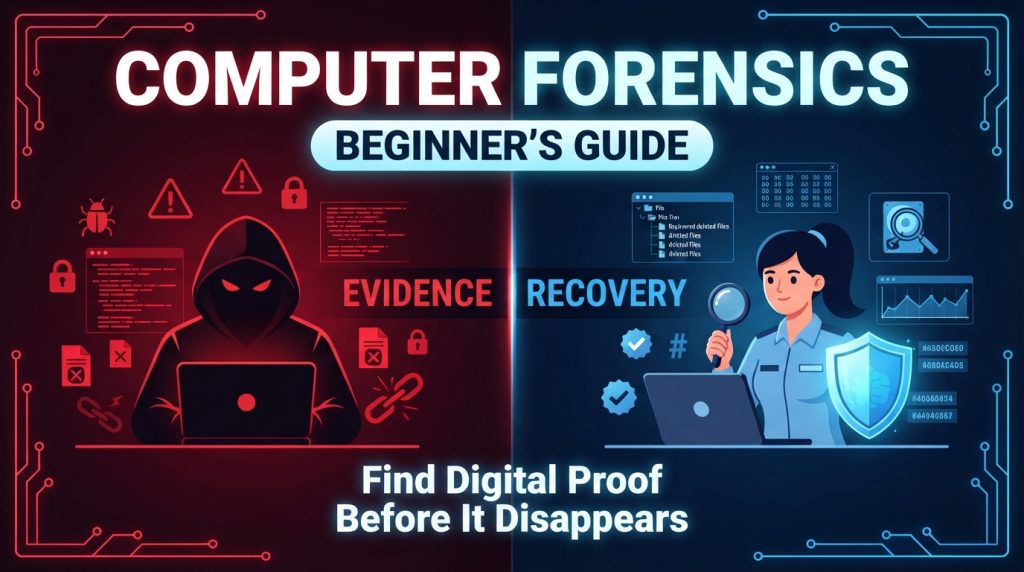
One deleted file. One entry in the browser cache. One timestamp within the Windows registry. They don’t mean much to most people, but for forensic investigators working on computers, these details can make all the difference when solving crimes, and they’ve been doing this longer than you think.
The truth is that computer forensics is no longer exclusive to police work. It’s everywhere: corporate boards, incident response centers, even your own home network. It’s important to know how it all works and where it’s going.
In this guide, you will learn everything you need to know about computer forensics. From the history to its present state to its future. There is a lot for everyone, whether you’re a beginner or an experienced security expert. Let’s get started.
What Computer Forensics Actually Is (And Isn’t)
Computer forensics is a science of the process of identification, preservation, analysis, and reporting of digital evidence in a legally defensible way. “Legally defensible” is precisely what makes forensics different from a casual hard drive investigation.
Finding evidence is not the only objective of computer forensics. What really matters is the ability to uncover and present evidence in court, in a disciplinary hearing, or at an incident post mortem.
The principle behind computer forensics can be described as follows: every digital action leaves evidence. Deleting files results in file data retention in unallocated space, editing files creates metadata that tracks who made changes and when, and plugging in a USB drive logs its serial number by Windows.
That is what computer forensics is about: collecting the evidence, interpreting it, and reporting on it.
Misconception: forensics is “hacking in reverse.” Not really. While ethical hacking (or penetration testing) seeks to uncover system vulnerabilities before the bad guys do, forensics tries to analyze what has already happened. Some technical knowledge is required for both activities, but the approaches are quite different.
A Short History: From Computer Hobbyists to a Science
It all did not just happen. The field developed gradually, with each phase defined by new technologies and a new legal environment.
The Ad Hoc Era (1970s–1980s)
The first case of computer crime took place in Florida in 1978. There were no standards, no specialized equipment, and no special training in the field. Usually, it was a computer hobbyist who was an investigator of computer crime at that time.
In other words, try to imagine yourself being a policeman in 1980. Someone gives you a floppy disk. What should you do? How do you handle it? Even how do you open it?
Michael Anderson, a special agent in the criminal investigation division, is considered a founder of the field due to the introduction of the first measures.
The Structured Era (1980s–1990s)
The FBI introduced the Magnetic Media Program that was renamed Computer Analysis and Response Team (CART) in 1984, while the Metropolitan Police of the UK set up a computer crime team.
Another significant development occurred in the early 1990s, when it became obvious to investigators that they required standardized methodologies, protocols, and procedures and not guidelines. A number of conferences held at the Police Staff College in Bramshill in 1994 and 1995 defined the current methodology of digital forensics in Britain.
In 1998, ACPO (Association of Chief Police Officers of the UK) issued the first version of the Good Practice Guide for Digital Evidence, which is still one of the fundamental guides in this field.
Finally, in the United States, the International Association of Computer Investigative Specialists (IACIS) was founded in 1988 to develop the first training program for Seized Computer Evidence Recovery Specialists (SCERS).
The Enterprise Era (2000s–Present)
That is where digital forensics evolved into science. The first meeting of the Digital Forensics Research Workshop (DFRWS) was conducted in 2001 by academia, military, and commercial participants. It was during this conference that the concept of “digital forensic science” was coined.
Various standards organizations such as SWGDE (Scientific Working Group on Digital Evidence) and ISO started issuing guidelines for the field, which now has standards for accreditation, tool validation, and methodologies.
Computer forensics has become a formal field of study and is now practiced in various applications, including criminal investigation and incident response.
The Core Principles: Why Evidence Must Be “Forensically Sound”
You cannot simply duplicate files and consider that as evidence. The data needs to be forensic data, which means the integrity of data and the process by which it was handled will be proven.
There are three important points:
- There will be no change to the original evidence. Forensic analysis should not be done on the original media. Instead, a forensic image of the media is made.
- Hashing. When an image is made, a hash function such as MD5 or SHA-256 will be run against it. Each single bit of difference will result in a different hash number. This hash value is calculated for the original as well as for the copied one.
- Chain of custody. All people who ever touched the evidence need to be recorded. Who collected it? When? How was it stored? Where were the transfers performed? Failure to establish the chain of custody may result in the evidence becoming inadmissible, even if the investigation was perfectly performed.
Example: while making the image of a suspect’s laptop, a hardware write blocker should be connected between the source drive and the forensic workstation. Using the FTK Imager application, an image is made and hashed.
The Investigative Workflow: From Seizure to Report
The forensics investigation is conducted following a systematic process. This may differ from one institution to another, although the fundamental stages remain the same.
Stage 1: Identification and Preservation
The first step is to understand what sort of evidence exists and its location. This can be a laptop, mobile phone, cloud account, network logs, or IoT devices.
It becomes important here to understand the order of volatility. The data stored in RAM, running processes, and network connections disappear when the device is switched off. Thus, volatile data comes before non-volatile storage.
Stage 2: Acquisition
Here, you will develop your forensic image. If the drive is physical, you need a write-blocker and an imaging tool. If the system is live, it becomes more complex because you may have to capture memory, processes running on the machine, and network conditions before shutting down the system.
There are different procedures for different situations. Onsite triage is used where the computer cannot leave the location or where volatile evidence needs to be captured instantly.
Stage 3: Analysis
Here comes the interesting part. Forensic analysis can be divided into several different fields:
File system analysis goes beyond visible files to analyze unallocated space and slack space, where most deleted files are usually found. Applications such as Autopsy analyze the file system, extract evidence, and create timelines.
Windows artifacts are an invaluable source of information. The registry stores information about installed software, connected USB devices, and activity of users. Event logs store system and security events. The USN journal stores information about changes in the file system even when the files have been deleted.
Memory forensics has become essential. Fileless malware never touches disk. Applications such as Volatility 3 analyze memory dumps to get information about running processes, malicious code injections, network connections, and credentials stored in memory only.
Network forensics reconstructs what happened during network activity. Wireshark is still the industry standard when analyzing packet captures and restoring command-and-control communication, lateral movement, and data exfiltration.
Stage 4: Reporting
the disk. A forensic report has one and only purpose, which is presenting findings in a clear and defendable manner. It means that another forensic examiner will be able to read your report and come to the same conclusion.
The defensible report contains the scope of research, methodology and version of tools used, findings and interpretation separately, a complete list of evidence with hash values, and limitations of the report.
Tools that Do the Job
The set of tools has changed greatly. Here are the must-haves.
Acquisition Tools
FTK Imager is the tool of choice for performing disk imaging. This software is free, reliable, and produces a hash value and verified images in E01 format, among others. Alternatively, there is dd under Linux for more precise handling of uncommon media and scripting possibilities. Which one to choose depends on the OS and the medium being imaged.
Analysis Software
Autopsy is the leading open-source software. It can deal with disk images, recover deleted files, extract artifacts, and create timelines. Other commercial analysis software includes EnCase, FTK, and X-Ways.
Tools for Memory and Network Analysis
Tools used to analyze memory include Volatility. Packet captures can be made using Wireshark, while NetworkMiner automatically extracts artifacts from the network.
Specialized Tools
WinHex is used for hex analysis; OSForensics is used for artifact extraction and password recovery. Tsurugi Linux is a Linux forensic distribution that includes the forensic tools in one bootable distribution. It is very clear that toolkits have become larger. In the past year, the average number of tools used in a single case has risen from 5.5 to 7.1. The main problem has been that of integration due to multiple output tools.
The Modern Challenges: Why Forensics Is Getting Harder
There are some challenges facing the field. There is more data being generated compared to the ability of investigators to process it. The attackers are becoming smarter. There are legal and ethical limitations being imposed.
Volume and Distribution
Digital evidence is not centralized anymore. It is located on laptops, mobile phones, and cloud storage. There could be many devices in a single investigation involving terabytes of data.
The traditional methods used for investigation on stand-alone systems and fixed networks fail in dealing with this situation. The information is decentralized, and there are many input points and volumes of data.
Encryption and Anti-Forensics
Encryption of an entire hard drive is now common practice. Modern malware employs fileless strategies, which never involve the disk. Wiping and time-stamp manipulation tactics are used by the intruders.
The honest report takes into account these issues instead of giving a misleading impression. Lack of evidence, documented correctly, may carry the same weight as your recovered evidence.
Mobile Devices
The mobile evidence is crucial, according to 61% of enterprise investigators who always or frequently use it. However, extraction becomes more difficult due to OS security features, encryption, privacy laws, and MDM constraints. Inadequate mobile data extraction is the number one problem for the third year in a row.
Advanced Corner: AI, Blockchain, and the Future
If you’re comfortable with the fundamentals, here’s where things get interesting.
AI and Machine Learning in Forensics
Currently, 68% of corporate investigators make use of AI within their investigation practice compared to 20% back in 2024. This is because AI can help process much larger amounts of information and classify evidence more accurately and faster than human analysts.
Machine learning methods are used for evidence classification, anomaly detection, malware analysis, and multimedia analysis. Data volumes have already surpassed the processing capability of human analysts in time, so now AI becomes a credible answer.
However, there’s a problem. Three structural challenges hinder development in the field: the lack of standard forensic datasets, poor reproducibility, and legal validation. AI algorithms should be explainable, reliable, and legally acceptable. Otherwise, black-box models have no practical value in forensics.
“Achieving AI-Enhanced Digital Forensics” focuses on human-centered, explainable, and legally defendable AI that complements rather than substitutes human expertise. Three key directions of development include AI-assisted triaging and artifact prioritization, explainable AI architectures for trustworthy decision-making, and LLM-enhanced forensic reporting.
Blockchain for Evidence Integrity
Blockchain technology provides a solution to one of the oldest problems in forensics, proving that the evidence was not tampered with.
By recording hash values and custody activities in an unchangeable and distributed ledger, investigators provide an untampered audit trail. Examples of use cases include forensic timestamping, tampering-proof logging, and smart contracts for access control automation.
The idea of Zero Trust Digital Forensics further advances this approach. One possible implementation of the idea is the proposed architectural approach known as ZTF-CSI (Zero Trust Forensics & Continuous Security Intelligence).
Large Language Models
LLMs provide completely novel types of digital evidence such as conversational transcripts, agent execution logs, tool invocation logs, and reasoning chains.
Each type of evidence is characterized by the combination of structured data and unstructured natural language, the need to understand conversational context, and the possibility of crossing multiple system boundaries. All of this is not what traditional forensics techniques were built for.
The problem: LLMs are stochastic. The same input results in different outputs. It violates the principle of reproducibility necessary for being admissible evidence. Also, LLMs hallucinate, creating information that may mislead an investigation if not verified.
Digital Twins and XR
New research in the field considers using digital twins to create virtual crime scenes and extended reality (XR) technology for creating immersive forensic training and virtual courtrooms. Such an approach may completely change how complicated cases can be visualized and evidence presented in court.
Practical Advice: How to Become Good at Computer Forensics
Proficiency comes in stages that can be predicted. Here’s a feasible roadmap.
Begin with Basics
Learn about file system structures (NTFS, FAT, ext4). Understand the Windows registry architecture. Gain proficiency with Linux and Windows command lines. Learn basic networking (TCP/IP, DNS, HTTP). One does not need to master something before using a tool. One only needs some knowledge so as to know what is happening.
Get Hands-On
Build a lab. This can be done completely using free software.
Create a virtual machine with a forensics-ready distribution such as Tsurugi Linux or SIFT Workstation. Both of these have analysis software already installed.
Perform imaging. Take an image of the contents of a USB drive with the help of FTK Imager. Validate the hash and mount the image and analyze it.
Experiment with datasets. Disk images can be practiced using the Digital Corpora project. The Digital Forensic Research Workshop has challenges to solve that have a known solution. Participate in the Tsurugi Linux training that includes labs and exercises for the entire forensics process from acquisition to reporting.
Learn the Standards
Review the ACPO Good Practice Guide. Get to know NIST SP 800-86 (Guide to Integrating Forensic Techniques into Incident Response) and ISO/IEC 27037 (Guidelines for Identification, Collection, Acquisition, and Preservation of Digital Evidence).
Knowing the standards is more than just theoretical knowledge. It’s the difference between an amateur and a professional whose findings are admissible in court.
Consider Certifications
The CHFI is an acronym for Computer Hacking Forensic Investigator. This course includes evidence collection, forensic examination, and presentation of evidence. The course is accredited by ANAB and approved by DoD. Other recognized courses include GCFA and EnCE. Certification is not an alternative to practical skills. However, certification indicates dedication.
Stay Current
The area is dynamic. Stay on top of DFRWS research. Check out the Journal of Digital Investigation. Join forums such as Forensic Focus and r/computerforensics. Follow DFIRs that share their experiences. The State of Enterprise DFIR Report 2026 by Magnet Forensics is a perfect example of an annual review of industry developments.
What to Do Next
Computer forensics is not only an area of expertise; it’s the ability to observe meticulously, document everything, and communicate clearly.
Should this have interested you, here is what you need to do:
This week: Install FTK Imager and Autopsy. Image a USB drive. Explore the image. Try and discover the artifacts there.
This month: Create a forensic Linux VM. Analyze a digital corpora dataset. Create a timeline based on the artifacts.
This quarter: Choose one specialization in memory forensics, mobile forensics, network forensics, or cloud forensics and learn deeply about it. Study the research papers and practice using the tools.
This year: Think about getting a certification. Build a portfolio of lab work. Make contributions to the community.
The field requires individuals who are knowledgeable not only of the technological aspect but also of its legal and ethical dimensions. The evidence will always be there. The problem is how to detect it, comprehend it, and document it clearly.
Be curious and keep documenting everything. Remember that the aim of computer forensics is not only to get at the truth but also to prove it.
Explore Our Cybersecurity Category. And if you are reading it up to here, leave a sweet comment to motivate us to write blog everyday.