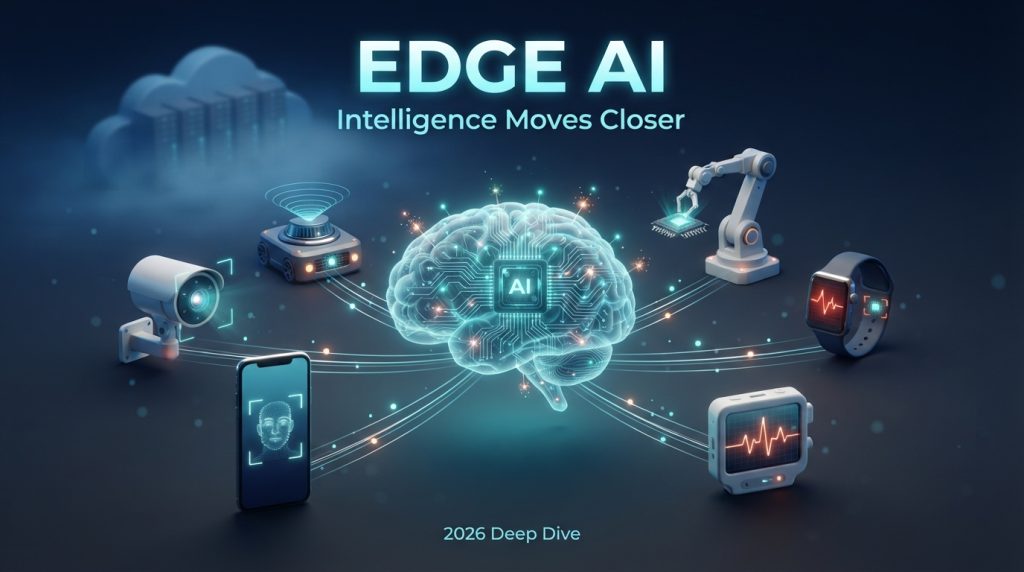
A car slams on its brakes 30 milliseconds before the driver sees the object. A factory robot detects a defect too small for the naked eye to see and rejects the product before the picture can leave the production line. A cardiac health monitoring device detects an arrhythmia in the patient’s heart and sends them an alert without sending a single bit of information to the server half-way around the world.
None of this is from the realm of science fiction. This is edge AI, the subtle but monumental revolution happening as we shift artificial intelligence from giant data centers to the machines and devices all around us.
What makes this moment particularly fascinating is that, over the last ten years, the story of AI has been one where “bigger was better.” Bigger networks. Bigger servers. Larger bills for cloud services. However, there has been a countermovement brewing, asking the simple question, “Why ship data halfway around the world when I can do all the computations here?”
This guide is my own effort to make sense of what Edge AI is all about, right from scratch, from its origin to the technologies driving it, applications of Edge AI, and even its future prospects. Nothing exaggerated, nothing too technical. Only what you need to know.
What Edge AI Actually Means (Without the Jargon)
Edge AI can be defined as executing AI models either within or very close to the device where the data is collected (phone, surveillance camera, machine sensor, or biomedical implant) rather than uploading the data to the cloud and analyzing it there.
The meaning of the word “edge” relates to the edge of the network, which is essentially the place where the digital world interacts with reality a smartphone in your pocket, a camera in a street, or even a robotic arm in a manufacturing setting.
An important differentiation to make is
- AI training, teaching an AI model how to recognize certain patterns, usually takes place in the cloud or data center because of the immense computational power available there.
- AI inference, the process of using this trained model to make predictions on new data, is the part that shifts to the edge.
Imagine it this way: the cloud is where AI is educated. Edge is where it works.
This is not about denying the potential of cloud computing. This is about acknowledging that not everything needs to go through a round-trip to a server farm. Real-time processing requires real-time decision-making. Confidential information cannot always travel beyond the device. And bandwidth is limited and comes at a cost.
Why Edge AI Matters Right Now
This is no coincidence. There are several reasons why Edge AI has become possible and necessary.
The latency has become critical. The cloud round trip latency, the delay for data to get to a server and back, usually ranges between 50 and 200 milliseconds, depending on network performance. While making an emergency decision about braking for a self-driving vehicle, it takes forever. Edge AI brings this time down to single-digit milliseconds.
Bandwidth is expensive and limited. One single 4K video camera produces up to 7 gigabytes of data per hour. Multiply this number by thousands of cameras for a smart city project, and you are looking at processing petabytes of information being transferred to the cloud each day. The bandwidth requirements can be decreased up to 60% by processing videos and transferring only metadata like “person detected” and “vehicle counted.”
Privacy laws come with consequences. In Europe, the GDPR law, the CCPA law in California, and many others create regulatory challenges in sending personal data internationally. Processing the data on-device avoids that issue, since the data is never shared outside the device.
Technologies have advanced to support on-device inference. Half a decade ago, it was still research to process a neural network on a mobile device. Now, specialized AI accelerators, NPUs, TPUs, and VPUs perform tens of tera operations per second using only single-digit wattage.
The industry is reacting to this change. The worldwide Edge AI market size was estimated to be around $24.91 billion in 2025** and is forecasted to reach **$118.7 billion by 2033, growing at a CAGR of 21.7%. This technology is not a novelty anymore.
A Brief History: How We Got Here
This transition to edge AI was not abrupt. Instead, it is a result of several evolutions in computing architectures.
The Cloud Era (2006-2015)
All services in the cloud era were centralized. Large companies such as Amazon, Google, and Microsoft constructed huge data centers, where the main idea was straightforward: push data up and receive results down. Everything worked perfectly for web applications, emails, and storage. However, AI applications also used the similar architecture training on cloud GPUs and making inferences on cloud APIs.
Content Delivery Networks: The First Step Toward the Edge
There existed CDNs before edge AI appeared. In the Content Delivery Network (Akamai, Cloudflare), static content images, videos, and scripts were cached closer to users’ servers. Although there was no computation relocation in CDNs, the main idea appeared: locality matters.
Fog Computing (2014–2018)
“Edge computing” was initially called “fog computing” by Cisco and referred to an attempt to expand cloud functionality to routers and switches. The concept was to establish a hierarchical architecture of computing: at the bottom edge devices, in the middle fog nodes, and cloud computing on the top.
Mobile Edge Computing (MEC)
The concept of mobile edge computing was developed by ETSI, which introduced a new approach placing computations even closer to cellular base stations and bringing them inside the radio range of mobile devices. Ultra-low latency application development became possible due to MEC technology, which later became essential for the 5G standard.
TinyML and the Edge AI Revolution (2019-Present)
The breakthrough happened when TinyML, i.e., the possibility to execute machine learning algorithms on a microcontroller with power consumption below a milliwatt, emerged. Coupled with special-purpose chips, produced by Google (Coral), NVIDIA (Jetson), and Qualcomm (Dragonwing) and other manufacturers, Edge AI moved from experimental projects to commercial products.
The release of systematic reviews of 141 Edge AI publications is a sign of the maturity of the field.
The Edge AI Stack: Hardware, Software, and Everything In Between
An understanding of Edge AI cannot be complete without consideration of the full stack, all the way down to the silicon that does the math to the frameworks that deliver the models. This section will get into technical details but will try to distill the essentials.
Hardware: The Silicon That Makes It Possible
Implementing AI at the edge requires specific hardware. GPPs (general purpose processors) are flexible and powerful but energy-inefficient and too slow for matrix math, which is needed for AI inference. Here’s an overview of the field:
NPUs (neural processing units) are designed specifically for AI inference. A popular example is Qualcomm’s Dragonwing IQ-8275 chip, which can offer up to 40 dense TOPS (tera operations per second) while remaining energy efficient enough. Such chips are used everywhere from smartphones to industrial gateways. Edge TPUs, like Google’s Coral Edge TPU, being the most famous, provide a combination of performance and energy efficiency for vision and sensor processing tasks.
GPUs (graphical processing units) remain relevant for edge deployments, especially NVIDIA’s Jetson platform. The Jetson Orin Nano 2 delivers up to 78 TOPS. IMC is the future. The Metis chip from Axelera AI computes directly in memory, thereby getting rid of the von Neumann bottleneck of normal architectures.
The importance of the performance gap can be seen in a study where different hardware platforms were compared in terms of their ability to execute YOLO object detection. The difference was huge; some chips offered high throughput but at the price of high power usage, while some focused on efficiency rather than speed.
AI Software Frameworks: Connecting Models and Hardware
Taking a trained model developed in PyTorch and making it efficient on edge devices isn’t as easy as one may think. Model import, quantization, and hardware optimizations all need tools to be done.
One such tool is the open-source framework Eclipse AIDE. It is designed to handle the entire chain: from the import of models in PyTorch and ONNX formats through the quantization and pruning stages and ending with code generation for diverse hardware architectures.
The other approach is Kubernetes AI Application Cores (KAN), which treats edge AI as a Kubernetes-native application and makes it possible to deploy AI models on edge device fleets with familiar container orchestration. There are several other software frameworks, including TensorFlow Lite, ONNX Runtime, and OpenVINO.
The message is simple: you don’t have to write kernels in CUDA yourself. Tools exist. However, you have to know the optimization strategies behind them, since the edge deployment is the trade-off game.
The Optimization Toolkit: Scaling Large Models to Smaller Devices
The problem at hand when it comes to Edge AI is that of scale: modern deep learning models are large, whereas edge devices have limited resources. Solving the problem entails optimization.
Quantization: The Most Powerful Approach
Quantization decreases the precision used for model weight and activation representation. Rather than using 32-bit floats (FP32), you will be representing them using 8-bit integers (INT8) or less.
The effect is noticeable: a study on deploying Edge AI revealed that quantization decreases energy use by a factor of 3 to 5 while preserving acceptable levels of accuracy . The memory requirements are cut down to one-quarter, and specialized hardware for INT8 computations becomes much faster.
Post-training Quantization (PTQ) uses this method after training is finished without having to repeat it. It’s faster and easier but somewhat less accurate than quantization-aware training.
Pruning: Eliminating Unnecessary Components
A neural network is usually over-parameterized. Pruning entails removing irrelevant weights or whole neurons from the model that have little impact on the output. A pruned model is more efficient, smaller, and equally accurate as before.
Knowledge Distillation: Making Small Models Act Like Big Ones
In knowledge distillation, a small student model is trained to behave like a big teacher model. The student is trained to reproduce teacher’s predictions and capture all its capabilities in a smaller package.
Trade-Offs Involvement Is An Inescapable Fact of Life
Here is the plain truth: all optimization procedures are associated with trade-offs. Quantization is always accompanied by accuracy reduction. Pruning may cause instability of the model. Edge AI is all about finding the right balance.
Where Are Edge AI Solutions Actually Used?
Applications aren’t theoretical; Edge AI solutions are implemented in areas where cloud-only solutions aren’t suitable because of latency, privacy, or network issues.
In Manufacturing and Automation
The factory floor may be where the most significant breakthroughs in Edge AI implementation happen. Vibrations are detected using onboard inference before machinery fails. Computer vision algorithms analyze products in real-time and spot defects that would be missed by human inspectors.
The economic sense is quite clear since unplanned downtime costs manufacturers $50 billion yearly. Using predictive maintenance and Edge AI can help to lower those costs significantly.
In Healthcare and Medical Devices
One of the most vivid examples of this solution being used comes from the spin-off company of DLR named Entrox Systems; their artificial heart has built-in Edge AI for calculating important parameters. It works without any cloud connection or latency because the patient’s life depends on immediate local computing .
Edge AI can be used in health monitors that analyze heart rhythms, falls detection, and movement patterns without uploading any private data to the cloud.
Autonomous Vehicles
An autonomous vehicle is basically an edge data center on wheels that processes the information collected from the car’s cameras, LIDAR, radars, and ultrasonic sensors in real-time, with decisions made in milliseconds that cannot be delayed for sending to a cloud and back.
It has been proven that in autonomous systems using Edge AI, application latency is reduced by more than 90% in smart city applications .
Smart City and Infrastructure
Edge AI-equipped traffic cameras can perform such functions as counting cars, detecting accidents, optimizing signals, and all this without sending the video to the central server. It means that no footage of any person leaves the camera, preserving privacy and reducing the costs of bandwidth .
Retail and Agriculture
Edge AI is used in retail for building a cashier-less store, inventory tracking, and customer analytics. Edge AI allows doing precision farming using drones and ground sensors that track the health of crops and optimize water use without relying on the cloud.
The Challenges No One Discusses Often Enough
Edge AI is not the silver bullet. There are multiple challenges that are yet to be solved or only partially solved.
There are resource limitations. Edge devices have limited storage capacity, computing power, and heat dissipation capabilities. Running a state-of-the-art language model on a microcontroller is something that will never happen. Models that run on the edge are specifically engineered or heavily optimized .
Security is more challenging on the edge. Cloud data centers have physical security measures in place, network segmentation, and security experts. Edge devices are usually deployed on premises, making them accessible physically and running security tools that consume resources becomes more challenging .
Fleet management is complicated. Deploying a model on one device is simple. Deploying new versions of the model on a fleet of diverse devices with varying hardware, operating system, and network conditions is still a challenge . Regulatory issues can become an issue. The EU AI Act and other similar regulations put certain restrictions on AI systems that might be challenging to meet on the edge devices.
Advanced Perspective: The Future Is Now
For those who wish to dig deeper than the basics, here’s what the future holds.
Federated Learning: Distributed Training
Federated learning turns the training process on its head by shifting the training process from centralized training to localized training. Local models train independently using data that they possess and transmit only model parameters updates and not data itself.
It maintains privacy and saves bandwidth while enabling ongoing learning. However, the process is complex due to the need to coordinate the learning process among a variety of disconnected devices.
Autonomous Edge Systems: Actions Not Predictions
Another development in the field is autonomous AI edge systems which will not only be able to perform predictions/classifications but will be able to act based on the situation on their own. A factory robot making an independent decision to stop the production process; a drone changing its flight trajectory depending on weather conditions. An energy grid that routes power supply on its own without human intervention.
Reasoning and planning are some of the skills necessary for these processes.
6G and Edge Convergence
6G technology which is slated to be rolled out in the early 2030s is being engineered with edge computing in mind from the very start. Ultra-reliable low latency communications (URLLC) coupled with distributed inference of AI will make possible such impossible-to-realize applications as collaborative robots and holographic telepresence.
Neuromorphic Computing
Imitating the functioning of a human brain, neuromorphic computer chips carry out computations in the form of spiking neural networks. Being incredibly energy efficient in certain computational jobs such as always-on sensing and anomaly detection, they can be the core of an emerging ultra-low-power edge platform.
Practical Takeaways: What This Means for You
If you’re a developer, a decision-maker, or just trying to understand the direction of technology development, here’s what you need to know.
If you’re developing an AI application: The implicit assumption that “everything goes to the cloud” doesn’t work anymore. Whenever latency, privacy, or connectivity become a factor, Edge AI needs to be considered. You’ll have to figure out which inferences can and should take place on the Edge.
If you’re assessing hardware: TOPS isn’t everything. Just like power efficiency, bandwidth of the interconnect bus, maturity of the software stack, and overall lifecycle of the system should be taken into account. A chip that provides 40 TOPS while dissipating 25 watts of energy might prove to be absolutely irrelevant for a battery-powered sensor.
If you care about privacy: Edge AI is your ally. Any inference that takes place on the Edge means one less round trip for the data that gets outside of your control. The more restrictions there are from regulators, the bigger edge you get on competition .
If you’re a developer learning this stuff: Begin with the toolkit for optimizations. Get quantization right. Know what model architectures there are which have been designed to be efficient. Explore tools such as TensorFlow Lite or Aidge. The need for engineers who understand this bridge will only grow from here.
Conclusion
Edge AI is nothing less than a paradigm shift in the design of intelligent systems. It was assumed for ages that more capable data centers and cloud servers would resolve all the issues. But Edge AI comes up and questions that view. Some challenges need solutions at the place of occurrence.
The technology is fully mature for deployment in production environment. The hardware is available. The software frameworks are in place. The market is expanding at a rapid rate. What is still lacking is the understanding required for adoption.
It is coming soon. The next time you unlock your device with facial recognition or your car detects a pedestrian or a plant saves a huge expense by avoiding a machinery malfunction, you would be using Edge AI. It is not the future but something present today.
The intelligence is coming nearer and nearer. You don’t have any choice regarding adopting Edge AI. Your organization would adopt it sooner or later. The only thing remaining for you is to understand it fully.
Explore Our AI Category. And if you are reading it up to here, leave a sweet comment to motivate us to write blog everyday.


