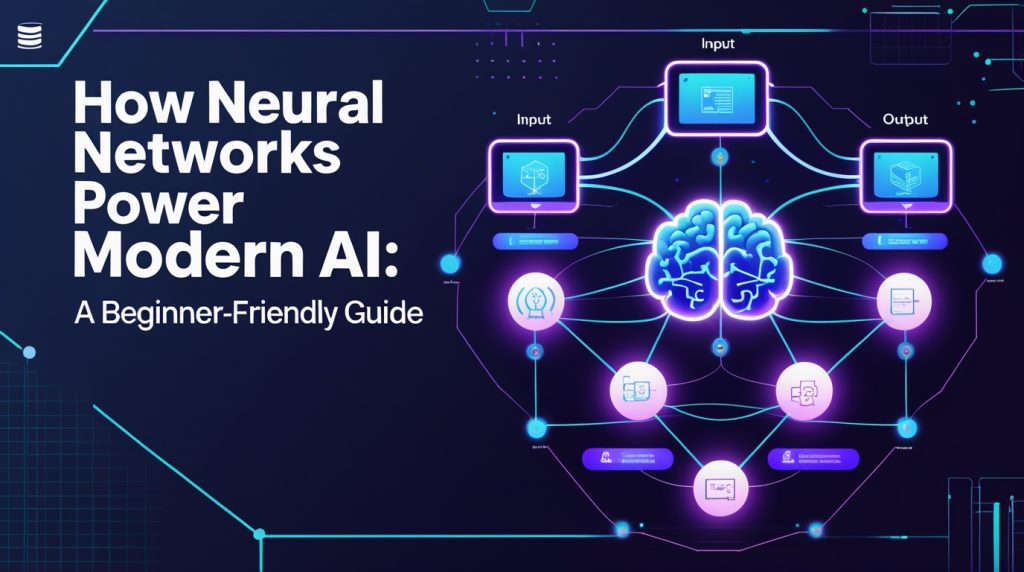
In today’s digital world, stuff like your phone knowing your face, real time translation, and even AI art is becoming normal. The heart of all this tech is something called an artificial neural network. But what exactly is this digital brain copy, and how does it actually do its job? It’s not just about code and data; it’s about building a new kind of smarts, piece by piece.
To get it, you have to forget how we usually program computers with strict rules. We don’t tell a neural network a cat has whiskers, pointy ears, and fur to make it recognize a cat. Instead, we show it tons of pictures of cats and tons of pictures of things that aren’t cats and let it figure out the rules itself. It’s less like building a machine and more like growing something, where patterns just show up out of nowhere.
It All Starts With a Little Guy: The Artificial Neuron
Every big project begins with one small part. For a neural network, that part is the perceptron, a basic but strong model of a brain cell from the 1950s.
Imagine a tiny decision maker. It gets a few input signals like numbers showing how dark pixels are in a picture. Each input comes with a weight. Think of the weight as how important that input is. The neuron multiplies each input by its weight, adds all these weighted inputs together, and then adds a bias which is kind of like a built-in tendency to react.
But it doesn’t just spit out the sum. It sends this total through an activation function. This is the neuron’s special ingredient, its unique filter. The simplest version is a step function: if the sum is above a certain point, the neuron fires a 1 (or a strong signal); if it’s below, it sends out a 0. Newer networks use smoother functions like the ReLU (Rectified Linear Unit), which just outputs the input if it’s positive, otherwise it’s zero. This non-linear part is super important; it lets the network handle complicated, real-world relationships that a simple straight line couldn’t.
So, one neuron makes one simple, weighted choice. It’s not smart on its own. But just like with people, strength comes from being connected.
Building the Web: From One Neuron to a Whole Network
A single neuron can only draw a straight line to separate two things. The real magic happens when we put these neurons in layers and link them up into a huge, complex web called a Multi-Layer Perceptron (MLP) or a deep neural network.
A normal network has three types of layers:
- The Input Layer: This is like the front desk. It doesn’t do much processing; it just takes in the raw info every pixel in a picture, every word in a sentence, every sensor reading.
- Hidden Layers: This is where the real work happens. Data goes from the input layer into the first hidden layer. Each neuron in this layer does its weighted sum, applies its activation, and sends its output to neurons in the next hidden layer. A network can have tons of these hidden layers (that’s why it’s deep learning). Each layer after the first builds on the last, seeing more and more complex things. For pictures, early layers might spot edges. The next layer puts edges together to find corners. Deeper layers might see parts like eyes or wheels. The final hidden layers recognize whole things: a face, a car, a cat.
- The Output Layer: This is the answer. It takes the highly processed signals from the last hidden layer and turns them into the answer we need. For sorting things, this might be probabilities: [Cat: 95%, Dog: 4%, Hamster: 1%]. For guessing a number, it might give a single value, like a house price.
This setup is super clever. It turns raw, meaningless data (pixel values) into more and more meaningful stuff, until you get something a human can understand.
The Learning Dance: How Neural Networks Figure Things Out
Here’s the coolest and weirdest part: how they start and how they learn.
When a neural network is first made, its weights and biases are just tiny random numbers. It’s pretty much a clueless genius right then. If you show it a picture of a cat, its random connections will just give you nonsense.
So how does it learn? Through a constant, automatic process of trial and error called training, guided by something called gradient descent.
- The Forward Pass: The network makes a guess. Data flows from input to output, just like we talked about.
- The Loss Function: How Wrong Was It?. We know the right answer (like cat). We compare the network’s wrong guess to this right answer using a loss function. This is a single number that tells us: How wrong was the network this time? A common one for sorting is cross entropy loss, which punishes confident but wrong answers a lot.
- Backpropagation: The Learning Engine. This is the main event. The loss score kicks things off. Backpropagation is the method that takes this error and sends it backwards through the whole network, from the output to the input, to figure out the gradient.
What’s a gradient? Imagine a huge, bumpy landscape made of all the network’s weights (each weight is a direction, and the height is the error). The gradient is like a pointer showing the direction where the error goes up the most. Our goal is to go downhill, to the lowest error. So, we need to move in the opposite direction of that pointer. - The Optimization Step: A special tool (optimizer like Adam or SGD – Stochastic Gradient Descent) then takes over. Using the gradients from backpropagation, it updates every single weight and bias in the network with a simple rule:
New Weight = Old Weight (Learning Rate * Gradient).
The learning rate is a super important setting a small number (like 0.001) that decides how big a step we take downhill. Too big, and you miss the bottom. Too small, and it learns super slowly.
This cycle guessing, checking error, sending error back, updating weights happens tens of thousands, even millions of times, with massive amounts of data. Think of the network as someone lost on a dark, foggy mountain (the error landscape), feeling for the slope with each step (the gradient), and slowly shuffling downwards. It never sees the whole map; it just feels its way to the bottom, one example at a time.
The Right Tools: Different Setups for Different Jobs
The basic network we talked about is useful, but the big breakthroughs came from making special setups that fit the kind of data they handle.
- Convolutional Neural Networks (CNNs): The Eye Experts. Inspired by how animals see, CNNs are why computers can now see. They use a smart trick called a convolution. Instead of connecting every neuron to every pixel (which is a huge waste), a CNN uses small, learnable filters that slide across the image. Each filter learns to spot a certain local thing like a vertical edge. Pooling layers then shrink the data, so it doesn’t matter exactly where that thing was spotted. This local connection and building up features make CNNs super good and fast for pictures, videos, and any data arranged in a grid.
- Recurrent Neural Networks (RNNs) & LSTMs: The Memory Keepers. Language, speech, and data over time have a key thing: order and how things depend on each other. An RNN has a memory in its internal state that it carries forward, letting it use info from earlier words or times to understand the current one. But normal RNNs had trouble remembering things for a long time. The Long Short Term Memory (LSTM) unit, a more complex RNN cell with special gates to control what it remembers and forgets, mostly fixed this and led to big wins in translation and speech recognition.
- The Transformer: The New Boss. The latest big change comes from the Transformer setup, which powers models like GPT and BERT. It gets rid of the continuous memory thing. Instead, it uses something called attention specifically, self-attention. In one clever move, it lets every part of a sequence (like every word in a sentence) directly see how important every other part is, no matter how far apart they are. This attention map helps the model understand everything at once. With a lot of data, this setup has led to huge language models that can create and understand text incredibly well, almost like a human.
The Tricky Bits, Problems, and Why It’s Not Magic
Even with all their power, neural networks aren’t all-knowing. They’re very advanced pattern-matching machines with some big limits.
- They Need Lots of Data: They need huge amounts of labeled training data. How smart they seem directly comes from the data they learn from, including any biases in that data.
- The Black Box Problem: It’s super hard for humans to understand what’s happening inside the deep hidden layers. We can see a network is correct, but figuring out why it made a certain choice is a big research area called Explainable AI (XAI).
- Overfitting & Generalization: A network can just memorize the training data instead of learning general rules this is called overfitting. It will work perfectly on the data it trained on, but completely fail on new stuff it hasn’t seen. Tricks like dropout (randomly turning off neurons during training) and regularization (making big weights less desirable) are used to make the network learn more solid, general rules.
- Costly to Run: Training the best models needs a ton of computing power, usually from many special computer chips, which brings up worries about energy use and who can even access it.
Conclusion
So, how does a neural network work? It’s not just one thing, but a whole bunch of connected ideas working together.
It starts with a simple neuron that you can adjust. These neurons are put into deep layers that turn data from raw info into more abstract concepts. Through the never ending dance of sending info forward and sending errors backward guided by how much it’s wrong the network fine tunes millions of connections. It does this not by being told rules, but by sensing its own mistakes. Special setups like CNNs and Transformers help it understand visuals and language better.
The result is a machine that doesn’t just calculate answers in the old fashioned way but figures them out, building a web of statistics so dense and complex that it looks like the real world. It shows how powerful the idea is: that intelligence, or something very much like it, can come from carefully arranging simple, adjustable parts, if you have enough data and enough patience.
It’s not how our brain works, but it’s a new and important way of computing one that is quietly changing what’s possible.
Explore Our AI Category

