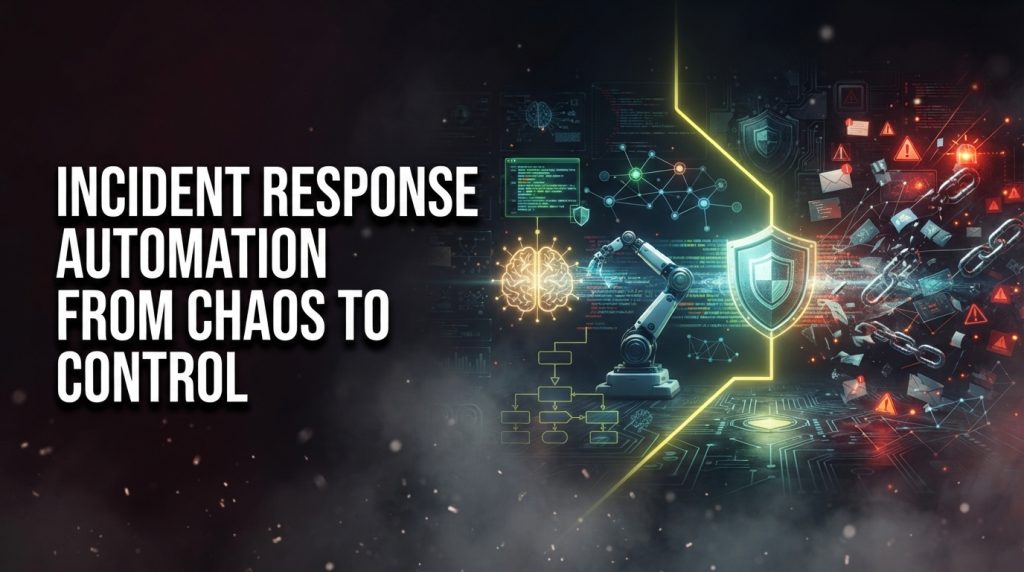
Let’s start off with a confession. Getting paged at 3 AM because some incident has happened is not a pleasant experience. After that, you have to spend half an hour switching between various dashboards, commands, and older Slack threads to understand whether there has been a similar situation in the past. The website is down, stress levels are through the roof, and there is just a wish for someone or something to tell you what’s going on.
That “someone or something” is exactly the essence of incident response automation. It is definitely not about automating human engineering work. Quite the opposite, it is about empowering people.
I have many years of experience in the trenches of security operations and Site Reliability Engineering teams, and one thing is absolutely certain. Modern day systems produce way too much information for humans to deal with. That requires a paradigm shift, so let’s figure out how it is done.
What Actually Is Incident Response Automation?
At the heart of automation of incident response is the use of software for handling routine processes associated with responding to the incident. The human factor is taken out of the equation as far as manual triage of each individual alert is concerned.
It might be best described as a continuum:
- Manual: Every single alert is manually checked, investigated, and then acted upon.
- Automated: AI clusters the alerts, reduces the noise, and carries out the triage. In some cases, it might even solve the problem without having to notify anyone.
There is one major challenge facing many companies: the volume of alerts keeps increasing by as much as 70% each year.
The Key Components of an Automated System
An automatic incident response system requires a handful of components to operate.
1. Consolidation of data and SIEMs
If you want to have any automation of incident responses, then you will first need to have information on hand. That means you should use a Security Information and Event Management (SIEM) solution or some kind of data platform that will collect all logs and events from your system servers, applications, network devices, and clouds and normalize them.
2. AIOps and Alert Noise Reduction
What drains people the most from both their enthusiasm and productivity? It is the phenomenon called alert fatigue that takes place when people receive hundreds of alerts a day. AIOps (Artificial Intelligence for IT Operations) leverages machine learning algorithms to group similar alerts and events and filter out noise. Some systems have the ability to filter out up to 91% of alert noise.
3. Orchestration and Runbooks
Here the rubber hits the road. A runbook, as its name suggests, is basically a sequence of steps on how to proceed during certain types of incidents. Historically, they were static documentation available in a wiki or Confluence page nobody referred to under stress.
In contrast, automated runbooks make those steps into actionable events. For instance, a runbook can say, “In case of an outage of a crucial API, restart a Kubernetes pod and notify Slack about it.” In such a case, instead of manually following each step, a process orchestrator will perform them itself. And now for something completely different. Be sure to check your runbooks on a staging environment before letting them work in production!
4. SOAR (Security Orchestration, Automation, and Response)
SOAR solutions move one step ahead with all of these three elements integrated within one solution, usually offering capability to integrate with over a hundred other security solutions as well. It is specifically designed for the intricate workflow in a Security Operations Center (SOC).
The New Frontier: AI and Agentic Incident Response
It is developing rapidly, and the next evolution step of the process relates to the usage of AI agents. It is a significant step up from basic automation.
What Is an AI Agent?
Basic automation is rule-based. You specify some conditions: “If X happened, then do Y.” An AI agent is different because it can apply LLMs to find the context of an incident, analyze it, and take any actions.
Picture yourself an AI SRE that doesn’t just restart a pod but finds out why the pod stopped in the first place. The agent will analyze logs and recent deployments, look at previous incidents, and provide a structured Root Cause Analysis (RCA) report before you finish your morning coffee.
How It Happens
With an incoming alert, an AI solution such as Aurora or Triagix triggers a squad of specific agents:
- The triage agent identifies the severity and type of the incident.
- The Root Cause Agent explores the problem within the entire infrastructure by using the kubectl command, checking logs and deployments.
- The remediation agent provides suggestions for the resolution of the problem and, in some cases, generates a pull request for the implementation of changes.
- The comms agent prepares a summary or post-mortem report for the team.
Some solutions have memory. SentinelAI, for instance, has the capability to memorize past incidents; therefore, if there is a connection pool error, it can identify that the same incident occurred three weeks ago and how it was resolved. That shifts us from the reactive position to proactive defense.
The Black Box Problem of Building Trust
One problem that exists with AI is that it is a “black box.” If the AI system advises the isolation of a server, it should explain its rationale. There must be a chain of reasoning.
This is one reason why most companies initially assign the role of “advisor” to AI agents. They can advise on what to do, but a human has to take the decision. Once trust is established, low-risk reversible tasks can be automated.
A Blueprint for Taking the First Step
Incident response automation requires a process, not a single effort. Follow these steps to ensure success:
Phase 1: Identify Your Objectives and KPIs
What issue do you want to address? Backlog of triages? Mismatched documentation? Handoff issues? It is important to define what success means to you.
Phase 2: Centralize your data sources
It is critical to have reliable data sources. Bring all your SIEM, endpoint information, identity information, cloud logging, and ticketing data into one place.
Phase 3: Get Going with Easy Wins
It doesn’t make sense to start automating everything. Begin with activities that are low-risk and eliminate toil without impacting your service delivery. Examples of such activities are
- Enrichment: Automatic gathering of threat intelligence about the suspicious IP.
- Incident Creation: Automatically generating an incident ticket in your ticketing tool.
- Alert Deduplication: Bundling similar alerts together in an incident.
- Evidence Gathering: Automatically gathering evidence in the form of logs and state of systems.
Phase 4: Create and Test Playbooks
Translate your proven manual procedures into workflows. Test the workflows extensively with actual stakeholders, not alone. The playbook is your production code; treat it accordingly.
Phase 5: Scaling and Optimization
Once you get your initial workflows working, increase your automation. Implement approval controls for more disruptive actions like taking down an essential system. Always be refining your rules and playbooks.
Conclusion
The concept of incident response automation lies in empowering your staff and alleviating the burdens of rotating on call shifts. The system can perform mundane tasks, which will release valuable mental power of your employees to make those complicated judgments that cannot be performed by any program.
The main principle here is pragmatism. Do not aim for the maximum number of automatic responses. It is much better to have an accurate set of workflows that you and your staff rely upon. Learn More
Explore Our Cybersecurity Category. And if you are reading it up to here, leave a sweet comment to motivate us to write blog everyday.