It’s yet another research paper, statistics guide, or blog article on some study that you come across. You can’t miss the words “independent variable” and “dependent variable” popping up everywhere. You nod your head in agreement. Sort of know what that means. But, if asked, you wouldn’t be able to point out these two elements in a case study.
It has nothing to do with the difficulty in comprehending those concepts. The issue lies in the fact that the definitions are thrown at you before you even get why they are needed. The purpose of this article is to solve this dilemma. We will begin with the actual problem of determining cause-and-effect relationships in order to show how these terms can help you achieve that. This is the goal of this article.
Why Do We Need These Terms at All?
Take any question you are actually interested in. For example, “Will more studying affect my grades?” “Will this drug help alleviate my headaches?” “Is social media usage making me depressed?” In all cases, we are talking about the problem of cause-and-effect relations. There is some factor that is believed to affect some other one: studying and grades, medication and headaches, and social media and your mood.
However, our life is very complicated. At any moment, a great number of things change, and the connection between two factors is far from being obvious. If your grades improved, does this mean it happened because of the increase in study time? Perhaps you slept better this week, or the test was simpler than the others? Scientists use the terms “independent variable” and “dependent variable” to classify this chaos.
The Core Idea
This is probably the easiest way to define this:
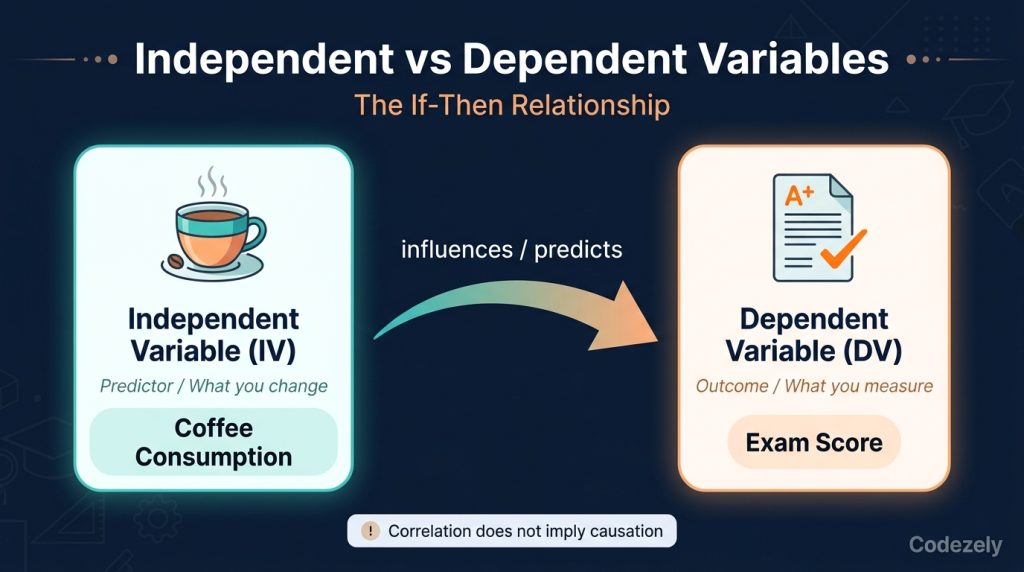
- The independent variable is what is changed, manipulated, or studied to see how it affects another variable. In an experiment, it usually represents the “if” part of the “if-then” statements.
- The dependent variable is the one that is being measured or observed. It represents the “then” part.
That’s all. The DV depends on the IV. The IV is independent because it is the input.
And here’s how textbooks usually put it: The variable that we need to predict is called the response or dependent variable. The variable that is used to predict the response variable is called the explanatory or independent variable. “The response variable is ‘dependent because it depends on other variables,’ and the explanatory variable is ‘independent because it does not depend on other variables.'”
A Simple Example You Can Actually Picture
For instance, let’s say I want to test whether drinking coffee before an exam helps increase my test score.
- Independent variable: Student drinks coffee (or doesn’t drink coffee) or how many cups of coffee a student drinks.
- Dependent variable: The test score.
A good experiment will have me assign randomly to a group that drinks coffee and one that drinks decaf (or no coffee at all). Coffee will be the independent variable because I control it, and the score will be the dependent variable because this is the value that I’m measuring to see if there’s any effect of coffee on it.
As per the UCLA statistics department, the simple definition is: “If I lose weight (independent variable), then I feel better (dependent variable).” The if-then logic is key here.
The Synonyms (And Why They Matter)
Each academic field uses its own terminology for the same concepts. It causes confusion for novice researchers all the time.
For the independent variable:
- Predictor variable
- Explanatory variable
- X variable
- Manipulated variable (in experiments)
- Treatment or intervention (in clinical trials)
- Factor or feature (in machine learning)
For the dependent variable:
- Outcome variable
- Response variable
- Y variable
- Measured variable
- Criterion variable
One of the most cited definitions goes like this: “The independent variables can be predictors, antecedents, or presumed causes or influences that are the subject of investigation. Differences in the independent variable are supposed to affect, predict, or explain differences in the dependent or outcome variable.”
Thus, when you read “features” and “target” in a machine learning guide, it is equivalent to the IV and DV. When you read about “treatment” and “outcome” in a medical research paper, it is still the same.
The Crucial Distinction: Experiments vs. Observational Studies
It is in this respect that most novice definitions fail. They state that “the IV is manipulated, and the DV is measured” and give no further details. However, this definition fits best for experimental designs.
In experimental research, the manipulation is carried out by the researcher on the IV. For instance, the researcher might manipulate the participants into drinking coffee or any other similar decaffeinated drink. This would enable the researcher to make more definite conclusions regarding causation, especially if the design of the experiment is well-structured and participants are randomly selected.
In the observational research, the participants are not assigned different exposures. The researcher simply observes/measures different variables. Thus, for instance, in the study that surveys individuals regarding their coffee drinking habits and their examination performance, the researchers could treat the amount of coffee consumed as an independent variable and examination performance as a dependent variable, although the researchers did not manipulate anybody to consume the coffee.
According to the HHS Office of Research Integrity, experiments involve manipulating the independent variable, while descriptive research involves observing variables in their natural state and studying the relationship between them. This is important because when you see “IV” and “DV” in an observational study, you shouldn’t think that there is a cause-and-effect relationship here. These terms simply refer to the role played by these variables in the research question or analysis.
How to Identify IV and DV in Any Study
While analyzing studies and even designing one yourself, ask yourself these questions:
- What is the research question usually formulated as? “Does X influence Y?” or “What influences Y?”
- What is manipulated or the basis of the research? It’s your IV.
- What is the result/outcome of interest? It’s your DV.
- Test with an if-then statement: Say your hypothesis aloud: “If [IV], then [DV]. ” Sounds good? Then, you’ve found it!
Let’s practice by analyzing some examples from the HHS module:
- Example: Does Mozart’s music influence reading comprehension skills of children?
- IV: Exposure to Mozart’s music (some children were exposed to Mozart’s music, and some weren’t).
- DV: Score on a reading comprehension test (measured).
It is taken directly from a documented case example: “The reading comprehension test score is the dependent variable, and exposure to Mozart’s music is the independent variable. This is because the test score is dependent on whether or not the child listens to Mozart’s music.”
The Misconception That Trips Everyone Up: Correlation ≠ Causation
It is important to note that simply because two variables tend to correlate, one does not cause the other. This is one of the most important concepts to grasp about independent and dependent variables. As a matter of general principle, correlation represents an association between variables, but association does not necessarily imply causality.
Take this famous example into consideration. During summer, ice cream sales and drowning deaths increase. Does eating ice cream cause drowning? Obviously, not. Hot weather may be a potential confounding variable since it contributes to both higher sales of ice creams and more swimming.
In observational research, the IV-DV dichotomy reflects the researcher’s hypothesis about the relationship between variables but does not imply causality. Good experiments, particularly randomized experiments, can establish causation. Observational and quasi-experimental research can shed light on causal relationships, but it is important to consider all confounding variables and alternative explanations.
Control Variables: The Hidden Ingredient
In addition to having an IV and DV, good experiments will attempt to control for other factors that could possibly influence the findings. These are referred to as control variables and are the other factors that researchers hold constant or account for in order to better be able to see how the independent variable and dependent variable are related.
For example, if I were trying to see whether drinking coffee improves test scores on exams, I would want all students to take the same exam on the same material. I would also look at how much sleep they got. Since some students may have gotten only 3 hours of sleep, whereas others might have gotten 8 hours, it might influence test scores and interfere with my ability to see the effect of coffee.
The One Thing That Surprises Most Beginners
Independent and dependent variables are terms for describing the function of the variable within a particular research project rather than a property of the variable itself. A variable may act as an IV in one research but as a DV in another research. For instance, “stress” may act as the DV in research examining the impact of sleeplessness on stress, while in another study, the stress may be considered IV, examining its effects on academic achievement.
These points have been clearly stated in the Springer chapter, “It is the placement of the variables in the research hypotheses (based on theory) that will determine what kind of variable. In other words, if we assume that there will be a positive effect of inclusion training on team-level belonging, but the research findings disprove it, then the inclusion intervention remains the IV and team-level belonging is the DV.”
Thus, even if your research hypothesis is proved wrong, the labeling will remain the same.
Putting It All Together: A Practical Checklist
In all cases, when you come across any study, paper, or data set:
- First, find out what is the research question?
- Second, determine what is taken as the input/predictor that is your IV.
- Third, find out what is taken as the output/dependent variable that is your DV.
- Determine whether your IV was manipulated or only observed?
- Be extra cautious with causal language if it was only observed.
- Look out for control variables that make your study more robust.
That’s your entire toolkit. No need to remember definitions, but ask the right questions.
Resources to Study More
- HHS Office of Research Integrity Module 3 Elements of Research: https://ori.hhs.gov/module-3-elements-research-section-1
- Springer Measurement and Sampling (open access chapter): https://rd.springer.com/chapter/10.1007/978-3-031-28674-2_5
- Oxford Academic Common mistakes in biostatistics: https://academic.oup.com/ckj/article/17/7/sfae197/7699866
- Taylor & Francis Types of variables: https://www.taylorfrancis.com/chapters/mono/10.1201/9781032692388-5/
You can learn more about Independent and Dependent Variables from the above sources.
Quick FAQ
1. Is there more than one independent variable?
Yes. There are many cases where a researcher may use several IVs in a study. One such case may include measuring a number of factors in relation to test scores, such as hours of study, hours of sleep and hours spent drinking coffee.
2. Is there more than one dependent variable?
Yes. A researcher may use more than one DV in a single study. An example would be a study that measures both test scores and stress levels as DVs.
3. What if I cannot decide which variable is which?
Check the hypothesis and you will find out. The one being predicted or explained is the DV. The one doing predicting or explaining is the IV. Use the if-then test!
4. Is the dependent variable always measured after the independent variable?
In an experiment yes. Both may be measured simultaneously in observational research.
5. What is the difference between a control variable and a control group?
Control variable is a constant (room temperature, etc.) Control group is a group of participants that do not undergo treatment.
Conclusion
Independent and dependent variables are simply labels attached to each side of the causal question being asked. The independent variable is where you begin. It is the potential cause or predictor under test. The dependent variable is what is measured to see whether there was any change.
The labels do not prove causation themselves. An experiment is needed to establish causation through appropriate controls. However, learning how to identify the independent and dependent variable is the first step in understanding any study, and designing your own. Start with the if-then formulation. Use it whenever you encounter something quantitative. It will soon become second nature to you.
Explore Our Programming Category. And if you are reading it up to here, leave a sweet comment to motivate us to write blog everyday.