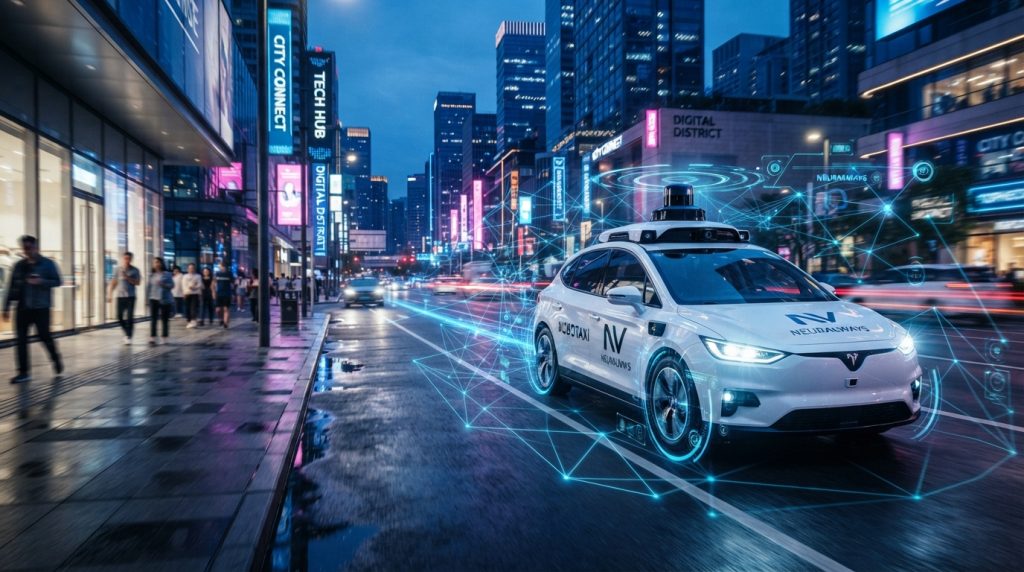
A quick question for you: when you think of self-driving cars, what companies come to mind? Is it Tesla? Waymo? Perhaps Uber? My guess is that “Pony.ai” is not the answer you would choose.
But this is precisely why I wanted to write this article. While everyone was debating Tesla’s Full Self-Driving capabilities on Twitter, an unknown company has been accumulating millions of kilometers in its autonomous fleet, making deals with Toyota and Uber, and launching in different countries.
It does not have Elon Musk as a brand spokesperson. It is not promoted by Google’s PR machine. Yet it is most certainly part of the race. And according to some, it is even winning some segments of it. I am going to explain to you who Pony.ai is, what its technology is, and why it is important regardless of whether you will ever ride in its robotaxi.
What Exactly Is Pony AI?
Pony.ai is an autonomous driving company from China that was established in 2016. The company has its headquarters in Guangzhou and works in two major spheres: robotaxis (self-driving ride-hailing service) and robotrucks (self-driving freight truck).
Pony.ai went public at Nasdaq in November 2024 under the ticker symbol PONY, which was called “the world’s first robotaxi stock.” Almost one year later, the company completed a dual primary listing on the Hong Kong Stock Exchange with the fundraising amount of about $829 million. This is important since Pony.ai is now able to access capital from the U.S. and Asia, which only a few autonomous driving companies can boast about.
What really piqued my interest, though, is this: Pony.ai is among the few companies in the world that have received permits from regulators for running robotaxis without any drivers at all in all four of China’s tier-one cities, Beijing, Shanghai, Guangzhou, and Shenzhen. It is not easy. Every single city has its own set of regulations, its own criteria for testing and safety norms. Getting the permit in one city is difficult. Getting it in four? Well, that shows something.
How Does the Technology Actually Work?
Alright, let’s get into the stuff that actually matters.
The Virtual Driver Idea
The backbone of Pony.ai is something they refer to as the Virtual Driver. You can think of this as a holistic software solution, which substitutes for the human driver not only the function that controls the steering wheel but also the one that perceives its surroundings, anticipates other people’s moves, and comes up with a decision during complex situations.
What you should know about the difficulties of autonomous driving: It’s not difficult to recognize a traffic sign. What’s difficult is recognizing a partially covered traffic sign under rain, while a cyclist tries to move to your lane and a pedestrian jaywalks ahead. That’s the real difficulty the virtual driver is aimed at coping with.
That’s how it works layer-by-layer:
- Perception: The sensor suite gathers information from cameras, LiDAR, and radar sensors. It then constructs a 360-degree understanding of the environment surrounding the car.
- Prediction: It forecasts the behavior of other road participants, including cars, pedestrians, and bicycles.
- Planning: It determines what the car should do (accelerate, brake, lane changing, yielding, etc.)
- Control: It actually tells the car what to do by issuing instructions to the car’s controls.
This happens within milliseconds. Literally every millisecond. Non-stop. For hours at a time.
Hardware: Gen-7 and Beyond
Right now, Pony.ai’s autonomous driving kit (ADK) is on its seventh generation, or Gen-7. It’s the hardware stack comprising the sensors, computing units, and everything else. The important thing about the Gen-7 kit is the following it costs 70% less to manufacture compared to the previous generation. Yes, you’ve heard that right. That is, their bill of materials cost dropped by 2/3.
Why? Essentially, due to two factors:
- Automotive-grade parts. Rather than employing expensive, specially made sensors, they have opted for mass-produced automotive parts used in regular vehicles. Gen-7 is the first of its kind to use 100 percent automotive-grade parts. This means that the same chips and sensors that can be found in a Toyota Camry can also be used in the robotaxi.
- Solid-state LiDAR. Traditional LiDAR systems are rotating mechanical devices that cost thousands of dollars. Solid-state LiDAR systems are free from moving parts and are less expensive to produce. Pony.ai managed to slash the price of its solid-state LiDAR system by 68 percent from the previous generation.
The Gen-7 ADK comes with nine LiDARs, three millimeter-wave radars, and 13 cameras, ensuring that the car has a full 360-degree field of view with no dead zones.
But they are still far from done. By 2027, Pony.ai hopes that the total cost of their robotaxi (including the base car as well as the ADK) will be under RMB 230,000 (equivalent to about $32,000). This is almost the price of a normal mid-tier car. Once a self-driving car is as affordable as any other car, the game changes.
PonyWorld 2.0: The Secret Sauce
Here comes the interesting part. Pony.ai just released PonyWorld 2.0. The company calls it a “self-improving physical AI engine.” In layman’s terms, that would mean:
Imagine a flight simulator for self-driving cars on steroids. Unlike the former, PonyWorld not only repeats scenarios that took place in real life but also creates new synthetic scenarios that are too dangerous and too infrequent to be tested in reality. A kid running across the street from behind parked cars. A truck losing its cargo on the highway. Pedestrian stepping down from a curb at night.
All of those simulations are used by the Virtual Driver as training data. And there is another cool thing about the system—it is closed-loop. The virtual driver takes a decision, the system evaluates it, and then it learns from it. So, no need to drive for millions of miles to cover all the edge cases.
According to the CTO of Pony.ai, the deployment of robotaxi fleets in several countries or cities simultaneously through PonyWorld 2.0 does not require an equivalent amount of engineers. This is a great strategic edge for any firm. Normally, firms have to form a new team for each new city that they enter into. However, Pony.ai can scale up more effectively because of its virtual driver.
The Robotaxi Business: Where the Rubber Meets the Road
Let’s talk numbers, because this is where Pony.ai gets interesting.
Fleet Size and Revenue Generation
In the second quarter of 2026, Pony.ai achieved revenues worth $12.1 million, which represented 691% growth compared to that of the previous year. The fare-charging revenue, that is, actual payment for rides, increased by 849%. This is not a mistake but the reality. Almost nine times revenue growth from actual paying passengers.
The size of the fleet grew to 2,000 units in mid-2026 with the target of having 3,500 units by year-end. It is an ambitious plan, but it is done on a solid foundation. The number of registered users across China exceeds 1.5 million. On average, a single robotaxi in Shenzhen completed 23 paid orders a day. To give you some context, an ordinary human-driven taxi cab completes 15-20 orders in one day in a Chinese city.
The Breakeven Milestone
One thing that isn’t talked about enough is that Pony.ai achieved city-wide breakeven in Guangzhou in November 2025 and Shenzhen in February 2026. Here, “breakeven” means that in these two cities, the revenue earned from robotaxi service is enough to cover the operational costs. That’s not R&D costs. They’re a totally separate matter.
It’s an important milestone because it shows that the economics do work. Saying that self-driving cars will be more affordable in the future is one thing. But showing it actually works in a city is quite another.
The “Asset-Light” Approach
One of the most intelligent moves Pony.ai is making is the joint deployment approach. Rather than investing in all the vehicles and running them themselves, they collaborate with local players.
How does this work?
- Pony.ai contributes the Gen-7 vehicles and the self-driving technology.
- The mobility provider (for example, Uber) contributes to ridership, the demand for hailing a ride.
- The local operator contributes to vehicle maintenance, charging, and other daily tasks.
As Pony.ai’s CFO noted, “The company will earn either revenue sharing or technology licensing income over the course of a robotaxi’s operational lifetime.” At the moment, they book the revenue upfront when delivering the vehicles, but they anticipate recurring revenue sharing income down the road as the fleet scales up.
It’s the traditional software-as-a-service business model adapted for cars. It’s a capital-light business, it’s highly scalable, and it allows local partners to take care of the gritty details, while Pony.ai concentrates on technology.
Going Global: Uber, Toyota, and Beyond
Pony.ai isn’t just a Chinese company anymore. It’s actively expanding into Europe, the Middle East, and East Asia.
The Uber Partnership
Uber is the first major partnership of the company. Pony.ai will be rolling out more than 2,000 robotaxis in five different European cities through Uber. That is not a small number either. While Uber has been partnering with other companies specializing in autonomous vehicles like Waymo, May Mobility, Momenta, and WeRide, the agreement with Pony.ai is amongst the largest in terms of the number of vehicles involved.
The first rollout of the robots will be in the Middle East region.
Toyota and BZ4X
There is a strong collaboration between Pony.ai and Toyota. They jointly designed Gen-7 bZ4X Robotaxi, and this model has received an on-road testing permit in Guangzhou already. The goal is to put 1,000 units of the bZ4X robotaxis on the road in the major cities of China.
What matters here is that Toyota integrates Pony.ai’s technology during the manufacturing process rather than fitting it after manufacturing. This approach is more efficient and reliable.
Korea, Singapore, Croatia, Luxembourg
The list of international collaborations never stops expanding:
- Korea: Pony.ai is working together with FutureLink in order to launch 200 Level 4 robotaxis in Seoul by 2028. The tests have already covered 80,000 kilometers without any incidents occurring.
- Singapore: A robotaxi service can be obtained via the Zig ride-hailing app of ComfortDelGro.
- Croatia: A commercial operation is going on in Zagreb, and it acts as a benchmark for European collaborations.
- Luxembourg: Deployments with Bolt and Stellantis are in progress.
The declared aim of the firm is to work in over 20 cities worldwide by the end of 2026.
The Robotruck Business: The Boring Goldmine
Here’s the thing about self-driving trucks: they’re not as flashy as robotaxis, but the business case might be even stronger.
Why Road Freight?
One constant issue plaguing road freight transport is the shortage of drivers. The drivers are getting old, the working hours are difficult, and the pay may not be all that good. Long-distance driving entails driving at night, time pressure, and safety hazards due to driver fatigue. Autonomous trucks can solve this problem not by replacing all drivers at once, but by increasing capacity during specific times.
Gen-4 Robotruck
Development of robotrucks began in 2018 by Pony.ai. The most recent version, called Gen-4, has been developed in collaboration with GAC Commercial Vehicle and debuted at IAA Transportation in September 2026.
Some features are as follows:
- Nine LiDARs, three millimeter wave radars, and 13 cameras for 360-degree coverage
- Fully redundant steering system, braking system, communication system, power system, computer system, and sensor system
- Utilizes the GAC T9 battery-electric heavy truck platform
- 70% lower ADK bill-of-material cost from its previous generation
- 30% lower transport cost per ton-km
The design is meant to provide 20,000 hours of operation or up to 1 million km.
Scale Targets
Pony.ai plans to roll out 500 to 1,000 Gen-4 heavy-duty trucks over the next two to three years within three use cases in China: long-haul freight transportation, bulk transportation, and port logistics. The light-duty truck scale targets 100,000 units of L4 autonomous light-duty trucks by 2030. The light-duty truck, which is developed in collaboration with CATL, can be used for urban logistics and lowers cost per kilometer by 40-50%.
Up until November 2025, Pony.ai had successfully completed more than 1 billion ton-kilometers of freight transportation. This is not a demo but actual freight transportation through actual highways and generating real revenues.
How does Pony.ai stack up against the competition?
Here’s the truth: The autonomous driving industry is competitive. From Waymo to Tesla, from Baidu to Cruise, and WeRide, they all want to carve out a spot in the market.
Road to Autonomy Index
A new artificial intelligence-driven benchmark called the Road to Autonomy Index assesses robotaxi players in almost real time.
As of mid-2026, the rankings were
- Baidu Apollo Go (China)
- Waymo (U.S.)
- Pony.ai (China)
- WeRide (China)
- Tesla (U.S.)
Pony.ai ranks third on the global scale, just below Waymo and Baidu and above Tesla.
What Sets Pony.ai Apart
A few strengths, in my opinion:
- Cost structure. This is an impressive 70% cut in ADK cost that helps Pony.ai scale faster and be more profitable even when charging less.
- Dual market presence. The listing in both the U.S. and Hong Kong markets provides access to money not available to purely Chinese companies.
- Robotaxi and robotruck. Most of the competition focuses on one thing, either robotaxi or robotruck. While Pony.ai is engaged in both with the same Virtual Driver technology.
- Real data from actual operations. 65 million autonomous kilometers by 2026 provides more actual driving experience than many competitors.
Advanced Corner: The Technical Deep Dive
Now that you have reached this point and you want some hardcore technical details, here they are. Otherwise, you can just go straight to the key learnings at the end.
Sensor Fusion Architecture
The sensor fusion architecture employed by Pony.ai’s perception system involves the combination of camera, LiDAR, and radar data into a unified world model.
Why these three types of sensors? Because they all have different strengths and weaknesses:
- Cameras give good texture and color information that makes it easier to interpret signs and detect lane markings. However, cameras have difficulties functioning in poor lighting conditions and may be affected by glare.
- LiDAR gives very good depth information and is effective in identifying objects and calculating distances. However, LiDAR is expensive and may be interfered with by rain and fog.
- Radar gives velocity information and functions well even during poor weather. However, its resolution is poorer compared to those of the two above technologies.
Through combining the three of them, the system will be able to offset the limitations of using one of them individually. For instance, when the camera fails due to the bright sunlight, the LiDAR and the radar will continue to function well.
Redundant Systems
Gen-4 Robotruck incorporates redundant designs for all its six major systems: steering, braking, communication, energy source, computing, and sensing. How do we understand “redundant” here? We understand it as having a spare for each element. When the main system of steering stops working, a redundant one steps in. When the primary computer breaks down, a secondary one functions. This is how redundant systems work on commercial aviation airliners, where redundant systems are necessary to avoid any failure.
For a Level 4 vehicle that is a self-driving vehicle capable of operating without a human driver under certain conditions, redundancy is not an optional design feature. It is a legal requirement.
The Domain Controller
The Gen-4 Robotruck and Gen-7 Robotaxi share the same domain controller. This was a smart move on the part of Pony.ai because by doing so, it enables the company to reduce costs associated with development and streamline its supply chain.
The domain controller serves as the brain of the car, the one that executes the virtual driver. Because of this common architecture, Pony.ai can make simultaneous updates for both robotaxis and robotrucks.
Considerations of Safety and Ethics
First of all, I would like to make one thing clear: autonomous driving systems have a great deal of responsibility. An error made by a driverless vehicle is not just a problem; it could be deadly.
All responsible autonomous driving companies such as Pony.ai consider the following aspects of safety:
- Simulation testing before going live
- Safety drivers in the early stages of entering new markets
- Hardware redundancy ensuring that there are no single points of failure
- Regulatory compliance according to local and national regulations
- Logging of data for investigation purposes
Overall, the industry itself is still struggling with the ethics of making decisions with regard to autonomous vehicles. For example, the question of whether the car should value the lives of its passengers more than the lives of pedestrians in the event of an accident has no definite answer. These are social questions that should be answered, not engineering questions.
As someone who tracks this development, it is essential to be up to date not only with the technology but also with the related discussion.
Conclusion
Pony.ai is not one of the most talked about companies when it comes to autonomous driving. It is not as famous as Tesla or as big as Google. However, it does have an actual technology stack that can be scaled affordably, a business model that requires minimal capital, and a global reach that grows faster than most people think.
The competition for autonomous driving is far from over; in many aspects, it is only beginning. But if you choose to follow one such company that remains unnoticed by everyone, Pony.ai would be a very good example. Keep your curiosity alive.
Explore Our AI Category. And if you are reading it up to here, leave a sweet comment to motivate us to write blog everyday.


