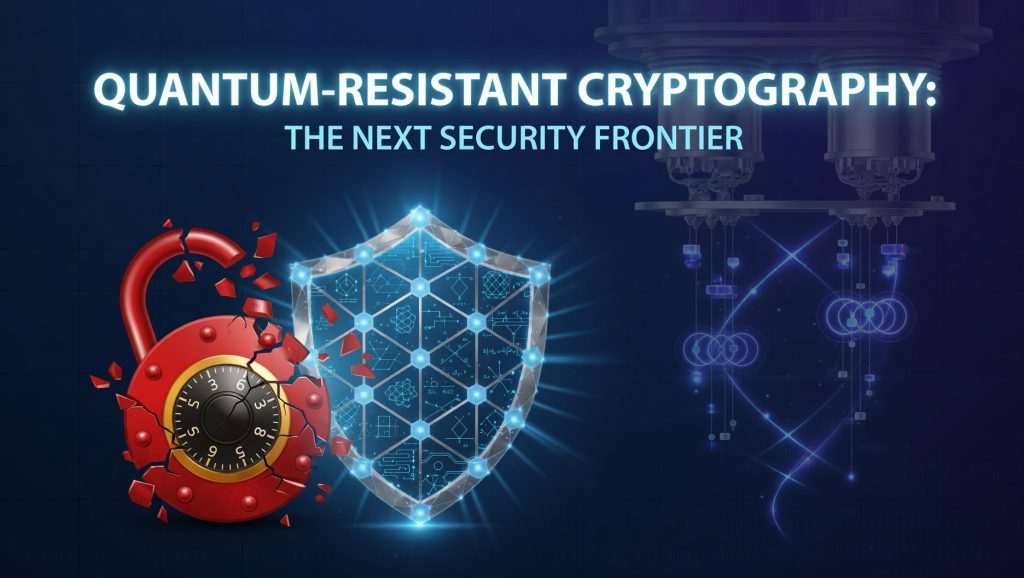
The Clock Is Ticking on Today’s Encryption
Think about sending a confidential email, doing an online transaction, or connecting to your employer’s virtual private network (VPN). Behind all of this, mathematics takes place in the form of cryptographic techniques based on algorithms like RSA and ECC (Elliptic Curve Cryptography). Both RSA and ECC rely on computationally hard problems such as factoring big prime numbers or computing the discrete logarithm of a number. A classical computer would take several millennia for cracking just one 2048-bit RSA key.
However, rules of computation are about to get changed!
Introducing quantum computers! Instead of binary digits (bits), which can be either 0 or 1, qubits used in quantum computing can have values of both 0 and 1 simultaneously due to their property of superposition. Therefore, quantum algorithms, like Shor’s Algorithm, can crack large numbers exponentially faster than any classical computer.
Here comes the kicker: there exists no fault-tolerant quantum computer capable of utilizing qubits reliably in millions or even thousands. However, experts at institutes like NIST (National Institute of Science and Technology) estimate a realistic time span of 5-15 years till then. This has led to the emergence of quantum-resistant cryptography, popularly known as post-quantum cryptography (PQC).
What Exactly Is Quantum-Resistant Cryptography?
Let us get a precise definition of this concept.
Quantum-resistant cryptography is a type of cryptographic algorithm (public-key crypto system) whose security would not be compromised even in the face of attacks from a quantum supercomputer. These kinds of crypto systems use classical computers that operate on traditional bits (0, 1). This implies that quantum computers are not necessary; instead, the system uses mathematically challenging problems to ensure security.
For instance, RSA encryption depends on the complexity of factorizing primes. It can be broken easily by the Shor algorithm. In case of PQC, we have complex problems such as solving a set of multivariate polynomial equations and determining the shortest vectors in n-dimensional space.
Radio Analogy:
The current encryption method (RSA/ECC) can be likened to a numerical padlock that requires numbers from 1 to 100. While a classical computer will attempt using 1,2,3… one at a time, a quantum computer will try all combinations at once. Quantum resistant cryptography alters the lock altogether by making use of color, shape, sound, and so forth.
Why the Rush? “Harvest Now, Decrypt Later”
Perhaps one of the biggest driving forces behind the use of PQC is something called “Harvest Now, Decrypt Later.” These attackers, whether they’re nation states, criminal organizations, or intelligence agencies, are intercepting and stockpiling data right now because they know they won’t be able to crack that data yet.
However, they believe that in 5-10 years’ time, they’ll be able to use their quantum computers to decrypt all of this information that’s been harvested.
And it includes:
- Medical records stored long-term
- Confidential government communications
- Proprietary knowledge related to pharmaceutical or defense technology
- Financial backups encrypted against disasters
Therefore, when you think about 2035 as your deadline, you’d better think again.
The Four Main Families of Quantum-Resistant Algorithms
The NIST revealed the initial four post-quantum cryptography standards after an international competition lasting six years between 2022 and 2024. Let’s take a look at some of these cryptographic families along with examples.
1. Lattice-Based Cryptography (Most Prominent)
Lattice-based cryptography is based on the difficulty of determining the shortest lattice vector in a high-dimensional lattice. Imagine a 3D point grid for now. Now, picture a point grid in 500 dimensions. There isn’t anything quantum computers can do better here.
- Example Application: CRYSTALS-Kyber (standardized version is known as ML-KEM), for key encapsulation. Consider that as a method for two parties (for example, you and your bank) to generate a secret symmetric key by establishing a quantum-resistant connection between the two endpoints.
- Real-world use case: The Signal messaging app is already working on integrating Kyber with their new “PQXDH” protocol.
2. Hash-Based Cryptography
These digital signature schemes depend solely on the security of hash function algorithms (such as SHA-3), which are currently quantum-resistant to Grover’s attack algorithm, since it offers only a quadratic speedup and not an exponential one.
- Example of Practical Implementation: SPHINCS+. Useful in the context of firmware authentication, e.g., a company needs to use cryptography to ensure that the software updates for the battery management system of its electric vehicle (EV) are legitimate.
3. Code-Based Cryptography
According to the problem associated with breaking a general linear code. The standard reference is the McEliece system (invented in 1978, not yet broken by quantum computers). Drawback? Public keys are very large (hundreds of kilobytes to several megabytes).
- Practical Example: Protection of information stored in an archive. An organization can encrypt census data for 50 years using McEliece, despite the size of public keys involved.
4. Multivariate Cryptography
Uses a scheme based on multivariate quadratic equations in finite fields. The problem of finding solutions for such equations is NP-hard even for quantum computers. Rainbow was one contender for such a protocol but was hacked in 2020 using classical methods, indicating the need for proper standardization.
- Practical Application: Secure boot for IoT sensors in smart grids. Such machines have limited power resources and cannot upgrade fast; therefore, multivariate algorithms would be suitable for them.
Real-World Practical Examples (Beyond Theory)
Let’s ground this in what you can touch today.
Example 1: Web browsers and Cloudflare
Starting in 2022, Google Chrome has been testing X25519Kyber768 an algorithm that provides key exchange based on a combination of ECC and quantum-proof Kyber. Currently, when you connect to any server through Cloudflare PQ, your browser will generate a key pair resistant to a hypothetical quantum attack.
Example 2: Signal messaging app
In September 2023, Signal has started using PQXDH (Post-Quantum Extended Diffie-Hellman). The process of sending a “Hello” message involves generating keys, both classical and Kyber-768, for each session. Even in case the attacker captures your communication at the initial stages and obtains a quantum computer in the future, it won’t be able to decrypt any messages.
Example 3: VPNs and zero-trust networks
Large companies like Google use hybrid post-quantum protocols for internal network traffic. For instance, when one connects to a company database via a corporate network, it generates quantum proof and classical keys. In this way, the system avoids retrospective decryption of previously obtained traffic.
Example 4: Blockchain and Cryptocurrencies
The signatures used by Bitcoin (ECDSA) can be cracked using Shor’s algorithm. Once a quantum computer is available, it will be possible for anybody to forge Satoshi’s signature. In QRL (Quantum Resistant Ledger), XMSS (hash-based signatures) has been implemented. The development team behind Ethereum has looked into the possibility of shifting to STARKs.
What NIST and CNSA 2.0 Say (Critical Deadlines)
CNSA 2.0, which was issued by the National Security Agency (NSA) of the United States in 2022, requires that any national security system uses PQC technology by 2035. NIST standardizes the following protocols in 2024:
- ML-KEM (previously known as Kyber): General encryption.
- ML-DSA (previously known as Dilithium): Digital signature.
- SLH-DSA (previously known as SPHINCS+): Stateless hash-based digital signature.
If you are a defense contractor, a hospital working on the Medicare data, or a company operating in finance technologies, then your road map to compliance with PQC includes the following steps:
- Inventory: In what cases do you have any usage of public key cryptography (for example, TLS, SSH, S/MIME, code signing)?
- Hybrid trials: Implement hybrid protocol X25519+Kyber in test environments.
- Crypto-agility: Implement cryptographic agility,
Common Misconceptions (And the Truth)
Myth 1: “Quantum computers are going to break everything, even AES.”
Fact: AES-256 is quantum-resistant since Grover’s algorithm lowers its key strength down to 128 bits, which is too much for brute forcing. But what we need to be really concerned about is asymmetric cryptography (RSA, ECC, DH).
Myth 2: “But I’ll wait till quantum computers come out.”
Fact: Remember the principle “Harvest now, decrypt later.” By the time you find any quantum computer, your previous logs from the VPN, backups, and emails are already vulnerable.
Myth 3: “But PQC ciphers are not proven yet.”
Fact: Research in lattice and code-based cryptographies dates back almost 30 years ago. NIST’s competition was done over the course of 15 years by analyzing 82 algorithms proposed by numerous mathematicians.
Practical Steps You Can Take Today (For IT Professionals)
As a systems administrator, there is no need to panic, but action is imperative.
- Upgrade your TLS libraries: OpenSSL 3.2+ will have support for providers for Kyber and Dilithium. Enable hybrid key exchange in Nginx or Apache.
- Utilize forks that are post-quantum ready: For example, Signal, WireGuard (post-quantum branch), and some OpenSSH forks.
- Keep an eye on NIST press releases: Next wave of standards in PQC cryptography will emerge by 2026.
- Conduct crypto-agility training exercises: Can you change your root CA certificate or SSH host key in 7 days due to security vulnerabilities? The same applies for PQC cryptography.
Conclusion
We’re not yet in the age of quantum supremacy as it applies to breaking crypto, but we are definitely in the age of planning, experimenting, and hybrid solutions. The adoption of post-quantum cryptography is not an abstract discussion. It’s a migration process, akin to Y2K, but one that takes ten years and doesn’t have a definitive deadline on any calendar.
Organizations implementing a hybrid approach now will have more sound sleep in their beds. Organizations waiting for the quantum breakthrough will be providing their auditors with explanations as to how their competitor’s harvest and crack attack did not put their sensitive information at risk, but theirs did.
So to conclude, post-quantum cryptography is not about designing locks for future thieves to unlock. It’s about changing all existing locks in advance before quantum computers become the universal key. And that’s precisely what is currently happening not only here on your computer screen but also in browsers, messaging apps, and enterprise level server solutions.
Explore Our Cybersecurity Category