Picture yourself as a World War II spy. You’ve got a message something crucial, something you can’t let the enemy read. But you and your contact have a trick: every letter in your note jumps three spots forward in the alphabet. A sneaky “A” becomes a “D,” “B” turns into “E,” and so on. To anyone snooping, it’s nonsense. But your contact knows the shift, so they crack your code in seconds. This old-school trick is the Caesar Cipher, and it’s basically the starting line for what we now call symmetric key cryptography.
Fast forward to today, and that simple idea has grown into the backbone of digital security. It’s the silent workhorse behind your online banking, the thing keeping your private chats actually private, and the unseen wall protecting your files. For something so central, it does its job in the shadows. In this post, we’re shining a light on that hidden world. We’ll look at how symmetric cryptography ticks, why it’s so effective, the problems it runs into, and what role it plays as the world gets even more encrypted.
Chapter 1: The Core Idea – One Key to Rule Them All
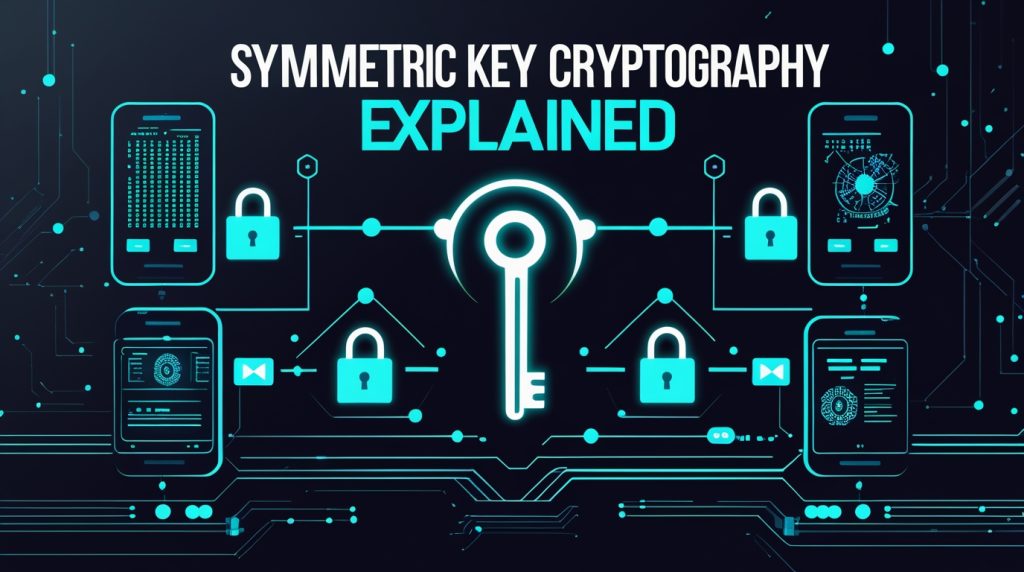
Symmetric key cryptography runs on a single, powerful idea: you use the same secret key to lock and unlock your information.
It’s like sharing a lockbox. Both of us have copies of the same key. You drop a note inside, seal it up, and send it over. I use my key to open the box and read what you wrote. The whole system relies on one thing keeping that key secret, and making sure the lock is tough enough to keep out everyone else.
Here’s how the process plays out:
- Plaintext: The message or data in its original, readable form.
- Secret Key: A string of bits, known only to you and the person you trust.
- Encryption Algorithm (Cipher): A mathematical recipe. It scrambles the plaintext using the secret key and spits out…
- Ciphertext: The scrambled, unreadable output.
- Decryption Algorithm: The reverse recipe. It takes the ciphertext and, using the same key, recovers the original message.
That’s the beauty of it symmetry. One key does the whole job, forwards and backwards. This makes symmetric cryptography super fast and perfect for locking down big piles of data. That’s why it’s everywhere: protecting hard drives, securing database entries, and wrapping a shield around the actual content you send across the internet.
Chapter 2: Building the Digital Lock: How It Works Under the Hood
The world’s moved past swapping around letters. Modern symmetric ciphers are tough built on math that’s designed to stand up to relentless attacks from computers. They usually fall into two main camps:
Block Ciphers: The Secure Vault
Block ciphers slice your data into fixed sized chunks blocks, usually 64 or 128 bits. It’s like loading your valuables into a set of uniform, heavy duty boxes. If your message doesn’t fill the box, you pad it out.
- How does it work? The cipher takes one of these blocks and, through several rounds, mixes it up using your secret key. It swaps bits around (substitution), rearranges them (permutation), and does this again and again. Each round adds confusion (making it tough to figure out how the key affects the message) and diffusion (so that changing one letter in the input changes a bunch of stuff in the output).
- The Heavyweight: AES (Advanced Encryption Standard). After a global contest, NIST picked AES back in 2001. It’s now the gold standard used everywhere from Wi-Fi (WPA2) to encrypted files to top level government secrets. AES works with 128 bit blocks and key sizes of 128, 192, or 256 bits. To brute-force a 256-bit AES key? You’d need more time than the universe itself has existed. Seriously.
- Modes of Operation: There’s a catch if you just use a block cipher straight up for a long message, you can leak patterns. If the same chunk of plaintext shows up twice, you’ll see the same chunk of ciphertext. Bad news. That’s where “modes” like CBC (Cipher Block Chaining) or GCM (Galois/Counter Mode) step in. In CBC, each plaintext block gets mixed with the previous ciphertext block before encryption, chaining everything together. This makes sure that even if the input repeats, the output looks nothing alike.
Stream ciphers don’t chop data into blocks.
They handle things one bit or byte at a time, just letting the data flow. The trick is in the keystream a river of random looking bits built from your secret key. You mix this keystream with the real message (usually with XOR), and out comes the encrypted stuff.
- The Ideal: The One-Time Pad: Now, if you want perfection, there’s the one time pad. People call it unbreakable for a reason. It uses a truly random keystream that’s exactly as long as your message, and you never use it twice. Sounds great, right? The catch: you have to somehow share a secret key that’s as big as all the data you’ll ever want to send. Not exactly practical.
- The Practical: Algorithms like ChaCha20: So, in real life, we reach for things like ChaCha20. These modern stream ciphers take a short secret key say, 256 bits and mix it with a unique starting value (a nonce). That combo cranks out a long, unpredictable keystream. They’re lightning fast in software, and a lot of folks now use them instead of AES, especially in things like TLS, which keeps your browser’s “S” in HTTPS safe.
Chapter 3: The Immense Power and the Achilles’ Heel
Symmetric cryptography has a few superpowers that make it absolutely essential. First, it’s fast. Really fast. These algorithms can encrypt video in real time, handle massive data transfers, or lock down an entire hard drive all without making your computer break a sweat.
Then there’s the strength. Algorithms like AES aren’t just strong; they’re battle tested. People have poked and prodded at them for decades, and they’re still standing. That kind of track record wins trust.
And honestly, the system is simple. One secret key does the trick so there’s less to mess up. The fewer moving parts, the less chance of a disaster.
But here’s where things get tricky. The very thing that makes symmetric cryptography so appealing the single shared key creates a huge headache: the key distribution problem.
Think back to the classic spy scenario. You and your contact want to communicate secretly, so you agree on a “shift by three” code. But how do you both agree on that in the first place? You have to meet face to face, or trust someone to carry the message for you. In the digital world, how do you hand off a secret key to your bank when you log in for the first time? You can’t just email it. That’s like mailing a lockbox with the key taped right on top.
That’s the heart of symmetric cryptography’s dilemma. You need a secure way to share the secret, but the whole point is to build a secure channel in the first place. It’s a chicken and egg problem that haunted cryptographers for years. Banks and governments spent fortunes shipping keys around on tapes, smart cards, or whatever else they could trust to a courier in an armored van. There wasn’t a better way until the 1970s, when everything changed.
Chapter 4: The Partnership That Secured the World: Symmetric Meets Asymmetric
The fix didn’t come from tweaking symmetric encryption. Instead, it came from a whole new way of thinking: asymmetric, or public key, cryptography.
Whitfield Diffie and Martin Hellman kicked it off, and later, Ron Rivest, Adi Shamir, and Leonard Adleman (RSA) took it further. This approach uses two keys that are mathematically linked. One’s public share it with the world. The other stays private.
Here’s where it gets clever: if Alice encrypts something with Bob’s public key, only Bob’s private key can unlock it. Suddenly, you don’t need to share a secret in advance. No armored trucks, no secret meetings just math.
But in real life, we rarely use public key cryptography to lock up entire messages. It’s just too slow way slower than symmetric encryption. So, we use a hybrid trick, and this is what makes internet security work.
Here’s how it plays out, say, when you log into your bank:
- Asymmetric Handshake: Your browser connects to your bank’s website. It grabs the bank’s public key (from the SSL certificate) and uses it to set up a shared secret usually through something like Diffie-Hellman Key Exchange. This all happens out in the open, but only you and the bank end up with the secret.
- Symmetric Session: Now you both have a shared session key. From here on, symmetric encryption (AES or ChaCha20, for example) takes over.
- Fast, Secure Communication: All your banking data logins, balances, transfers gets encrypted at blazing speed with that session key.
So, asymmetric cryptography handles the tricky introduction, whispering the secret safely across the internet. Then symmetric cryptography jumps in and does the heavy lifting, keeping everything else secure and fast for as long as you need it. That’s the partnership that keeps your digital life safe.
Chapter 5: Symmetric Cryptography in Your Daily Life
You interact with symmetric cryptography countless times a day:
- Web Browsing (HTTPS/TLS): That little green padlock in your browser? It means your connection’s safe. After a quick asymmetric handshake, the session runs on a symmetric key.
- Wi-Fi Security (WPA2/WPA3): When you connect to Wi-Fi at home, your password acts as the shared secret. Devices use it to do a handshake with the router and then switch over to encrypting everything with AES.
- Full-Disk Encryption (BitLocker, FileVault): If your laptop has full disk encryption, your hard drive gets locked down with a symmetric key linked to your password or maybe a TPM chip. Every file you open or save goes through AES, so if you lose your device, your data stays safe.
- Password Managers: All your saved passwords? They’re stored in a vault and encrypted with a symmetric key that comes from your master password.
- Secure Messaging (Signal, WhatsApp): Messaging apps like Signal and WhatsApp use the Signal Protocol. They rely on a clever Diffie Hellman handshake to keep rotating symmetric session keys, which means even if someone grabs a key, they can’t read your old messages.
Chapter 6: The Future and The Quantum Shadow
Symmetric cryptography isn’t stuck in the past. New algorithms keep popping up, optimized for speed and custom hardware. There’s a whole race to design ciphers that don’t leak secrets through side channels like power use or timing quirks.
But honestly, the biggest thing shaking up the world of cryptography right now is quantum computing.
Quantum computers flip the script, especially for asymmetric cryptography like RSA and Diffie Hellman. With tricks like Shor’s Algorithm, they could tear through the math that keeps those systems safe. If that happens, the current system of combining asymmetric and symmetric cryptography gets thrown into crisis.
Here’s the upside: symmetric cryptography actually holds up pretty well.
The main quantum threat is Grover’s Algorithm, which can brute-force a key faster than any regular computer. But the fix is pretty straightforward just use a longer key. Grover’s only gives a quadratic speedup, so bumping AES up from 128 to 256 bits puts you back on solid ground. AES-256 still stands strong, even against quantum computers.
So, in a post-quantum world, symmetric cryptography isn’t going anywhere. It’ll still handle most of the heavy lifting for encrypting data. The real scramble is for new asymmetric algorithms what people call Post Quantum Cryptography (PQC). These are the next gen building blocks for key exchange and digital signatures. Right now, NIST is working on picking the best PQC algorithms, and soon, those will handle the “handshakes” that protect tomorrow’s symmetric keys. Learn More
Conclusion: The Unseen Foundation
Symmetric key cryptography isn’t flashy. It just gets the job done quietly, relentlessly, always in the background. Sure, asymmetric cryptography gets most of the attention with its clever math tricks, but without the speed and muscle of symmetric keys, our digital lives would stall out fast. This is humans doing what we’ve always done: finding a way to share secrets with people we trust, just with a lot more math.
Think about it. People have whispered secrets for thousands of years, from ancient Rome right up to today’s internet, and the basic idea hasn’t changed. A shared secret forms a circle of trust. Now, it’s just invisible code instead of a whispered plot. Really understanding how this “invisible lock” works is key to seeing the fragile, brilliant system of trust holding up everything online.
So next time you spot that little padlock in your browser, send money online, or hop on your Wi-Fi, give a nod to symmetric key cryptography. It’s the modern version of a spy’s secret code only now, it’s protecting your messages, your money, and your daily privacy, not just government secrets.
Explore Our Cybersecurity category