Picture this: you send a message, and only your best friend can read it, no matter who else gets their hands on it. Or you buy something online and feel totally safe, knowing nobody can sneak a peek at your credit card number. That’s cryptography in action. It’s not magic, but it does feel a little bit like it sometimes. People have been hiding secrets for thousands of years from ink on ancient scrolls to the chips in your phone. Cryptography has shaped wars, protected powerful people, and now, it quietly keeps your digital life safe. If you’ve ever wondered how all this secret-keeping actually works, you’re about to find out. You won’t need a PhD in math just a bit of curiosity.
What’s Cryptography, Really?
At its core, cryptography is about keeping communication safe from anyone snooping around. The word comes from Greek kryptós means hidden, graphein means to write. So literally, hidden writing. Basically, you turn a message into something nobody else can read unless they’re supposed to.
But it’s not just secret codes and spy games. Modern cryptography mixes math, computer science, and engineering. It covers a few big ideas:
- Confidentiality: making sure nobody else can read your info.
- Integrity: making sure nobody messes with it along the way.
- Authentication: checking that the person you’re talking to is actually who they say they are.
This stuff is everywhere. It’s what protects your email, your bank app, and even those little locks next to website addresses.
A Quick Trip From History
To get why cryptography matters, it helps to peek into the past. People have been hiding messages forever.
Take Julius Caesar, for example. Around 100 BC, he’d send messages to his generals using a code a simple one. He just shifted every letter forward by three spots. So A became D, B became E, and so on. If you didn’t know the trick, the message looked like nonsense. But if you did, everything made sense. That’s what we call a symmetric cipher: you use the same key to lock and unlock the message.
Things stayed pretty basic for a long time. Then, in the 9th century, the scholar Al-Kindi changed the game. He figured out that certain letters pop up more often in every language like E in English. By counting these letters in a coded message, you could start cracking ciphers even if you didn’t know the key. That was the start of cryptanalysis the art of breaking codes.
Fast forward to World War II. The Germans had the Enigma machine a crazy complicated device with spinning rotors. They thought it was unbreakable. But a bunch of brilliant minds, including Alan Turing, proved them wrong. Breaking Enigma was a landmark moment, showing that even the best code is only as good as how you manage the keys and keep the method secret.
From clay tablets to spinning machines, cryptography has always wrestled with the same problems how to share keys, handle complexity, and build real trust. Those are the same challenges we face in the digital age.
Building Blocks: Breaking Down the Lingo
Let’s get on the same page with some terms you’ll see a lot in cryptography:
- Plaintext: the original message, easy to read. (“Meet me at dawn.”)
- Ciphertext: the scrambled, unreadable version. (“Qhhw ph dw gdzq.”)
- Encryption: turning plaintext into ciphertext.
- Decryption: turning ciphertext back into plaintext.
- Key: the secret info (like a number or password) that locks or unlocks the message.
- Algorithm (or cipher): the set of rules or math that does the scrambling. The recipe, basically. Good algorithms don’t need to be secret the key is what matters.
- Cryptanalysis: the craft of cracking codes and finding weak spots.
Think of it like a locked box. You write a letter (plaintext), lock it in the box (encryption) with your key, and send it. Your friend has a matching key (decryption) to open it up. If someone intercepts the box (ciphertext) but doesn’t have the key, they’re out of luck.
The Big Divide: Symmetric vs. Asymmetric Cryptography
In today’s world, most cryptography falls into two main camps, each with its own set of strengths and tradeoffs.
1. Symmetric Key Cryptography: The Shared Secret
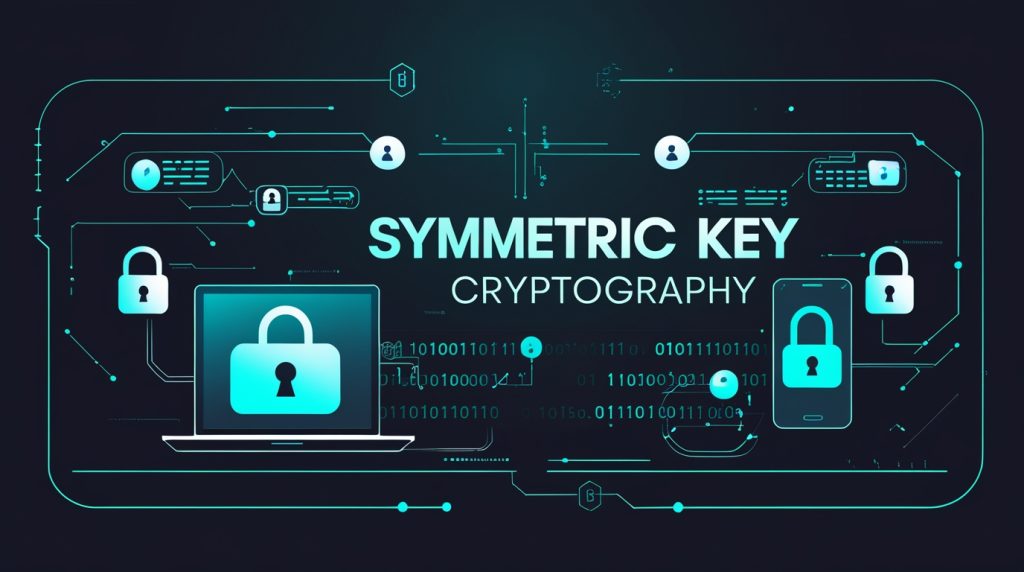
This is where both encryption and decryption use the exact same key. It’s fast really fast. Perfect for scrambling big chunks of data. Here’s the idea: Alice and Bob secretly agree on a key. Alice uses it to lock up her message. Bob uses that same key to unlock it. Simple.
Take AES, for example the Advanced Encryption Standard. The U.S. government made it official in 2001, and now it’s everywhere. Your Wi-Fi, your files, even your phone probably rely on it. With a long enough key, like 256 bits, no one’s brute-forcing their way in anytime soon.
But there’s a catch: how do Alice and Bob agree on that secret key without anyone else finding out? If they just send it over the internet and someone like Eve is listening, game over. This “key exchange problem” stumped people for ages.
2. Asymmetric Key Cryptography: The Key Pair Revolution
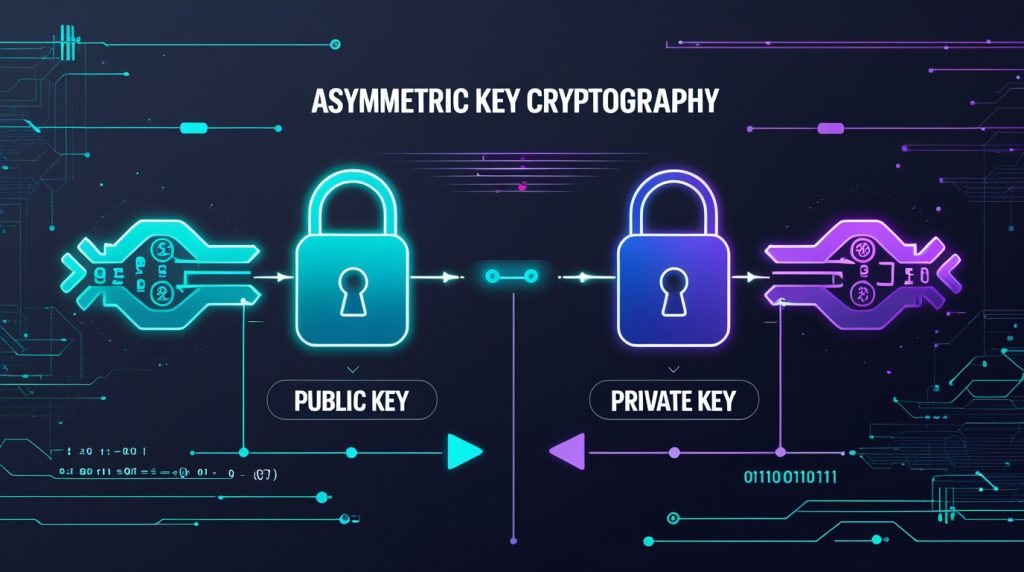
Enter public key cryptography a game changer from the 1970s, thanks to Diffie, Hellman, and Merkle. It cracked the key exchange problem wide open by using two keys, not one: a public key and a private key, linked by some mathematical magic.
Here’s how it plays out:
- The public key? You can hand it out to the whole world.
- The private key? Guard it with your life.
And you get two core tricks:
- Encryption: Bob wants to send Alice a secret? He locks it with Alice’s public key. Only Alice’s private key can open it. Not even Bob can unlock his own message once he’s sent it.
- Digital Signatures: Alice wants to prove she wrote something? She signs it with her private key. Anyone can check that signature using her public key. If it checks out, you know it’s really from Alice and untouched.
For real world use, think RSA the backbone of secure web connections. When you see “HTTPS” in your browser, RSA is working behind the scenes. Your browser grabs the site’s public key, and off you go into a secure conversation.
Downside? Asymmetric cryptography is slow too slow for encrypting, say, an entire movie. But for swapping a small secret like a symmetric key, it’s perfect.
The Handshake That Secures the Web: Hybrid Cryptosystems
In the real world, we mix the best of both worlds. Here’s a stripped-down version of what happens when you head to https://yourbank.com:
- Your browser connects and asks the bank for its public key.
- The bank sends back its public key inside a digital certificate (think of it as a cryptographic ID checked by a trusted authority).
- Your browser checks the certificate. If everything looks good, it generates a random session key (a symmetric key, for something like AES).
- The browser locks up this session key with the bank’s public key and sends it over.
- Only the bank using its private key can unlock that session key.
- Now both sides have the same session key. From here on, all your data (logins, balances, whatever) gets encrypted super-fast with symmetric crypto.
All this goes down in a flash, every time you see that little padlock in your browser. That’s the TLS/SSL handshake in action.
Beyond Secrecy: The Other Pillars of Security
Cryptography isn’t just about hiding stuff. It does a lot more.
Hash Functions: The Digital Fingerprint
A hash function is like a high-tech blender. Toss in any data a password, a file, a whole book—and out comes a short, fixed length string: the hash.
What makes hashes special?
- Same input, same hash. Every time.
- Once you have the hash, you can’t work backward to figure out the original data.
- Even a tiny tweak to the input (“hello” vs. “hell0”) totally changes the hash.
- It’s nearly impossible to find two different things that produce the same hash.
You see hash functions everywhere checking the integrity of a downloaded file, storing passwords (sites keep the hash, not your actual password), and holding together blockchains. They’re the unsung heroes of digital security.
Digital Signatures: The Unforgeable Seal
We already talked about asymmetric crypto, but let’s dig a little deeper. A digital signature does three important things: it proves the message actually came from who says they sent it, it shows nobody tampered with the message along the way, and it keeps the sender from pretending later that they never sent it.
Honestly, it’s way more binding than scribbling your name on paper. A digital signature is locked to you through your private key and to the message itself. Change either, and the signature breaks.
The Human Factor: Where Cryptography Meets Reality
Now, here’s where things get real. You can have the world’s toughest algorithm, but if you mess up the way you use it, or get lazy with security, it all falls apart. Most hacks don’t happen because someone cracked the math they happen because of human mistakes.
Look at these common slip-ups:
- Weak Keys & Passwords: If you set your password as “123456,” you’re basically locking your front door with a twist-tie. Cryptography only works when keys stay secret and strong.
- Bad Randomness: Keys have to come from real randomness. If your random number generator is predictable, attackers can guess your keys.
- Side-Channel Attacks: Hackers get creative. Instead of cracking the math, they measure things like how much power your computer uses during an operation, or how long it takes. Little clues can give away big secrets.
- Implementation Flaws: Bugs in the code running your crypto can give attackers a way in, even if the algorithm itself is solid.
This all boils down to one rule: Don’t invent your own cryptography. Trust the libraries and standards that experts have pounded on and tested. Your job is to use those tools right, not to reinvent the wheel.
A Glimpse into the Future: Quantum & Post-Quantum Cryptography
Here’s where things get wild. Quantum computers aren’t just science fiction anymore they’re coming, and they play by rules that make today’s cryptography look fragile. Stuff like Shor’s Algorithm could break the math that protects RSA, which means a lot of our digital signatures and encryption would suddenly be wide open.
What’s the plan? Cryptographers are hustling to build new defenses algorithms that even quantum computers can’t easily crack. NIST is leading the charge, working to nail down these “post-quantum” standards. Switching over won’t be easy, but it’s one of the biggest and most important tasks facing cybersecurity in the next decade. Explore More
Your First Steps as a Cryptographer
Ready to roll up your sleeves? Here’s how to dive in:
- Play with Tools: Grab something like
openssland try encrypting files, making hashes, or generating key pairs. See how things work for yourself. - Explore Code (Safely): Check out the docs for cryptographic libraries in your favorite programming language. Libraries like Python’s
cryptographypackage do a lot of the hard work for you and warn you away from common mistakes. - Learn by Breaking: Jump into challenges on sites like Cryptopals or OverTheWire. Nothing teaches you how ciphers work (or fail) like trying to break a weak one.
- Stay Curious: Follow blogs from security researchers and companies. The landscape is always shifting, and there’s always something new to learn.
Conclusion
Cryptography isn’t loud or flashy, but it’s the quiet force keeping our digital world safe. It’s what lets us trust, share, and buy things online without thinking twice. From simple tricks like Caesar’s cipher to tomorrow’s quantum proof algorithms, it’s a never ending battle between builders and breakers.
Learning the basics isn’t just for math nerds or secret agents anymore. If you use the internet, you should know what’s happening under the hood. It makes you a smarter, safer user and helps you appreciate the math that shields your privacy.
Next time you send a message, punch in a password, or spot that green padlock, remember: there’s a whole universe of clever math working behind the scenes to safeguard your secrets. You’ve just taken your first step into that world. There’s a lot more to explore, and you’re on your way.
Explore Our Cybersecurity Category