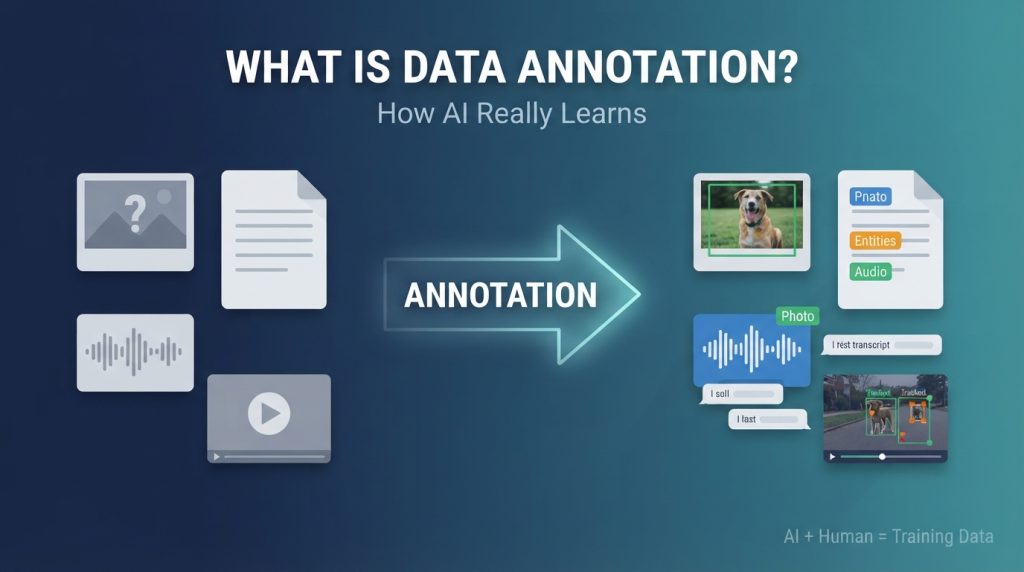
Short answer: Data annotation is the process of marking up raw images, text, audio, and video to allow machine learning models to comprehend the input. No data annotation means that AI just matches patterns in noise. With data annotation, AI understands how to detect pedestrians, analyze customer sentiments, and transcribe voices. The worldwide data annotation market is expected to increase from around $1.3 billion in 2025 to over $6.4 billion by 2033.
Why This Matters Right Now
The next time you unlock your phone by facial recognition, ask Siri about the weather, or browse a social media platform that always seems to know exactly what videos you will want to spend time watching, take a minute to consider the human effort behind all of that magic. That human effort is called data annotation.
Data annotation is by far the most boring part of the AI revolution. It’s not going to get any keynote spotlights or go viral on social media. But without it, nothing would work. Nothing at all.
Here’s the harsh reality: the most sophisticated model architecture ever created is useless without the right quality of annotated data for training it. As the saying goes in the AI industry, data is the new oil, and annotation is the refinery that processes the raw material into fuel that makes sense.
In this guide, I will cover what data annotation is, its history from academic interest to billion-dollar business, different kinds of annotations, the methods of ensuring their quality, and the future of annotation as the field of AI learns to do it for itself.
Let’s dig in.
What Exactly Is Data Annotation?
Data annotation is the process of labeling data with descriptive tags so that machines learn from it. It means the following: a computer treats an image as numbers on a grid and cannot understand whether a certain set of pixels belongs to a dog, a car, or a stop sign because it simply sees RGB values. Through annotation, we make explicit statements that a certain set of pixels corresponds to the stop sign and is located at this spot on the image.
The result of annotation is the labeled dataset, a set of raw data together with human-supplied context that acts as a ground truth for training machine learning algorithms.
Let us provide some practical examples:
- Image annotation: annotating all pedestrians on a street view image with a rectangle
- Text annotation: tagging the word “Apple” as a company and not a fruit in the sentence “Apple opened a new store in London”
- Audio annotation: transcribing speech and specifying when speakers begin and end their turn
- Video annotation: identifying the trajectory of a moving ball in the sports video
All these tasks have one thing in common: humans supply the interpretation missing from machines.
Concepts to Understand Before Digging Deeper
To start off with, here is some terminology that comes up all the time in annotation and helps understand other concepts better.
Ground Truth
“The correct” label that a specific piece of data has. For example, when you annotate an image with a label “contains a cat,” you are establishing ground truth that will be used to train the machine learning model. The better the ground truth you provide, the better the trained model will be.
Annotator
A person (or even a machine learning model itself) who performs labeling. It can be either a domain expert (radiologist who annotates medical images), a co-worker from Amazon Mechanical Turk, or an ML model that provides preliminary labeling.
Label
A specific tag or category assigned to a piece of data. For instance, a label in the case of image classification can be “cat” or “dog,” while in sentiment analysis it can be “positive” or “negative.”
Annotation Scheme
It refers to the collection of rules and classes for defining how labels need to be applied. The best annotation scheme does away with any ambiguities, clearly defining which object qualifies as a “vehicle” and which is a “car.”
Inter-annotator Agreement (IAA)
An agreement score that indicates the level of consistency between different annotators when labeling the same set of data. A high level of agreement indicates clear instructions, while low agreement implies confusion or ambiguity.
History of Data Annotation: From Hand-Labeled Data to a Worldwide Industry
Annotation of data did not occur immediately but rather developed in tandem with machine learning technologies that rely on it.
The Early History: Hand-Labeled Data in Academia
At the earlier stages of development, annotation was a job done exclusively by the researchers themselves. Smaller sets of data, specific focus areas, and budget constraints meant that researchers who built the model would also label the data. This process was costly and time-consuming, yet effective in experiments.
2007: A Shift in Approach Due to the ImageNet Project
However, all this changed with the emergence of the ImageNet project that utilized crowdsourcing to create a huge database of labeled images. It showed that you could indeed label large amounts of data through such methods. This breakthrough was not only an academic success but also a way of showing that annotation could be turned into a full-fledged industry.
2015-2020: Deep Learning Revolution
With the revolution in deep learning came an increased need for labeled data. Every AI company started requiring labeled data, and annotation firms came up to cater to the demand. Mechanization through sites like Amazon Mechanical Turk enabled companies to distribute labeling tasks to a global workforce.
India became a major center for providing annotation services thanks to its cheap and sizable English-speaking workforce.
2022-Current: Generative AI Period
Large Language Models (LLMs) have once again transformed the field of annotation. Annotation tasks for training LLMs require not just an increase in volume of data but also specific types of instructions: following instructions, preference labeling, and safety annotations.
In current times, annotation tasks are moving away from being purely manual to being partially automated through the use of AI models generating labels.
Major Types of Data Annotation
Various data annotation techniques are appropriate for various kinds of data. Let’s have a look at the major kinds of annotations.
Image Annotation
The oldest and most popular method of annotations.
Image Classification
Putting a single label on the whole picture. “Here we have a picture of a dog.” It is easy, quick, and helpful for categorization.
Object Detection
Putting bounding boxes around multiple objects and assigning labels to them. Widely applied for autonomous driving, security, retail, etc. The neural network learns what object is and where it is located.
Semantic Segmentation
Assigning categories to all pixels in the image. Rather than putting a bounding box on a car, we need to assign the label “car” to each pixel forming this object. This approach is important for medical imaging and autonomous driving when it is vital to separate multiple overlapping objects.
Key Point Annotation
Marking points of interest, joints in the case of pose estimation, faces in the case of emotion detection, etc. Applied to augmented reality, fitness, and movies.
Text Annotation
Training algorithms to comprehend language.
Named Entity Recognition (NER)
Detecting and categorizing named entities in texts: people, organizations, places, dates, and amounts of money. Needed by search engines, recommender systems, and information extraction.
Sentiment Analysis
Categorizing text as positive, negative, or neutral. Used for customer service automation, brand reputation management, and product review analysis.
Intent Classification
Understanding the intent of the user in his/her text. “I wish to cancel my subscription” is classified as the “cancelation” intent. Needed by chatbots and virtual assistants.
Part-of-Speech Tagging
Assigning grammatical roles to each word (noun, verb, adjective). Fundamental for many NLP workflows.
Audio Annotation
Transcription
Transcribing spoken audio to written language. Applications include voice assistants, analytics for call centers, and accessibility solutions.
Speaker Diarization
Separating speakers from each other in a multi-speaker audio recording. Required for transcription of meetings and analysis of podcasts.
Emotion and Tone Annotation
Annotation of the emotional tone of the speech: angry, satisfied, neutral. Applications for quality control in customer services.
Video Annotation
Object Detection
Detection and tracking objects in frames. Rather than annotate every frame separately, it is more common to annotate key frames and use an interpolation algorithm for the rest.
Action Annotation
Annotation of specific actions or behavior, such as falling, running, and handshaking. Applications include sports analysis, surveillance, and health care.
Scene Segmentation
Division of a video on scenes or shots. Useful for content moderation.
Annotation Quality Measurement and Maintenance
Quality of annotations matters immensely. A machine learning model trained on low-quality annotations is bound to learn the noises. What are the strategies used by annotation teams to maintain the quality of their work?
Inter-Annotator Agreement
What is the percentage of agreement between different annotators labeling the same data? These metrics are measured using Cohen’s and Fleiss’ Kappas, and high percentages are usually an indicator of good annotation instructions. However, inter-annotator agreement cannot be trusted at face value since consistent agreement on incorrect labels is still agreement.
Consensus Methods
What if there is disagreement between annotators? Possible methods include:
- Majority voting: The majority decision determines the label
- Probabilistic Models: Models such as Dawid-Skene estimate annotator reliability and apply weights accordingly
- Expert Adjudication: A domain expert evaluates and resolves disputes
Gold Standard Tasks
Gold standard tasks are tasks where known answers are incorporated within the pool of annotated items. The annotators are unaware of the gold standard tasks, and their performance on those serves as an ongoing quality measure.
Iterative Feedback
Some of the best labeling tasks are not “label and done.” They involve iterative processes whereby the annotator gets feedback about their error rate, clarification on gray areas, and learns incrementally.
Challenges to Data Annotation
Cost and Scale
Data annotation at scale required by contemporary AI is expensive. Training even one large language model may require hundreds of thousands of human labeled data points, costing millions of dollars .
Subjectivity and Ambiguity
There are clear right and wrong answers to certain tasks. Whether an image contains a car is a yes or no question. But whether a review is sarcastic or whether a medical scan is concerning relies on judgment. Disagreement among annotators is not a problem; it is an inherent part of the process .
Domain Expertise
Sometimes the annotation process requires domain-specific expertise. Medical imaging requires radiologists. Legal documents require lawyers. This kind of expertise is costly and rare .
Bias Propagation
Each annotator has his own biases. When a dataset is annotated by a homogeneous group, these biases will be reflected in the data as well, which is particularly dangerous in mission critical applications such as hiring and lending decisions .
Workforce Treatment
The industry of data annotation has been criticized for its working conditions, including low pay, mental stress associated with moderating disturbing content, and lack of stability.
Advanced Corner: Model-Based and Automated Annotation
This chapter is for those who wish to gain a technical understanding of how annotation is evolving.
Model-Assisted Annotation
The state-of-the-art annotation pipeline is now as follows:
- Model provides a tentative label
- Human annotators check it and fix it
- Corrected labels are used in training
It can increase the speed by 2-3 times or more . However, there is a drawback automation bias. Human annotators are biased towards accepting the output of the model even if it is not accurate since disagreement is harder.
Active Learning
As opposed to random sampling, the idea behind active learning is that data is selected to annotate based on its informativeness. In other words, it is model uncertainty which guides the selection process. That means that the required number of annotated samples will be lower in comparison with random sampling.
Semi-Supervised and Self-Training
From a small set of labeled data you train a model, apply it to unlabeled data (pseudo-labeling) and re-train the model on the combined dataset. Repeat until convergence. It works best when the labeled data are of high quality and the model is trustworthy .
Rule-Based and Programmatic Labeling
In the case of a structured task, you could make rules yourself to automate the labeling process. In the case that you need to “extract all dates from invoices,” you can use a regular expression for 90% of the work with no human help.
The Future of Data Annotation
A few trends will shape the future of annotation.
From “Label Everything” to “Label What Matters”
With active learning and uncertainty sampling, not all data points need to be annotated. Only relevant data points need annotation. This changes the goal from a numbers game to a quality game.
Use of Synthetic Data and Pre-Labeling
Using generative models, synthetic data images, text or audio files can be created that did not exist earlier. Pre-labeling of such synthetic data reduces the need for human annotation. However, synthetic data can have biases of its own and fail to cover edge cases in the real world.
Expert-in-the-Loop Annotation System
Crowdsourced annotators are being replaced by expert-in-the-loop annotation system where artificial intelligence takes care of simpler tasks, generalists deal with medium complexity tasks, and experts resolve complex issues. This system improves costs and quality of annotation simultaneously.
Standardization and Regulation
AI algorithms have been increasingly subjected to regulatory control. Annotation standards are now being regulated too. The European Union’s General Data Protection Regulation considers annotation labels to be personal data in certain circumstances.
Globalization of Annotation
Annotated data is provided globally, although the distribution is unequal. There is dominance by the United States and China in the marketplace, with India serving as an important provider of annotation services. The language barrier continues to be a problem for the model.
Takeaways for Practitioners
If you are developing AI or work with annotated data, here is what you should consider:
- Define your schema upfront. Lack of clarity leads to poor results. Provide detailed guidelines, use examples, and pilot test your schema on a small sample.
- Calculate agreement, not just accuracy. If your annotators cannot agree with each other, your model won’t learn uniformly.
- Work incrementally. Do not plan to annotate 100,000 samples on the first day. Annotate 500, develop a model, analyze problems, and then scale up.
- Think about assisted workflows. Pre-labeling with a model and then verifying the results manually can greatly lower the cost, but keep automation bias in mind.
- Collaborate with annotators, do not treat them as replaceable resources. You rely on them to produce high-quality training data.
- Prepare yourself for long-term annotation work. When you develop an ML model that works under new data distributions, you will need additional annotation.
Real-World Examples and Cases
Autopilot at Tesla
Tesla collects billions of miles worth of data about how people drive. Yet videos aren’t directly usable for training; they require annotation. Approach used by Tesla: A blend of automation (through existing models) and manual annotations (to account for rare cases). There is a big in-house annotation team employed by the company and specific tooling created for the task.
All interventions, that is, every time a person takes over from the car (Autopilot), become a priority case for annotation [citation:12].
Google’s reCAPTCHA for Annotation
Remember those “are you a human” challenges where you have to pick out traffic signals or crosswalks? Well, you’re actually doing annotation.
Google uses reCAPTCHA technology to annotate its computer vision models. Every time you click the crosswalk or traffic light, your efforts contribute to training self-driving cars and Street View datasets [citation:24].
OpenAI RLHF Pipeline
ChatGPT training involved huge amounts of annotation work. OpenAI collaborated with firms such as Scale AI and Sama for human feedback on model-generated responses. Annotators generated ideal responses, ranked model outputs, and reported any harmful content. This information helped in training the reward model that steers ChatGPT’s actions. This process is cyclic: annotation, training, evaluation, finding flaws, reannotation, and so on. This procedure goes on even now [citation:10].
Medical Images at Stanford
In medical imaging AI research done at Stanford University, radiologists perform annotation of CTs, MRIs, and X-rays. These annotations are at the pixel level, which helps in identifying cancerous regions and healthy regions in the body.
This process is tedious and costly as radiologists are rare and valuable. However, the models built based on this process have better accuracy and can detect cancers in advance [citation:25].
Glossary of Key Terms
| Term | Definition |
| Annotation | Adding labels to raw data for ML training |
| Ground Truth | The “correct” label for a data point |
| Annotator | Person or system doing the labeling |
| Schema | Rules defining how labeling should be done |
| IAA | Inter-Annotator Agreement consistency between annotators |
| Cohen’s Kappa | Statistical measure of agreement between two annotators |
| Fleiss’ Kappa | Statistical measure of agreement between multiple annotators |
| Dawid-Skene | Algorithm for estimating annotator reliability |
| Active Learning | Selecting most informative examples for annotation |
So What to Do Next
If you want to dig further:
- Play around with labeling tools. Label Studio, CVAT, and Doccano are free and open-source options. Install one and label some samples.
- Get familiar with active learning. A great primer on the topic is Burr Settles’ survey. Python implementations include modAL and ALToolkit.
- Check your own data. If you’re building any models, trace their input back to the labels: how did they get there? by whom? according to which criteria?
- Keep an eye on the industry. Scale AI, Labelbox, and Appen produce research and case studies. The Snorkel blog is especially good for weak supervision.
- Think about ethics. Who is doing the labeling of your data? under what circumstances? what biases might they introduce?
- Go one step at a time. Start with one project, label 100 instances, train some models, see what happens. The best way to understand annotation is to try it yourself.
Data annotation is dull. It’s boring. It’s costly. Yet it’s also the backbone of everything AI does. To understand it isn’t just helpful – it’s crucial for those who want to make AI work.
Conclusion
Data annotation is the invisible engine of today’s machine learning. All of our face unlocks, voice commands, product recommendations, and chatbots’ responses start from people who annotated their data in order for ML models to be able to learn from it.
This field developed from researchers manually annotating small data sets to an international industry of billions, and it is continuously evolving. AI-based data annotation, active learning, and synthetic data have transformed the way annotation works, but there’s one universal truth – models are as good as their data.
There’s just one thing you need to remember: annotation is not a mere formality before training, but a design choice that determines what your model can and can’t do. Annotation is as important as architecture or hyperparameters since all your model will know is what you teach it.
Get the labels right, and everything else will follow.
Note:- This article is meant for academic purposes only. Every technique and tool described above must be used in accordance with all relevant legislation, data protection requirements, and ethical considerations. In case you deal with human annotators, make sure to pay them fairly and provide a safe work environment.
Explore Our AI Category. And if you are reading it up to here, leave a sweet comment to motivate us to write blog everyday.


