Answer In Brief: Red Teaming is a simulated test, an approved process wherein an organization is attacked by adversaries that try to expose weaknesses in the people, processes, and technology within the organization in order to exploit them before they are exploited by real attackers. It is different from penetration testing, where vulnerabilities are sought rather than testing the overall security posture of the organization.
Why Should You Care About This Right Now?
Here’s a figure to take note of: Large companies employ around 83 security solutions on average, but even with that amount of money spent, gaps exist in the interplay between those tools.
Attackers know this too. They do not attempt to beat all the defenses you create; they look for the gap that is left unaddressed. And that’s where red teams can help. Red teaming isn’t about adding yet another tool to your collection; it’s about checking if the tools you have work when faced with an attacker.
Red teaming has never been more relevant than now. Recently, the Cybersecurity and Infrastructure Security Agency (CISA) published results of a red team assessment of an organization where the team was able to get initial access through a web shell deployed during a previous vulnerability disclosure program a piece of leftover digital trash that became a way in. They successfully moved to the internal network, escalated privileges, and compromised multiple systems that were of critical importance. While some part of this activity was noticed by the organization, a lot more would’ve been undetected had CISA not informed the organization of what happened.
The Origin Story: From War Games to Cyber Operations
The origin of the phrase “red team,” as the story goes, is rooted in the Cold War era, when red was employed by Western armed forces to stand for the Soviet Union in the course of war-gaming drills. The idea is rather clear build a special group that would play devil’s advocate and find holes in your plan before your opponent can do that.
The tradition came to be via military uses, intelligence operations, and eventually cyberwarfare. In the realm of intelligence operations, red teams took the adversary’s thinking process on and contrasted it with the analysts’ assumptions. In the sphere of information security, Sandia National Laboratory described red teaming as “ethically hacking from a black hat point of view” using all the methods, philosophy, and mindset of malicious hackers with one aim: to find vulnerabilities without harming the system itself.
Currently, red teaming has become a common practice in the government, defense, and enterprise realms. According to NIST, red teaming is defined in SP 800-115 as “a team of individuals authorized and organized to emulate an adversary’s attack or exploitation capabilities against an enterprise’s security posture.”
Red Team vs. Penetration Testing: Not the Same Thing
This is where most misunderstandings arise. While people may use the terms “red team” and “pentest” interchangeably, these are two completely different tasks with their own aims.
Penetration testing is all about uncovering vulnerabilities. You identify a specific system or network, provide the testers with all relevant details about the environment, and let them find as many vulnerabilities as possible within the set period of time. As a result, you receive a report on vulnerabilities and remediation strategies.
Red teaming is aimed at the testing of detection and response capabilities. The red team works with a minimum amount of information possibly only the name of the company and one of its domains. They replicate the actions of a certain threat actor or threat profile. In addition to gaining access, they aim at reaching some predetermined objectives while staying undiscovered.
Here’s what CISA states about the difference between the two types of assessments:
Red teaming is an emulation of a realistic adversary in a full-scale simulation against the target organization’s technology, people, and processes. This approach is more targeted, utilizes more resources and time, and also explores other attack vectors, such as social engineering and physical security and supply chain attacks.
A penetration test poses the question, “Are you able to locate the vulnerability in this wall?” A red team exercise asks, “Supposing someone had gained entry into the building through the window, would anyone be able to detect it?”
The Core Methodology: How Red Team Exercises Are Done
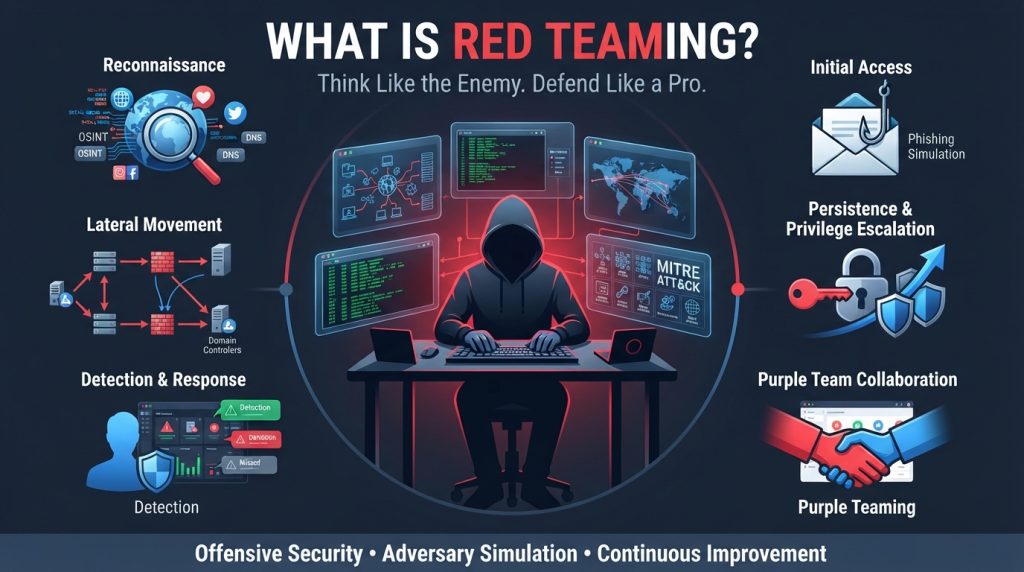
Red team exercises are carried out following a step-by-step process that corresponds to the actions taken by the adversary in a real-world attack scenario. The MITRE ATT&CK framework, which is a collection of 14 tactic families and numerous techniques developed from observation of threat actor behavior, is the reference point in this process.
Here is the process, according to the methodology of red team assessment from CISA and adversary simulation from NCSC:
Phase 1: Scoping and Reconnaissance
The exercise begins with a scoping discussion. The client determines the critical functions in their operation that will bring the business down if compromised. The objectives must be set around the critical functions, which, if compromised, will bring down the business’s ability to function.
Following the scoping discussion, the red team begins the exercise with passive reconnaissance. This involves gathering information about the organization from sources that do not involve interacting with the target: online databases, search engines, IP and DNS records, certificates, and social media.
Phase 2: Active Reconnaissance and Initial Access
This phase marks the beginning of interaction with the targeted party. Limited port scanning. Surfing the sites owned by the organization. Surveying the available online services. Detection is possible at this stage since active reconnaissance poses the danger of being detected.
The methods used to gain initial access include phishing and watering hole attacks based on what was obtained during reconnaissance. According to NCSC, if the defensive team of the organization detects the attack, there must be agreed-upon escalation options for what to do.
Phase 3: Internal Phase Lateral Movement and Persistence
In the internal phase, the red team begins moving towards the agreed objectives. This phase represents the real test of the ability of the customer to detect any anomalous activity and protect the most important functions.
CISA advises on an instance where the red team escalated its privileges, found credentials in a misconfigured Network File System (NFS) share, transitioned from DMZ to internal network, and compromised high-value systems. They abused a certificate for client authentication to attack a system that had Unconstrained Delegation configuration, obtained a ticket-granting ticket for the domain controller, and used it to further compromise the domain.
Should the red team manage to achieve one or several objectives without being detected, they brief the customer about it and make arrangements on what to do next. It is up to the customer to determine whether the objective has been achieved depending on the information provided.
Phase 4: Reporting and Cleanup
The last step involves proper documentation of the entire process, including the attack vectors, vulnerabilities exploited, detection gaps, and prioritized actions for remediation. The value lies in the reporting phase when it is used.
The Red, Blue, and Purple Spectrum
The red teaming process does not occur alone. In practice, it is one of three different functions that combine into a holistic approach to security testing and defense. The Red Team works offensively within the rules of engagement. They mimic adversary behavior, aim to achieve objectives, and perform detection and response exercises.
The Blue Team is the countermeasure for the internal security function responsible for securing systems, detecting attacks, and responding to incidents. These are the guys staring at the SIEM console and working to improve alerting and investigate anomalous activities.
The Purple Team is the mechanism of collaboration. It is not so much a team as a functional or mental state where the red and blue teams work in tandem. The red team performs an attack, and the blue team watches whether any detection controls react to that. The vulnerability is quickly corrected, and the same attack vector is run until it is detected.
In this regard, the CISA Cybersecurity Advisory on Purple Teaming mentions the collaborative approach for critical infrastructures. However, the difference lies in the fact that during regular red teaming activities, the blue team is unaware of what is going on. During purple teaming, both teams work in parallel, sharing experience.
At the same time, the process is sequential and recursive rather than simultaneous. In the case of a red team evaluation of an organization that does not have log aggregation and alerting in place, there will be no way to implement findings. At the same time, a blue team that never tests its detection capabilities against real attacks will not be able to measure its efficiency.
Red Team Common Misconceptions & Pits
Misconception 1: “Red teaming is nothing more than pentesting on steroids.”
Not really. Pen testing uncovers the vulnerabilities. Red teaming tests whether you can spot it and act. A red team operation doesn’t even require any software vulnerabilities. Phishing, credential abuse, and misconfigurations are usually sufficient.
Misconception 2: “When the red team is detected, this means that the exercise was a failure.”
Wrong. The point of the exercise is to test the detection capabilities. If you detect the red team early, this proves that it works .
Misconception 3: “Red team findings represent a simple checklist of actions required”
They represent only the symptoms. For example, if the red team operated in a lateral movement for three weeks without being detected, the issue is not about the technique that was used by the red team itself.
Common Pitfall: Known-Bad Detection
One of the key issues raised by the CISA advisory was that the defenders were focused on certain IOCs (Indicators of Compromise) such as the attributes of certain files, C2 (Command and Control) methodologies or the use of C2 domains. They were able to identify the use of certain red team tools but did not know the extent of their compromise. The red team used tactics which evaded almost all detections.
Common Pitfall: Red Teams Which the Blue Team Will Never Operate
Red teams can provide findings which the blue team will never implement. This is what the purple teaming comes into play. The blue team sees the attack occurring first-hand and understands the gap in their capabilities through their very eyes. They can create the detection rules right next to the red team operators.
Advanced Corner: The Future of Red Teaming
Autonomous Red Teaming and Artificial Intelligence
And here is where it gets really interesting and even a little scary.
Modern research has considered Language Model Agents (LMAs) as a primitive that may be used for enhancing the capabilities of red teams. LMA agents may assist in attack planning, adversary simulation, and multi-staged activities such as lateral movement .
In a recent study, the performance of LMAs in lateral movement scenarios has been benchmarked for three operational paradigms: fully autonomous operation, self-scaffolded planning, and expert-defined plans of action. Preliminary results show that expert-defined action plans have higher task success rates than autonomous ones; however, failure is common to all paradigms owing to brittle command invocation and unstable environment .
AI can help with red teaming; it cannot yet replace humans for more complex engagements. Yet.
Multi-Agent Reinforcement Learning
Research on a more advanced level is conducted on using multi-agent reinforcement learning (MARL) to enable autonomous cyber agents to conduct distributed attacks. The experiment done by using NASim environment has shown that MARL agents successfully learned to coordinate their actions even in small environments, becoming more adaptable and stealthy.
However, scalability remains a significant challenge. As network complexity increases, stabilizing multi-agent training becomes the primary bottleneck .
The Emergence of AI-Based Attacks
Another way in which the landscape of red teaming is changing is through the landscape of attackers themselves. AI is being deployed by attackers as a force multiplier, generating attack variants, designing context-aware phishing attacks, and developing polymorphic malware, all at a rate far surpassing what any human-based team can achieve.
In 2025, EchoLeak (CVE-2025-32711) was identified as an attack in which Microsoft 365 Copilot was exploited to leak data via a single crafted email . This represents a brand-new form of attack targeting production AI assistants, and this is precisely the sort of novel attack that red teaming needs to evolve in order to counteract.
“Where the true frontier of cybersecurity risk lies is not in the model, but in its agent system ecosystem wrappers, plugins, and frameworks,” writes one IEEE paper.
Metrics That Matter
The greatest value that purple teaming brings is its ability to quantify security improvements. The key metrics are operational, such as the percentage coverage of the MITRE ATT&CK matrix prior to and following the execution of the techniques, mean time to detect and respond, and percentage of controls tested which triggered . A good test would be to establish a baseline, run the techniques, and then re-measure.
How to Get Started: What to do Next
If you are contemplating a red teaming project within your organization, here is a realistic plan of action:
- Determine your level of maturity first. If you lack log aggregation, alerts, or an operational SOC, then there is little value in a red teaming project. Blue teams need to be developed before red teams can test them.
- Understand what “critical” means. The red team’s objectives should focus on the functions whose compromise will affect your critical business operations. Work together with the leadership to identify such functions.
- Plan your first engagement with proper rules of engagement. Every engagement requires a planning meeting that will help establish the objectives, provide necessary information, and determine how to escalate once the blue team recognizes the presence of the red team.
- Do a purple team engagement first. If you are new to red teaming, you will learn more from a cooperative purple teaming engagement than from a blind red team assessment.
- Measure and iterate. Monitor MITRE ATT&CK coverage, detection ratios, and time of the detection/response both before and after. Conduct exercises regularly, not just annually.
- Have a library of TTPs. Ensure that the red team is aware of the latest MITRE ATT&CK TTPs. Build a resource library and conduct training .
- Record everything. Screen shots, outputs, and detailed documentation. Post-exercise analysis is very important to prioritize remediation.
Bottom Line
Red teaming is not about demonstrating that you are vulnerable to a cyberattack. It is about discovering the way that you would be attacked, knowing when an attack happened and being prepared to counteract any attack. This is a framework for testing your assumptions, overcoming groupthink and finding the flaws that live in the cracks between your systems.
The companies that will get the most out of red teaming are not those who can afford to spend a lot on cybersecurity solutions, but those who will listen to the results and use the information to develop a culture where challenges are encouraged. At a time when advances in artificial intelligence technology reduce the cost of an attack and autonomy increases the capacity of an agent, the difference between “we have defense measures” and “they work” is crucial.
Explore Our Cybersecurity Category. And if you are reading it up to here, leave a sweet comment to motivate us to write blog everyday.