You’ve got a killer firewall, the priciest antivirus out there, and you change your super long passwords every other day. You’re safe, right? Nope. Even the world’s fanciest security system falls apart when someone tells a good, simple lie to the right person.
Welcome to social engineering. It’s not about hacking computers; it’s about hacking people. It’s like old school con artists but for the digital age, and it’s behind over 90% of successful cyberattacks today. Instead of fighting computer code, social engineering messes with how we think and feel. It plays on things that make us human: trust, wanting to know things, fear, and wanting to help out.
This isn’t about finding glitches in software, it’s about finding glitches in you.
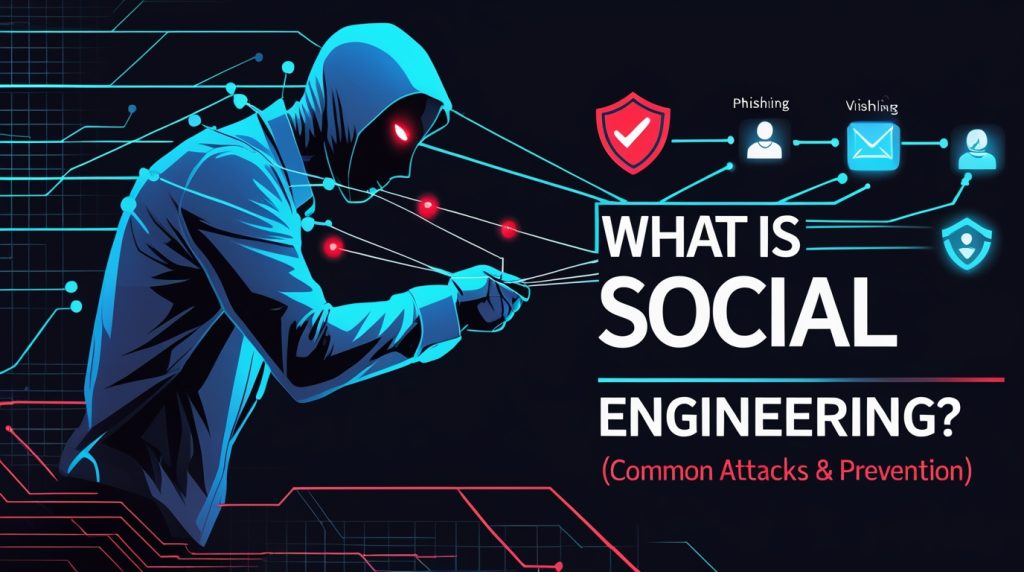
What Exactly is Social Engineering?
Basically, social engineering is when someone messes with your head to get you to do something or spill private info. Think of it as hacking your brain instead of your computer.
A hacker could spend months trying to find a never before seen flaw in your work email server. Or, they could spend an afternoon writing an email that looks like it’s from your boss, asking you to hurry up and pay an invoice. Which way is quicker? Which is easier?
That’s why these tricks happen every single day. They’re cheap, don’t need fancy tech, and they work incredibly well. Learn More
The Daily Bag of Tricks: A Hacker’s Go To Moves
Let’s peek behind the curtain at the usual tricks showing up in your inbox, on your phone, and even on your social media right now.
1. Phishing: The Big Net
This is a classic. It’s a mass email that looks like it’s from somewhere legit your bank, Netflix, UPS, a coworker. It makes you feel like you need to act fast or get curious: Your account is locked! Problem with your package delivery! Click here to see this shared paper!
The goal is simple: get you to click a bad link that steals your passwords or installs bad software, or get you to open a file that’s infected.
But phishing has gotten smarter. It’s not just badly written Dear Sir emails from Nigerian Princes anymore.
- Spear Phishing: This is like a focused dart, not a big net. Hackers dig into your life using LinkedIn, Facebook, company websites to write a super personal email. They might mention a recent get together you went to, a project you’re on, or a friend you both know. This makes it way more believable.
- Whaling: This is spear phishing for the big shots. CEOs, CFOs, senior managers. The email might pretend to be a legal order, a request from a board member, or from an important business partner. The score is much bigger.
They’re playing on: How urgent things feel and trusting people. We’re wired to react to important people and things that need to be done right away. A good phishing email shuts down our logical brain with a jolt of panic.
2. Vishing & Smishing: The Sound of a Scam
Phishing’s relatives use other ways to get to you.
- Vishing (Voice Phishing): A phone call. Hi, this is Microsoft Support. We found a virus on your computer. The caller often sounds pushy, trying to get you to let them control your computer or give up info. They use fake caller IDs so it looks like they’re calling from a real company or even a local number.
- Smishing (SMS Phishing): A text message. USPS: We can’t deliver your package. Confirm your address here: [bad link]. Or Your bank card is suspended. Send your PIN to reactivate. We tend to trust texts more than emails.
They’re playing on: How a human voice sounds believable and how immediate texts feel. A real voice feels more official. A text feels personal and direct, often cutting through all the other digital noise.
3. Pretexting: The Made Up Story
This is like a play. A hacker makes up a fake situation (the pretext) to talk to someone and get info. They often pretend to be someone important an IT worker, an outside accountant, a police officer, or a salesperson.
They might call the front desk, saying, Hi, this is Mark from IT. John in Accounting is having Wi-Fi problems. I need his password to fix his account. They’ve done their homework: they know names, departments, and what normally happens. They sound sure of themselves, and they’re counting on the employee wanting to help and not cause problems.
They’re playing on: Respect for authority and wanting to be helpful. We’re trained to help, especially when the request seems normal and comes from someone who should be asking.
4. Baiting: The Digital Gift
Remember the story of the Trojan Horse? Baiting is like that today. It offers something tempting a free movie download, a flash drive left in a parking lot (with Company Bonuses written on it), a trick for a popular game.
The bait has bad software inside. The curious employee who plugs the flash drive into their work computer accidentally creates a way for hackers to get into the whole company network. This trick plays on our curiosity and wanting stuff for free.
5. Quid Pro Quo: Something for Something
A hacker calls 50 employees at a company, pretending to be IT support offering free computer help. The first 49 say no. The 50th says, Oh, actually, yes! My Wi-Fi has been acting up.
The technician then helps by having the employee turn off their firewall or download a checking tool (which is bad software). The hacker gets in; the employee thinks their problem is solved.
They’re playing on: The feeling of owing someone. We feel like we should give something back when we get something, even if we didn’t ask for it.
6. Tailgating & Piggybacking: Getting In Physically
Not all social engineering is digital. Tailgating is when someone not allowed in follows someone who is into a restricted spot carrying coffee, looking busy, and saying, Can you hold the door? My hands are full! Piggybacking is when they’re actually let in (I forgot my badge, can you let me in?).
They’re counting on people being polite and not wanting to cause a fuss. Nobody wants to be rude or make a scene.
The Psychology Behind the Scam: Why We Keep Falling For It
Hackers are experts at understanding people. They don’t need to break your security, they just need to get you to break it for them. They use a bunch of common human behaviors:
- Authority: We tend to listen to people we see as important. A uniform, a fancy title, an email address that sounds official.
- Urgency & Not Enough of Something: Act now or your account will be shut down! This creates panic, making us stop thinking clearly.
- Social Proof: Your coworker in accounting just approved this. If others are doing it, it must be okay.
- Liking & Connecting: A friendly tone makes us drop our guard. A hacker might spend minutes chatting about the weather or local sports to build a fake connection.
- Owing Someone: As seen in Quid Pro Quo the feeling that we owe someone.
- Believing What We Expect: We’re more likely to believe something that fits with what we already think. An email from HR about a new rule? That makes sense to us, so we don’t look at it too closely.
A Day in the Life of a Social Engineer (A Made Up Story)
8:00 AM: Looking Around. Eve, our pretend hacker, checks LinkedIn. She finds Acme Corp, targets the head of Finance, and sees he’s connected to the CFO and an outside accounting firm.
10:00 AM: Getting Ready. Using a website that looks almost exactly like the accounting firm’s (like audit-partners.com versus audit-partners.com), she writes a spear phishing email to the Finance head. Subject: Quarter 3 Audit Files Need Review Fast. The email is polite, mentions the real CFO, and has a link to a fake login page.
11:30 AM: The Bite. The Finance head, busy and expecting audit emails, clicks the link. The page looks perfect. He types in his work passwords.
11:31 AM: The Catch. Eve now has his login. She gets into the company network, finds the money systems, and, because many people use the same passwords, might even get deeper access.
2:00 PM: Moving Around. From inside, she calls the IT helpdesk. Hi, this is Mark from Finance. I’m working from home and can’t get into the payroll system. Can you reset my security key? With info from the director’s account, she answers all the checking questions perfectly.
3:00 PM: The Loot. With access to payroll, she starts a bunch of money transfers to a fake account. The attack, which started with one email, is done.
How to Build a Human Wall: You Can Stop Them
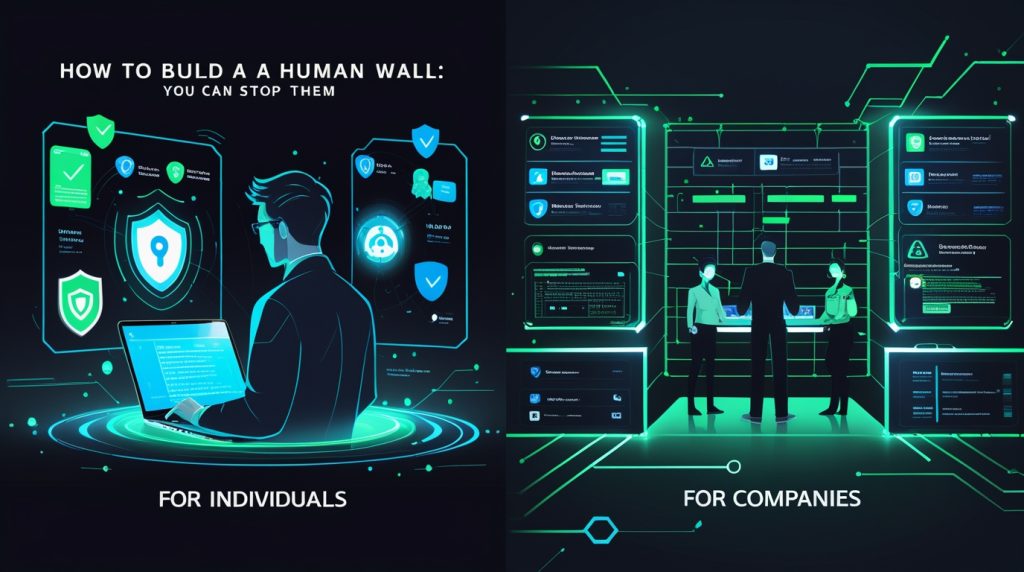
Technology alone won’t save you. You need to build a Human Wall. This means thinking about security not just as tech, but as a mix of tech and people.
For Individuals: Be a Little Suspicious (in a good way)
- Stop. Breathe. Think. Attackers use urgency as a weapon. Break its hold. Is this request really weird? Would my boss really ask for 50 gift cards by email?
- Check Using a Different Way. Got an email from your boss to send money? Call them on a known number (not one from the suspicious email). Got a call from your bank? Hang up and call the number on the back of your actual card.
- Look Closely, Don’t Just Click. Hover your mouse over links to see where they really go. Check email addresses very carefully for small mistakes. Is the website address real?
- Be Careful What You Share Online. The less you share publicly (birthdays, pet names, work details, vacation plans on social media), the less info you give to a spear phisher.
- Always Use Two-Step Verification (MFA). If a hacker gets your password, MFA is the last thing stopping them. Make sure you use it for all important accounts.
For Companies: Create a Security Minded Culture
- Ongoing, Fun Training. Go beyond yearly, boring training videos. Use fake phishing tests, hands on workshops, and real-life examples. Make knowing about security a normal part of work, not just something you tick off a list.
- Make Reporting Easy and Without Blame. Employees need to feel safe reporting suspicious emails or their own mistakes. A quick report can stop a problem; hiding it out of shame can make it much bigger.
- Give Only Necessary Access. No one should have access to info or systems they don’t absolutely need for their job. This limits how much damage one hacked account can do.
- Set and Follow Checking Rules. Make simple rules: All payment changes need someone to say yes out loud. No IT password resets without a ticket number. Break the social engineer’s script.
- Physical Security Matters. Teach front desk staff and employees to politely but firmly question strangers. Sorry, I can’t let you in without a badge. Let me call the person you’re here to see.
The Future of Social Engineering: Fake Voices & AI
The game is changing. Artificial Intelligence is giving hackers scary new tools.
- AI-Powered Phishing: AI programs can write perfect, personal phishing emails very quickly, in many languages, getting rid of the grammar mistakes that used to be a dead giveaway.
- Fake Voices: With just a short sample of a CEO’s voice from a company podcast, a hacker can now make a convincing fake audio clip. Imagine getting a voice note from your boss okaying a money transfer.
- Fake Videos: A video meeting where a CFO on screen tells you to move money.
Stopping this will mean being even more careful about checking things and understanding that seeing and hearing might not always be believing anymore. Learn More
Conclusion: The Most Important Thing to Fix
Social engineering works because it doesn’t attack computers; it attacks what connects those systems human thinking, talking, and trust. The most crucial fix isn’t some software update; it’s changing how you think. It’s moving from This won’t happen to me to This could happen, and I’m ready.
Security isn’t just for the IT folks anymore. It’s everyone’s job, something we do every day by being smart about our digital lives. By knowing the tricks, seeing the psychological buttons they push, and making checking things part of our routine, we can go from being the weakest link to the strongest defense.
The hackers are counting on you being human. The best way to fight back is to be human, but also aware, educated, and a little bit suspicious. Check first, then trust. In today’s digital world, that moment you take to check is the strongest security tool you have.
Explore Our Cybersecurity Category