“Source code” is one of those jargons in tech that is mentioned all the time yet explained in such a manner that implies that you know its meaning. However, this guide will give you an overview of source code, starting from its definition, its origin, the process of compiling it to form a computer program, and why you need it, whether you are a developer or not.
What source code really means
Source code, sometimes referred to simply as “code” or “source,” is readable plain text that specifies how the computer is supposed to operate. It is written in some programming language, for instance, Python, JavaScript, C, or Java. It represents the form of software in which humans can read, modify, and reason.
For example, in C, the code might look like this:
c
#include <stdio.h>

int main() {
    printf("Hello, world\n");
    return 0;
}
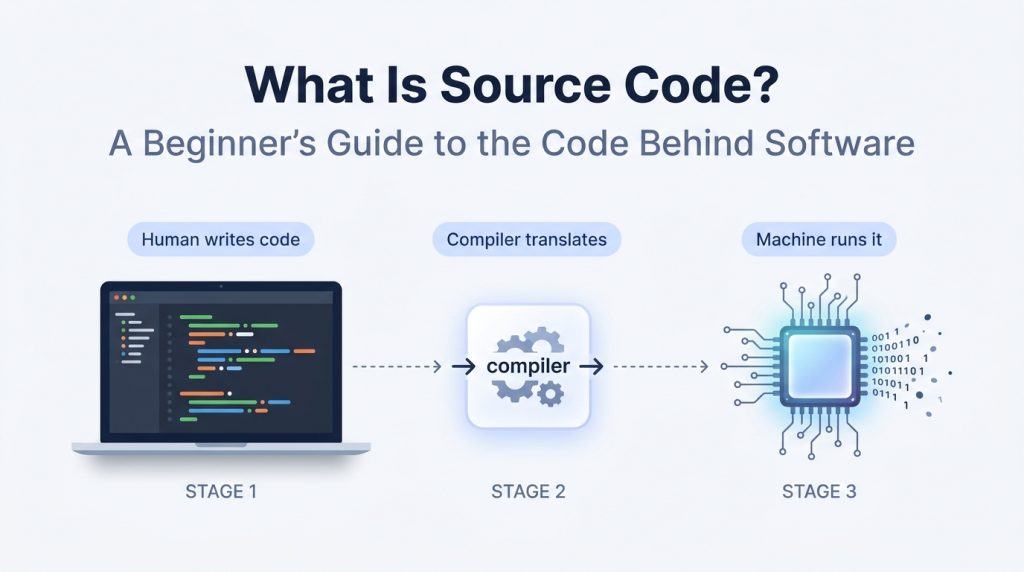
This is a source code. It cannot be executed by the computer without being converted to something that the hardware can understand, i.e., either machine code or executed through an interpreting program.
The difference is crucial because while the former is for humans, the latter is for machines. In fact, the same source code could be converted for different hardware systems, and that is why source code is so significant.
A short history: from machine code to human‑readable code
These early programmable electronic computers in the late 1940s used machine language for programming purposes, which involved writing machine instructions directly to be executed by the processor. Machine instructions were difficult, time-consuming, prone to errors, and lacked portability to other computers.
The name “coding,” referring to the preparation of computer programs, dates back to 1950 or 1951, when the process of loading programs from punched paper tape or punched cards became possible. Back then, the “source code” referred to the machine instructions written on punched cards or tape.
However, all these have changed with the arrival of high-level programming languages. FORTRAN, developed at IBM by John Backus and his team between 1953 and 1958, is often considered the very first high-level programming language. High-level programming languages allowed programmers to use human-like language and mathematical terms to create algorithms. They also needed compilers to convert the source code into machine code. Ever since, the term “source code” began to refer to the program written in a high-level language.
How source code becomes a running program
The conversion of a source program into a computer-readable format may happen through two general methods.
Compilation: A compiler analyses the whole source program and translates the program into machine code (or an intermediate version like bytecode). Languages like C, C++ are some of those languages whose programs require compilation. The process results in a separate executable file that can operate independent of the source program.
Interpretation: An interpreter is a system program that analyzes and executes the program simultaneously without generating an executable file. Examples of such languages are Python and JavaScript. Most languages make use of both of these techniques. For instance, there is a technique called just-in-time compilation where a program is compiled to bytecode and then interpreted.
None of these approaches can be said to be superior to each other. Compilation results in faster execution as the translation process occurs beforehand, whereas interpretation offers flexibility and portability as the source program may be executed anywhere as long as there is an appropriate interpreter.
Why source code matters
Source code is more than just an implementation artifact. There are several consequences that result from it.
Portability. Since source code is written for a programming language and not a specific machine, it can usually be recompiled for other machines. The same C program can be compiled for a PC, a server, or a microcontroller, as long as there is a suitable compiler and library available.
Debugging and modification. People can understand the source code, and therefore it is possible to correct any bugs, modify the behavior of the program, and add new functionality. On the other hand, object code (which is the compiled code) is not meant to be understood by humans.
Learning and cooperation. People often study other people’s source codes in order to learn from them. It is common knowledge that sharing source code contributes to learning.
Open source vs. proprietary: what it means for you
Access to source code is a distinct issue of whether software is free of charge.
Open source software provides access to the source code via a license permitting users to use, study, modify, and distribute the code based on the conditions of that license. For instance, according to the GNU General Public License (GPL), “the preferred form of the work for making modifications to it” is defined as the source code. In some cases, modified works have to be distributed under the same license. Open-source software is not “no rules”: there are still licensing conditions.
Closed-source (proprietary) software hides the source code behind closed doors. Users obtain the license to run the software but do not have access to view, modify, and distribute the source code.
One of the most popular misconceptions of a beginner is to consider open-source software to be always better or always safe. Open source software simply permits you legally to examine and modify the source code, but that does not mean anything.
How developers manage source code today
However, in most cases, modern software development is not conducted using one file. In order to keep track of changes, cooperate with other developers, and correct errors, programmers use version control (or source code management).
Git is one of the most popular distributed version control systems. Initially, it was created by Linus Torvalds in April 2005 and became the standard way to manage source code repositories. Using Git, each programmer is able to maintain the entire history of the repository, and modifications can be reviewed and combined effectively.
GitHub, GitLab, and Bitbucket are examples of the platforms that support Git-based repositories and provide additional functionality; however, the core concept is simple: source code consists of plain text and therefore can be versioned, diffed, and improved.
Limitations and things to keep in mind
- Not all software is released together with its source code. Many commercial products only release binary files.
- Source code is not enough to make software of good quality. Readable code may have errors or flaws.
- Different code types run differently. Each of them has its own strengths and weaknesses. There is no better type in general.
- Licensing is important. “Open source” is the special term that refers to certain conditions.
Conclusion
The source code is the readable text code that programmers write and edit; it is the actual code of software that can be understood and edited by humans. Source code became necessary when programs were too complicated to be written in raw machine code. The source code still constitutes the basis of how the software is created and developed today. What beginners should remember is that source code is designed for humans, while machine code is designed for machines.
Explore Our Programming Category. And if you are reading it up to here, leave a sweet comment to motivate us to write blog everyday.