Let’s face the elephant in the server room.
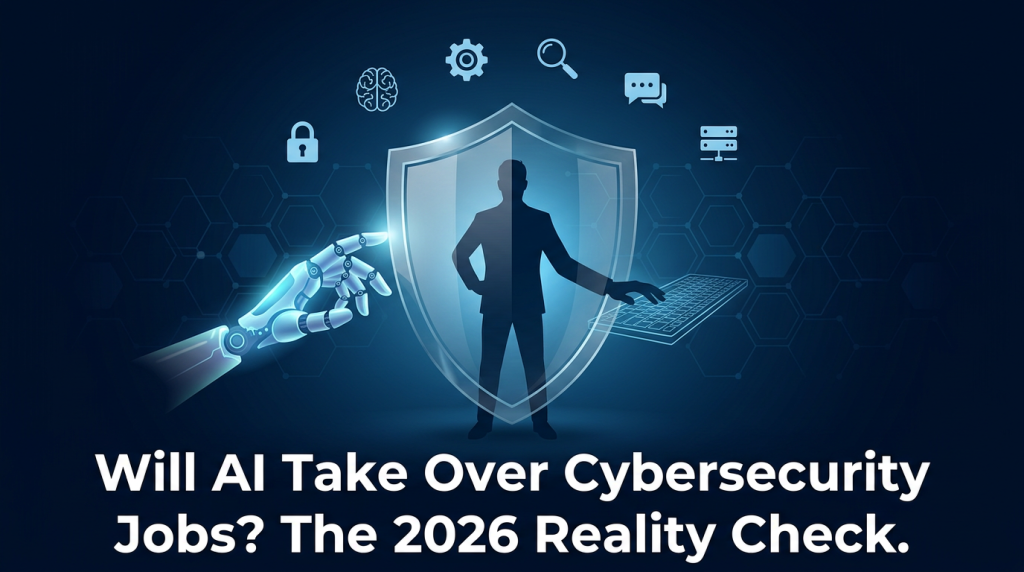
Each time there is a new AI-based cybersecurity tool that emerges, the same question inevitably pops up across various social media forums and the water cooler: “Do I need to think about changing my career path?” That’s a legitimate concern. The moment you hear how an AI-based system analyzes millions of log records in seconds or patches a zero-day vulnerability even before you can see it is coming, the feeling of apprehension is understandable.
Here is what the news does not tell you.
The interaction between artificial intelligence and cybersecurity is by no means a story about the demise of one party in favor of another. Rather, it’s a story of endless development. Don’t imagine it as being like robots replacing humans; it’s more like spreadsheets did not get rid of accountants; they helped them become better.
Let’s take a closer look at what’s actually going on in 2026.
What AI Actually Does Well in Cybersecurity Right Now
To start off, credit where credit is due: AI has gotten very good at some particular tasks. They were tasks that once drove young analysts crazy in just 18 months or so.
- Log and alert triage
On average, a middle-sized company is faced with millions of security events per day. Humans can’t monitor all these events. Thus, AI performs the function of analyzing these data, correlating them, and selecting only those 0.1 percent of the events that should be analyzed. One may compare this process with filtering spam emails, yet on a much higher level. - Pattern recognition and anomaly detection
AI systems, having been trained with billions of examples of attacks, can easily recognize anomalies. For instance, if one sees that an employee accesses his profile from London at 9 am and after 9 minutes he accesses his profile from Tokyo, this is a red flag immediately detected by AI. It would take ages for any person to check such information manually. - Automated response to known attacks
If a ransomware infection happens, AI can automatically isolate the computer with the ransomware infection, disconnect it from the network, and revert files that were affected by the ransomware to the previous version.
Real-life scenario from 2026:
An AI SOC assistant helps a regional bank. At 2 am on one particular Tuesday morning, the AI finds out that a phishing email has managed to slip through the filter. The assistant automatically extracts the email from all other employees’ inboxes, puts a block on the sending domain for the whole company, and sends a single-line notification to the on-call analyst.
What AI Cannot Do (And Likely Never Will)
Here is where the human advantage holds firm. Cybersecurity is not just about data. It is about context, judgment, and creativity.
- Evaluating strategic risks
AI can detect that a server has a vital vulnerability. It won’t know whether installing a new patch on this device might compromise legacy software used to calculate salaries. This decision involves not only technical knowledge but also political skills and willingness to take calculated risks. - Interpreting human behavior
The system notices an anomaly, a user downloading huge volumes of information late at night. The program identifies the action as unusual. However, it cannot discern whether the activity was caused by a malicious insider who wanted to steal confidential data or a tired worker attempting to finish an important task. Only humans can interpret nonverbal behavior and conduct interviews. - Being imaginative
Hackers have creativity. They combine disparate things such as a forgotten testing server, a cat’s name for a password, and firewall rule configuration issues. AI fights hackers based on previous experience. Humans do this with imagination. - Legal and ethical judgment
Where is the line between monitoring and spying? Where is the line between threat hunting and invasion of privacy? This is not a technical question. This is a legal, ethical, and cultural question.
Radio check: An AI is able to detect if a nurse uses the computer to pull out the file of a celebrity but not to make a choice on whether she should be fired, trained, or handed over to law enforcement agencies.
A Practical Breakdown: Who Wins, Who Adapts, Who Struggles?
Let us get specific about job roles. This is not theory. This is what the 2026 hiring data shows
| Role | AI Impact | Outlook |
| SOC Tier 1 Analyst (alert monkey) | High automation | Declining demand |
| SOC Tier 2/3 Analyst (investigation) | Augmented, not replaced | Growing demand |
| Threat Hunter | Augmented | Growing demand |
| Malware Analyst | Augmented | Stable |
| Compliance Auditor | Moderate automation | Stable |
| Security Architect | Low automation | High demand |
| CISO / Security Leader | Low automation | High demand |
| Penetration Tester | Slightly augmented | Growing demand |
What this actually means:
Tier 1 SOC functions are disappearing. The individual whose whole job consisted of looking at a computer screen and acknowledging alerts—this job function is disappearing. The individuals who held these jobs have become better skilled and moved elsewhere.
All other jobs have evolved, but none have disappeared. A threat hunter in 2026 employs AI to analyze petabytes of data, then applies human ingenuity to pursue the top 10 most interesting findings. They are more efficient, not obsolete.
New jobs are emerging. AI security specialist. LLM prompt injection tester. AI model auditor. These are jobs that didn’t exist three years ago.
Three Scenarios From the Real World
Scenario A: MSSP (Managed Security Service Provider)
The MSSP had employed about 200 Tier 1 analysts for dealing with client alerts. In 2026, there were 50 Tier 1 analysts and 75 Tier 2 analysts employed by the organization. What happened to the other 150 analysts? Forty joined the ranks of the Tier 2 analysts after receiving proper training. Thirty became AI tool operators. Twenty got jobs at client-advising posts. Others resigned from their positions. The total number of workers is now smaller, but better-paid and happier.
Scenario B: Fortune 500 Bank
In 2026, the bank retained all the same analysts. However, there were significant changes in their responsibilities. Previously, most of their working time (80%) was wasted on handling false positives. After implementing the new AI system, analysts have 80% of their working hours free for investigation, proactive threat hunting, and enhancing the security process.
Scenario C: The Small Retailer
A 200-person e-commerce business would not be able to maintain a 24/7 security team. They can now pay a monthly fee of $2,000 for their AI-powered SOC as a Service, which replaces no jobs since no jobs existed to begin with. It helps protect a company that was previously unprotected.
The Skills That Actually Matter in 2026
If you work in cybersecurity or want to, here is what you need to prioritize.
Technical skills still in demand:
- Security in the cloud (AWS, Azure, GCP)
- Identity and access management
- Incident response and forensics
- Security architecture and design
- Secure software development
New skills that emerged:
- Prompt engineering in security applications
- Vulnerabilities of LLMs (prompt injection, data leakage)
- AI model validation and testing
- Automation using security-oriented AI solutions
Human skills that matter more than ever:
- Communications (converting technical risks into business risks)
- Critical Thinking (recognizing what was left out by the AI)
- Curiosity (coming up with better questions than the AI)
- Judgment (trading off options in an uncertain situation)
Real-world application:
Job advertisement from 2026 for “Security Analyst,” who doesn’t require “SIEM experience” but requires “AI-assisted investigation tools experience” and “validate AI results ability.” The job hasn’t been eliminated; the tool has just shifted.
What the Numbers Actually Say
Let us analyze the figures concerning employment:
- Global cybersecurity labor gap: around 3.5 million unfilled jobs
- Annual increase of job openings for security professionals: 12%
- Increase in average pay for security jobs: 8% from 2024
- Jobs with “AI” or “automation” mentioned in job description increased by 300% from 2023
And here is the bottom line: We have a huge labor gap. Businesses simply lack security personnel. Automation is not replacing jobs. It is filling the void that humans do not fill on time.
The Honest Truth About Junior Roles
Let me say something straight out.
Cybersecurity entry-level positions are harder to obtain compared to five years ago. Why? Because AI took care of all the easy jobs. A company that used to hire three juniors to sift through alerts no longer needs to; one senior analyst will suffice because of AI. This is the reality. I will not beat around the bush.
But here is what happens on the flip side:
- Internship opportunities revolve around learning AI-based analysis techniques. Do that.
- Security+ and CySA+ certifications are useful. Supplement these with a quick course on AI-based security tools.
- Labs are now worth more than college degrees. Showcase your work done by performing various security investigations through AI.
- Soft skills make you stand out. Unlike AI, you will be able to write an executive-level incident report.
The path forward: Junior roles exist, but they expect you to know how to use AI, not compete against it.
A Radio-Style Summary: AI vs. Human in Cybersecurity
| Task | Better at AI | Better at Human |
| Review 1 million logs per second | ✓ | |
| Detect a novel attack pattern | ✓ | |
| Respond to a known threat in milliseconds | ✓ | |
| Interview a suspicious employee | ✓ | |
| Work 24/7 without sleep | ✓ | |
| Understand business context for risk | ✓ | |
| Write a clear executive summary | ✓ | |
| Scale across 10,000 servers | ✓ | |
| Make a legal/privacy judgment call | ✓ |
Observe the pattern here. AI deals with speed, size, and repetition. People deal with judgment, creativity, and communication.
Conclusion
Bottom Line
The AI that walks into SOCs is not coming to give anyone a pink slip. It is entering as the most powerful helper that the industry has ever seen. That idea of widespread unemployment arises because people misunderstand what the AI actually does and what cybersecurity work actually entails.
The jobs that vanish will be those that should have been automated a long time ago. The jobs that persist and thrive will be more engaging, well-paid, and distinctly human. Threat hunters will hunt more substantial quarry. Analysts will look into real threats rather than false alarms. Strategists will strategize rather than react.
For you as a cybersecurity expert today, there are two ways forward:
- Neglect AI and wish that it would go away (this won’t happen).
- Embrace AI as an amplifier for your abilities (and it will make you more effective).
The latter path remains wide open. The tools are out there. The need is great. And the human—curious, creative, and able to exercise good judgment—remains the rarest and most sought-after commodity.
Artificial intelligence will not take your job as a cybersecurity expert. Someone with artificial intelligence skills just might.
Don’t be the latter’s replacement. Be the latter.
Explore Our Cybersecurity Category